Browse · MathNet
PrintSelection Examination
Greece geometry
Problem
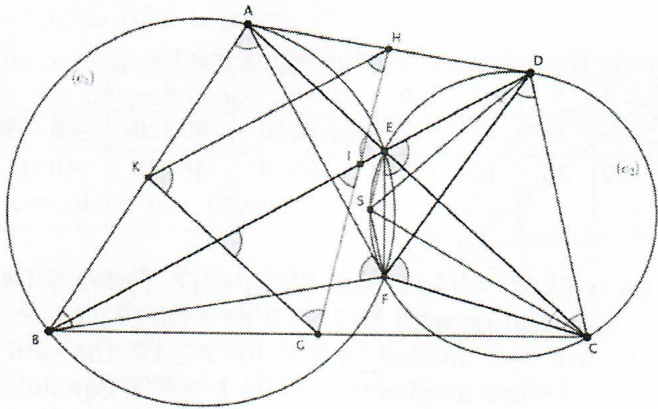
In a convex quadrilateral , its diagonals meet at and , are the midpoints of the sides , , respectively. The circumcircles and , of the triangles and , respectively, meet at point . If the parallel from to the line meets the circle at , prove that: .
Solution
In order to prove , it suffices , or . From the cyclic and we get where is the point of intersection of and . It suffices to prove that: . Angle chasing gives Figure 8 This means that and are similar with . Moreover, where the triangles and are similar with similarity ratio If is the midpoint of , then the triangle has , with Therefore, the triangle is similar to , and so
Figure 8
---
Alternative solution.
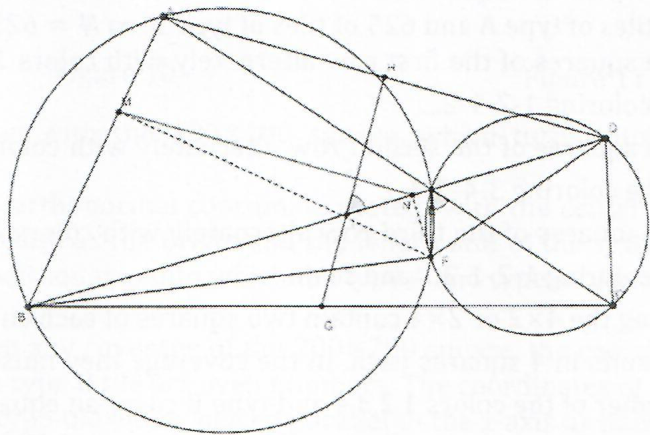
As in the first solution, it suffices to prove that: . Let , be the projections of to , , respectively. Then the line is a Simpson line of the complete quadrilateral and is the Newton-Gauss line. It is well-known that they are perpendicular. Therefore where in the third equality we used that is cyclic and in the last we used that is cyclic.
Figure 9
Figure 8
---
Alternative solution.
As in the first solution, it suffices to prove that: . Let , be the projections of to , , respectively. Then the line is a Simpson line of the complete quadrilateral and is the Newton-Gauss line. It is well-known that they are perpendicular. Therefore where in the third equality we used that is cyclic and in the last we used that is cyclic.
Figure 9
Techniques
Cyclic quadrilateralsSpiral similaritySimson lineAngle chasing