Browse · MathNet
PrintSelection Examination
Greece algebra
Problem
The positive real numbers , , satisfy: . Prove that
When does equality hold?
When does equality hold?
Solution
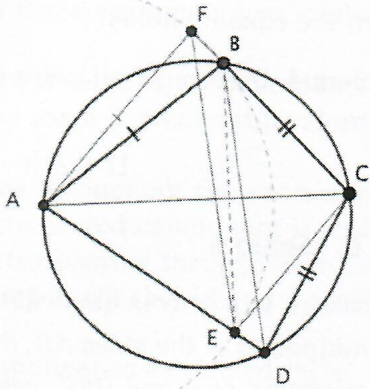
Hence is the bisector of the angle , and hence it is the perpendicular bisector of the base od the isosceles . Now we can complete the proof in two ways: First way: Since the points belong to the circle with center and radius , by using the relation between subtending angles and the angle formed by chord and tangent, we have the wanted result:
Figure 7
Second way: We have , as well as, . From the cyclic quadrilateral and the isosceles triangle we get: , and therefore the quadrilateral is cyclic. Thus we have;
Figure 7
Second way: We have , as well as, . From the cyclic quadrilateral and the isosceles triangle we get: , and therefore the quadrilateral is cyclic. Thus we have;
Final answer
Equality holds when a = b = c = 1.
Techniques
Cauchy-SchwarzQM-AM-GM-HM / Power Mean