Browse · MathNet
Print48th International Mathematical Olympiad Vietnam 2007 Shortlisted Problems with Solutions
2007 geometry
Problem
Let be a fixed triangle, and let be the midpoints of sides , respectively. Let be a variable point on the circumcircle. Let lines meet the circumcircle again at respectively. Assume that the points are distinct, and lines form a triangle. Prove that the area of this triangle does not depend on .
Solution
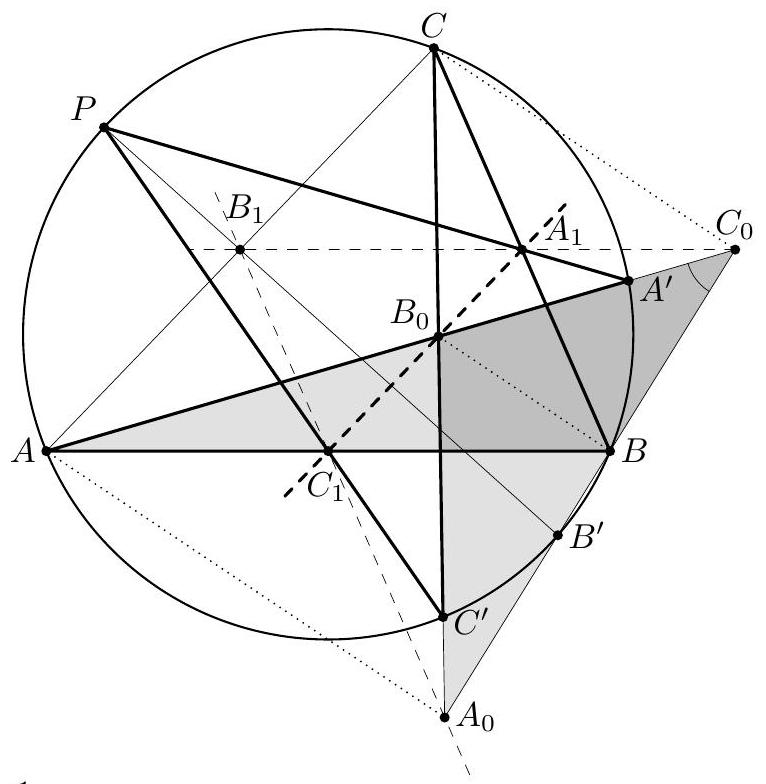
Let be the points of intersection of the lines and (see Figure). We claim that area , hence it is constant.
Consider the inscribed hexagon . By Pascal's theorem, the points of intersection of its opposite sides (or of their extensions) are collinear. These points are , , . So point lies on the midline of triangle . Analogously, points and lie on lines and , respectively.
Lines and are parallel, so triangles and are similar; hence we have Analogously, from we obtain Combining these equalities, we get or Hence we have Since lies on the midline, we have (we denote by the distance between point and line ). Then we obtain
---
Alternative solution.
Again, we prove that area .
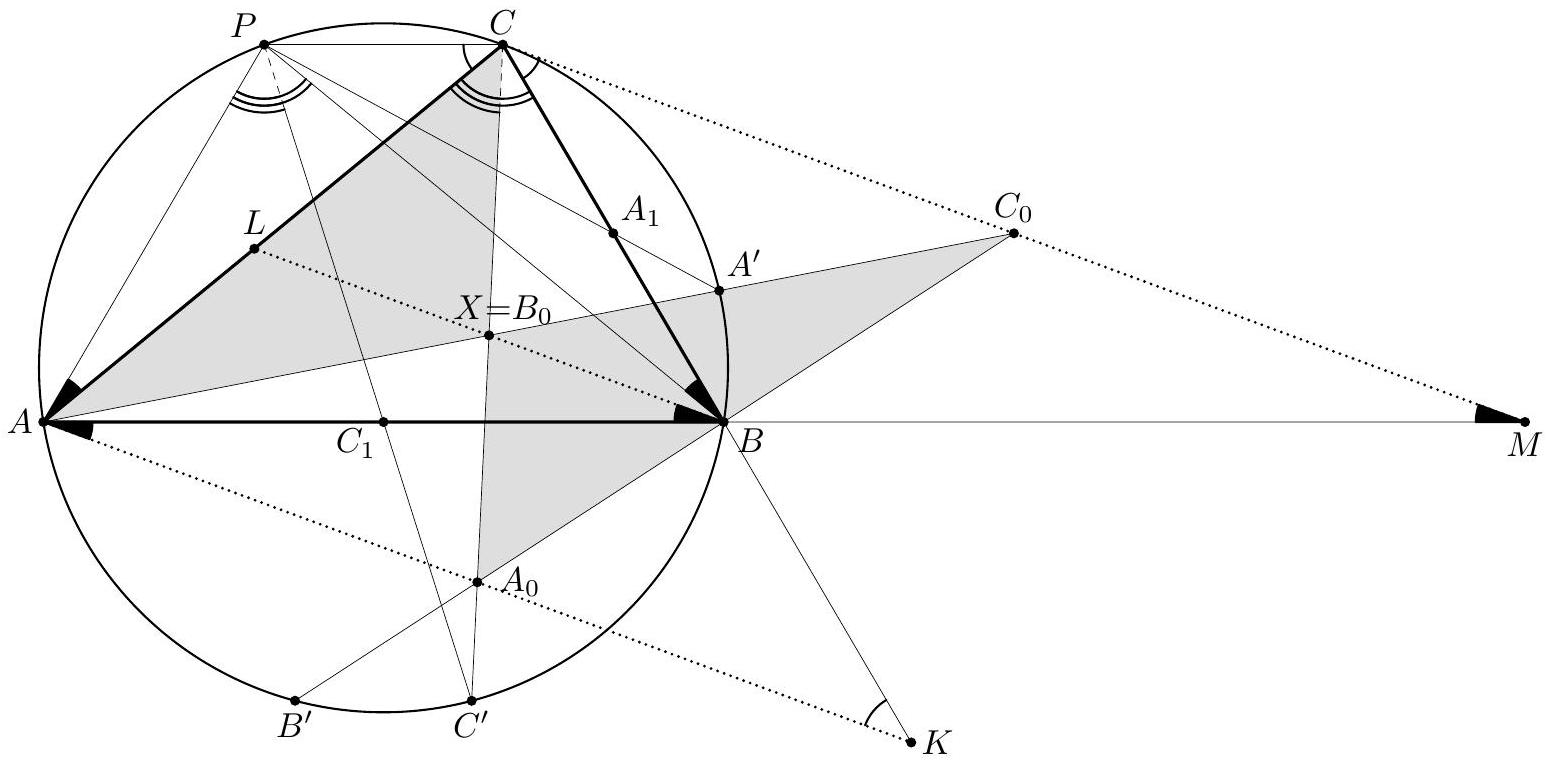
We can assume that lies on arc . Mark a point on side such that ; then . Note also that and . Hence, triangles and are similar, and so are triangles and .
Analogously, mark points and respectively on the extensions of sides and beyond point , such that and . For analogous reasons, and . Hence , , and . From these similarities, we have , while we have seen that . Hence, .
Let line intersect at point . Note that , and is a median in triangle . Since triangles and are similar, is a median in triangle , and is a midpoint of . For the same reason, passes through this midpoint, so . Analogously, and are the midpoints of and .
Now, from , we have Finally,
Consider the inscribed hexagon . By Pascal's theorem, the points of intersection of its opposite sides (or of their extensions) are collinear. These points are , , . So point lies on the midline of triangle . Analogously, points and lie on lines and , respectively.
Lines and are parallel, so triangles and are similar; hence we have Analogously, from we obtain Combining these equalities, we get or Hence we have Since lies on the midline, we have (we denote by the distance between point and line ). Then we obtain
---
Alternative solution.
Again, we prove that area .
We can assume that lies on arc . Mark a point on side such that ; then . Note also that and . Hence, triangles and are similar, and so are triangles and .
Analogously, mark points and respectively on the extensions of sides and beyond point , such that and . For analogous reasons, and . Hence , , and . From these similarities, we have , while we have seen that . Hence, .
Let line intersect at point . Note that , and is a median in triangle . Since triangles and are similar, is a median in triangle , and is a midpoint of . For the same reason, passes through this midpoint, so . Analogously, and are the midpoints of and .
Now, from , we have Finally,
Techniques
Concurrency and CollinearityTrigonometryDistance chasingConstructions and loci