Browse · MathNet
PrintEstonian Mathematical Olympiad
Estonia counting and probability
Problem
Is there a positive integer for which it is possible to write a number , or into each cell of an table in such a way that every integer from to occurs at least once among the row sums, column sums and the two sums of the numbers on one long diagonal? If yes then find the least such .
Solution
Suppose that an table is filled with numbers , , and in such a way that the conditions are met. The sums and can be obtained only from a row, column or diagonal with all s and all s, respectively, whence and cannot arise as sums of different kind (one as a row sum and the other as a column sum or similar) as such sums have a common summand. If both and arise as diagonal sums, must be even (otherwise the middle summand would be common) and each row and each diagonal must contain one and one . But then sums
and would be impossible to achieve. Hence and must be either both row sums or both column sums. W.l.o.g., assume that they are both row sums.
The number can arise only as the sum of numbers and one number . As occurs in each column and each long diagonal, can be obtained as a row sum only. Similarly, can be obtained as a row sum only. The number can arise as the sum of either numbers and two numbers or numbers and one number . As either two s or numbers and occur in each column and each long diagonal, can be obtained as a row sum only. Similarly, can be obtained as a row sum only.
Therefore, the table must contain at least rows.
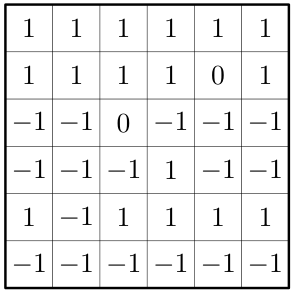
An example of a table that fulfils the conditions is shown in Fig. 42: the row sums from the top to the bottom are , , , , , and , the column sums from the left to the right are , , , , , , and the diagonal sums are and .
Fig. 42
and would be impossible to achieve. Hence and must be either both row sums or both column sums. W.l.o.g., assume that they are both row sums.
The number can arise only as the sum of numbers and one number . As occurs in each column and each long diagonal, can be obtained as a row sum only. Similarly, can be obtained as a row sum only. The number can arise as the sum of either numbers and two numbers or numbers and one number . As either two s or numbers and occur in each column and each long diagonal, can be obtained as a row sum only. Similarly, can be obtained as a row sum only.
Therefore, the table must contain at least rows.
An example of a table that fulfils the conditions is shown in Fig. 42: the row sums from the top to the bottom are , , , , , and , the column sums from the left to the right are , , , , , , and the diagonal sums are and .
Fig. 42
Final answer
6
Techniques
Coloring schemes, extremal argumentsPigeonhole principle