Browse · MathNet
PrintEstonian Mathematical Olympiad
Estonia geometry
Problem
Let be an altitude of an acute triangle and let be the point on side such that . Let be the point for which is a parallelogram. The areas of the triangles and are equal. Lines and intersect at .
a) Prove that the median of triangle drawn from the vertex intersects the line segment .
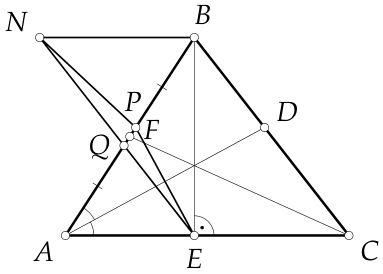
b) Prove that in the triangle , the bisector of the angle , the altitude drawn from the vertex and the median drawn from the vertex meet in one point.
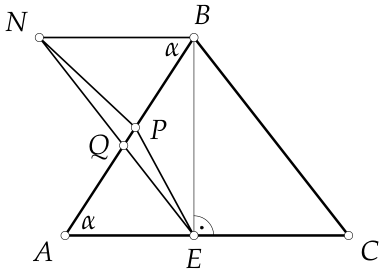
a) Prove that the median of triangle drawn from the vertex intersects the line segment .
b) Prove that in the triangle , the bisector of the angle , the altitude drawn from the vertex and the median drawn from the vertex meet in one point.
Solution
Fig. 40
Denote , , , and . As is a parallelogram, and . The latter implies (Fig. 40). As and , triangles and are similar.
a) The triangles and have areas and , respectively. Thus , whence . Similarity of triangles and implies which, after defining , rewrites to . This equality reduces to a linear equation of , meaning that it has only one root. By equality , must be the only root. Thus , whence the midpoint of the side coincides with the midpoint of the line segment .
Fig. 41
b) Let be the midpoint of the side and let be the point of intersection of the bisector of angle with side (Fig. 41). By angle bisector theorem, . Since and are parallel, triangles and are similar, whence also triangles and are similar. This and part a) of the problem together imply . Consequently, , giving the desired result by Ceva's theorem.
Denote , , , and . As is a parallelogram, and . The latter implies (Fig. 40). As and , triangles and are similar.
a) The triangles and have areas and , respectively. Thus , whence . Similarity of triangles and implies which, after defining , rewrites to . This equality reduces to a linear equation of , meaning that it has only one root. By equality , must be the only root. Thus , whence the midpoint of the side coincides with the midpoint of the line segment .
Fig. 41
b) Let be the midpoint of the side and let be the point of intersection of the bisector of angle with side (Fig. 41). By angle bisector theorem, . Since and are parallel, triangles and are similar, whence also triangles and are similar. This and part a) of the problem together imply . Consequently, , giving the desired result by Ceva's theorem.
Techniques
Ceva's theoremTriangle trigonometryAngle chasing