Browse · MathNet
PrintBelarusian Mathematical Olympiad
Belarus geometry
Problem
Given a convex hexagon with obtuse inner angles and parallel opposite sides.
a) Prove that there exists a pair of the opposite sides of which possesses the following property: there exists a straight line that is perpendicular to these sides and intersects each of them.
b) Is it true that there exist two pairs of the opposite sides of , each of which possesses the same property, as described in item a)?
a) Prove that there exists a pair of the opposite sides of which possesses the following property: there exists a straight line that is perpendicular to these sides and intersects each of them.
b) Is it true that there exist two pairs of the opposite sides of , each of which possesses the same property, as described in item a)?
Solution
b) it is not true.
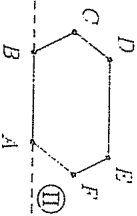
a) Let be a hexagon with all obtuse inner angles and parallel opposite sides (, , , see Fig. 1). Consider the greatest side of this hexagon (one of such sides if there are more than one). Let it be the side . Since the hexagon is convex, it completely lies in one of the half-planes with respect to the line ; denote this half-plane by .
Fig. 1
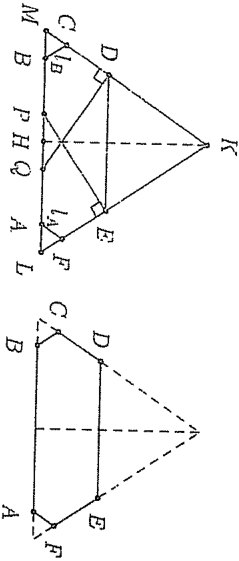
Suppose that none of the lines intersecting and perpendicular to the side intersect the side . Construct the perpendiculars and in the half-plane (see Fig. 2). By our assumption, there are no points of the side in the half-strip . In particular, either point lies to the right of the ray or point lies to the left of the ray . Without loss of generality, suppose that lies to the right of (see Fig. 2). Then the vertex lies neither to the right of the ray nor to the left of the ray . Indeed, otherwise we obtain (see Fig. 3) and (see Fig. 4), respectively. But any of these inequalities contradicts to the choice of the side as the greatest side of the hexagon. So the vertex lies in the half-strip , but in this case the angle is not obtuse, contrary to the problem condition. Therefore, there exists a straight line such that it is perpendicular to the sides and and intersects both of them.
b) Construct the convex hexagon satisfying the problem condition (all inner angles are obtuse and opposite sides are parallel) such that there exists exactly one pair of the opposite sides intersected by the perpendicular straight line.
Fig. 5 Fig. 6
Consider the isosceles triangle with the base and the acute angle (see Fig. 5). Let be the altitude of the triangle . Let points and be the inner points of the segments and , respectively, such that they are symmetric with respect to . Let be the foot of perpendicular from into , and let be the some point on the segment and some point on the segment . Construct the line passing through parallel to , and construct the line passing through parallel to . Let be the intersection point of and , and let be the intersection point of and (see Fig. 5). Then (see Fig. 6) it is easy to see that the hexagon is required.
a) Let be a hexagon with all obtuse inner angles and parallel opposite sides (, , , see Fig. 1). Consider the greatest side of this hexagon (one of such sides if there are more than one). Let it be the side . Since the hexagon is convex, it completely lies in one of the half-planes with respect to the line ; denote this half-plane by .
Fig. 1
Suppose that none of the lines intersecting and perpendicular to the side intersect the side . Construct the perpendiculars and in the half-plane (see Fig. 2). By our assumption, there are no points of the side in the half-strip . In particular, either point lies to the right of the ray or point lies to the left of the ray . Without loss of generality, suppose that lies to the right of (see Fig. 2). Then the vertex lies neither to the right of the ray nor to the left of the ray . Indeed, otherwise we obtain (see Fig. 3) and (see Fig. 4), respectively. But any of these inequalities contradicts to the choice of the side as the greatest side of the hexagon. So the vertex lies in the half-strip , but in this case the angle is not obtuse, contrary to the problem condition. Therefore, there exists a straight line such that it is perpendicular to the sides and and intersects both of them.
b) Construct the convex hexagon satisfying the problem condition (all inner angles are obtuse and opposite sides are parallel) such that there exists exactly one pair of the opposite sides intersected by the perpendicular straight line.
Fig. 5 Fig. 6
Consider the isosceles triangle with the base and the acute angle (see Fig. 5). Let be the altitude of the triangle . Let points and be the inner points of the segments and , respectively, such that they are symmetric with respect to . Let be the foot of perpendicular from into , and let be the some point on the segment and some point on the segment . Construct the line passing through parallel to , and construct the line passing through parallel to . Let be the intersection point of and , and let be the intersection point of and (see Fig. 5). Then (see Fig. 6) it is easy to see that the hexagon is required.
Final answer
a) Yes. b) No.
Techniques
Optimization in geometryDistance chasingConstructions and lociAngle chasing