Browse · MathNet
PrintBelarusian Mathematical Olympiad
Belarus geometry
Problem
Given a convex -gon with pairwise parallel opposite sides.
a) Prove that there exists a pair of the opposite sides of which possesses the following property: there exists a straight line that is perpendicular to these sides and intersects each of them.
b) Are there any values of such that for a convex -gon there exist two pairs of its opposite sides for each of which the property described in a) holds?
a) Prove that there exists a pair of the opposite sides of which possesses the following property: there exists a straight line that is perpendicular to these sides and intersects each of them.
b) Are there any values of such that for a convex -gon there exist two pairs of its opposite sides for each of which the property described in a) holds?
Solution
b) there are no such .
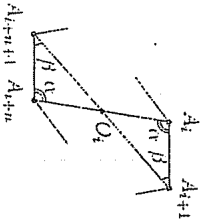
a) A diagonal of the convex -gon is said to be main if there are vertices of this polygon between the vertices connected by this diagonal. Suppose that there exist a convex -gon such that its opposite sides are parallel (, , and ) and there is no pair of the opposite sides possessing the property described by the problem condition (there exists a straight line that is perpendicular to these sides and intersects each of them). Consider some two opposite sides and of such -gon. Let be the intersection point of the lines and . Consider the triangles and (see Fig. 1).
Fig. 1 Fig. 2
Since we have and (let and ). If at least one of these angles is not obtuse, then there exists a straight line that is perpendicular to the sides , and intersects each of them. For example, the line passing through perpendicular to the side can be considered as . Therefore either or is greater than .
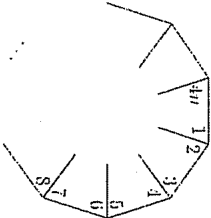
Any diagonal starting from the vertex of the angle of the -gon partitions this angle into two angles (we call that these two angles are adjacent to this diagonal). Construct all main diagonals of the -gon and number (in clockwise direction) all adjacent angles with the numbers from 1 to (see Fig. 2). By the above either angle 1 or angle is obtuse. Let, without loss of generality, angle 1 is obtuse. Then angle 2 is acute (any inner angle of a convex polygon is less than ). From what has already been proved, it follows that angle 3 is obtuse, and so on. We see that all angles with odd numbers are obtuse, while all angles with even numbers are acute. So one of the adjacent angles is obtuse but the other is acute for any main diagonal. Consider the greatest of the main diagonals (one of them if there are more than one). Let be such diagonal (see Fig. 1) and let, without loss of generality, . Since in which is impossible since the diagonal is the greatest one. This contradiction proves that any convex -gon with pairwise parallel opposite sides has a pair of the opposite sides such that there exists a straight line that is perpendicular to these sides and intersects each of them.
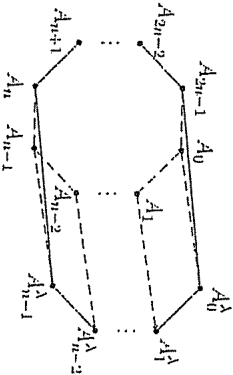
b) Consider a regular -gon with the vertices (). We choose the vector satisfying the relations for ,
Fig. 3
and , (here is the angle between the vectors and ). For any we denote by the convex polygon with the vertices , where for from 0 to (from the inequality it follows that the polygon is convex). In the polygon for large enough there exists a unique pair of the opposite sides such that there exists a straight line that is perpendicular to these sides and intersects each of them.
a) A diagonal of the convex -gon is said to be main if there are vertices of this polygon between the vertices connected by this diagonal. Suppose that there exist a convex -gon such that its opposite sides are parallel (, , and ) and there is no pair of the opposite sides possessing the property described by the problem condition (there exists a straight line that is perpendicular to these sides and intersects each of them). Consider some two opposite sides and of such -gon. Let be the intersection point of the lines and . Consider the triangles and (see Fig. 1).
Fig. 1 Fig. 2
Since we have and (let and ). If at least one of these angles is not obtuse, then there exists a straight line that is perpendicular to the sides , and intersects each of them. For example, the line passing through perpendicular to the side can be considered as . Therefore either or is greater than .
Any diagonal starting from the vertex of the angle of the -gon partitions this angle into two angles (we call that these two angles are adjacent to this diagonal). Construct all main diagonals of the -gon and number (in clockwise direction) all adjacent angles with the numbers from 1 to (see Fig. 2). By the above either angle 1 or angle is obtuse. Let, without loss of generality, angle 1 is obtuse. Then angle 2 is acute (any inner angle of a convex polygon is less than ). From what has already been proved, it follows that angle 3 is obtuse, and so on. We see that all angles with odd numbers are obtuse, while all angles with even numbers are acute. So one of the adjacent angles is obtuse but the other is acute for any main diagonal. Consider the greatest of the main diagonals (one of them if there are more than one). Let be such diagonal (see Fig. 1) and let, without loss of generality, . Since in which is impossible since the diagonal is the greatest one. This contradiction proves that any convex -gon with pairwise parallel opposite sides has a pair of the opposite sides such that there exists a straight line that is perpendicular to these sides and intersects each of them.
b) Consider a regular -gon with the vertices (). We choose the vector satisfying the relations for ,
Fig. 3
and , (here is the angle between the vectors and ). For any we denote by the convex polygon with the vertices , where for from 0 to (from the inequality it follows that the polygon is convex). In the polygon for large enough there exists a unique pair of the opposite sides such that there exists a straight line that is perpendicular to these sides and intersects each of them.
Final answer
a) Such a pair always exists. b) No values of n.
Techniques
Angle chasingTranslationVectors