Browse · MathNet
Print63rd Czech and Slovak Mathematical Olympiad
Czech Republic counting and probability
Problem
Determine the number of all coverings of a chessboard by (nonoverlapping) pieces which can be placed both horizontally and vertically.
Solution
Let us solve a more general problem of determining the number of all coverings of a chessboard by pieces , for a given natural . We will attack the problem by a recursive method, starting with .
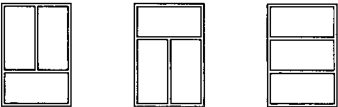
The value (for the chessboard ) is evident (see Fig. 2). To prove that by a direct drawing all possibilities is too laborious. Instead of this, we introduce new numbers : Let each denote the number of all "incomplete" coverings of a chessboard by pieces , when a fixed corner field (specified in advance, say the lower right one) remains uncovered. Thanks to the axial symmetry, the numbers remain to be the same if the fixed uncovered corner field will be the upper right one. Moreover, it is clear that .
Fig. 2
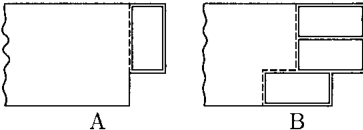
Now we are going to prove that for each , the following equalities hold:
Fig. 3
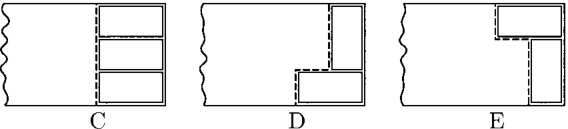
Similarly, the second equality in (1) follows from a partition of all coverings of a chessboard into three (disjoint) classes which are formed by coverings of types C, D and E respectively, see Fig. 4. It is evident that the numbers of elements in the three classes are , and , respectively.
Fig. 4
Now we are ready to compute the requested number . Since and , the proved equalities (1) successively yield
Answer. The number of coverings of the chessboard equals .
The value (for the chessboard ) is evident (see Fig. 2). To prove that by a direct drawing all possibilities is too laborious. Instead of this, we introduce new numbers : Let each denote the number of all "incomplete" coverings of a chessboard by pieces , when a fixed corner field (specified in advance, say the lower right one) remains uncovered. Thanks to the axial symmetry, the numbers remain to be the same if the fixed uncovered corner field will be the upper right one. Moreover, it is clear that .
Fig. 2
Now we are going to prove that for each , the following equalities hold:
Fig. 3
Similarly, the second equality in (1) follows from a partition of all coverings of a chessboard into three (disjoint) classes which are formed by coverings of types C, D and E respectively, see Fig. 4. It is evident that the numbers of elements in the three classes are , and , respectively.
Fig. 4
Now we are ready to compute the requested number . Since and , the proved equalities (1) successively yield
Answer. The number of coverings of the chessboard equals .
Final answer
571
Techniques
Recursion, bijectionCounting two waysEnumeration with symmetry