Browse · MathNet
Print63rd Czech and Slovak Mathematical Olympiad
Czech Republic geometry
Problem
We are given a triangle . Find the locus of points in the plane whose reflections through the lines , , are vertices of an equilateral triangle.
Solution
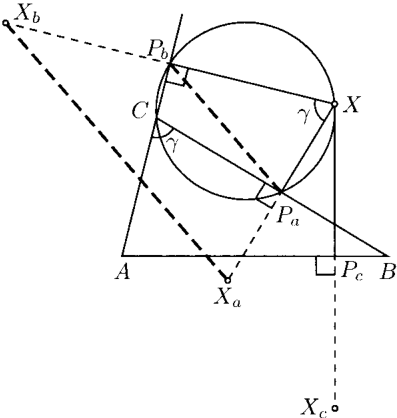
For any point of the plane , let and denote the reflections of through the lines , and , respectively (Fig. 5). First we prove that the distances between any two of the points and are given in general by formulæ in which denote the interior angles of the triangle as usual. Fig. 5 It suffices to prove the first equality (1) which is obvious if , because then . If , then the segment is a diameter of a circle (see Fig. 5) which passes through the marked orthogonal projections and of onto and , respectively (Thales' theorem). Since the chord subtends inscribed angles and , Law of Sines implies that . Using the homothety with centre and ratio , we conclude that , and hence the equalities (1) are established for any point .
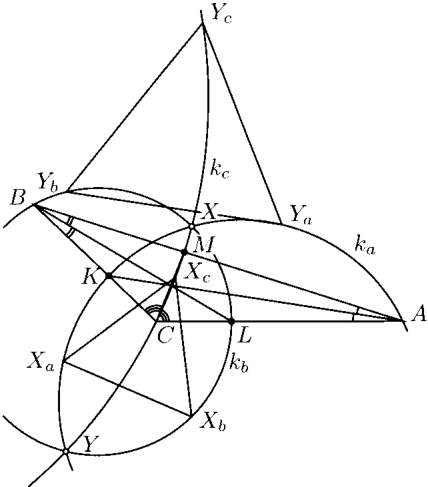
The proved formulæ (1) imply that our task is to find exactly such points in the plane that satisfy (recall that the triangle has to be equilateral). Otherwise speaking, we look for all points whose distances to , and are positive and proportional as follows: (we have turned from angles to sides of using Law of Sines again). Such points are determined as common points of the following three circles of Apollonius (i.e. sets of points in the plane which have a specified ratio of distances to two fixed points): It is clear that any point shared by two of the circles lies on the third circle as well. It follows from (2) that , and , which simplifies the construction of the three circles in practice: If the bisectors of interior angles in cut its interior in segments , and (Fig. 6), then , and (an immediate consequence of the well known proportions such as ). Hence the centre of can be constructed as the intersection point of the line and the perpendicular bisector of the segment (excluding the case , when becomes simply the perpendicular bisector of ). Similarly, using the perpendicular bisectors of and we get centres of and , respectively.
Fig. 6
Despite of the fact that the requested locus of points is determined (by an Euclidean construction), we have to discuss how the number of solutions depends on
a) If the triangle is equilateral, the "circles" are in fact perpendicular bisectors of the sides of . Consequently, the problem has a unique solution — a point which coincides with the incentre of .
b) If the triangle is isosceles (but not equilateral), say if , then the circle is a perpendicular bisector of the base which meets the circle in two points, because meets the interior of the chord , and hence the both arcs of the circle as well. Consequently, the problem has two solutions.
c) Suppose that the triangle is scalene, with the largest side, say (as in Fig. 6). Then the ratio for points is larger than , because of . Hence lies in the interior , while lies in its exterior. The last together with implies that , an interior point of , lies in the exterior of . Thus intersects the chord of which means that and meet in two points. Consequently, the problem has two solutions.
The proved formulæ (1) imply that our task is to find exactly such points in the plane that satisfy (recall that the triangle has to be equilateral). Otherwise speaking, we look for all points whose distances to , and are positive and proportional as follows: (we have turned from angles to sides of using Law of Sines again). Such points are determined as common points of the following three circles of Apollonius (i.e. sets of points in the plane which have a specified ratio of distances to two fixed points): It is clear that any point shared by two of the circles lies on the third circle as well. It follows from (2) that , and , which simplifies the construction of the three circles in practice: If the bisectors of interior angles in cut its interior in segments , and (Fig. 6), then , and (an immediate consequence of the well known proportions such as ). Hence the centre of can be constructed as the intersection point of the line and the perpendicular bisector of the segment (excluding the case , when becomes simply the perpendicular bisector of ). Similarly, using the perpendicular bisectors of and we get centres of and , respectively.
Fig. 6
Despite of the fact that the requested locus of points is determined (by an Euclidean construction), we have to discuss how the number of solutions depends on
a) If the triangle is equilateral, the "circles" are in fact perpendicular bisectors of the sides of . Consequently, the problem has a unique solution — a point which coincides with the incentre of .
b) If the triangle is isosceles (but not equilateral), say if , then the circle is a perpendicular bisector of the base which meets the circle in two points, because meets the interior of the chord , and hence the both arcs of the circle as well. Consequently, the problem has two solutions.
c) Suppose that the triangle is scalene, with the largest side, say (as in Fig. 6). Then the ratio for points is larger than , because of . Hence lies in the interior , while lies in its exterior. The last together with implies that , an interior point of , lies in the exterior of . Thus intersects the chord of which means that and meet in two points. Consequently, the problem has two solutions.
Final answer
The locus consists of the common intersection points of the three Apollonius circles k_a: |XB|/|XC| = |AB|/|AC|, k_b: |XA|/|XC| = |AB|/|BC|, k_c: |XA|/|XB| = |AC|/|BC|, which equivalently are the points X satisfying 2|XA|sin α = 2|XB|sin β = 2|XC|sin γ > 0. The number of solutions depends on the triangle: one solution (the incenter) if the triangle is equilateral; two solutions if the triangle is isosceles but not equilateral; and two solutions if the triangle is scalene.
Techniques
Circle of ApolloniusHomothetyTriangle trigonometryConstructions and lociAngle chasing