Browse · MathNet
PrintIranian Mathematical Olympiad
Iran geometry
Problem
Simple polygon with perimeter is called a rotund polygon, if for each two points and on the perimeter of that have a distance of at most in the plane, their distance on (i.e. the smaller part of the perimeter of that lies between them) is at most . We want to prove that a circle with radius can be drawn entirely inside a rotund polygon.
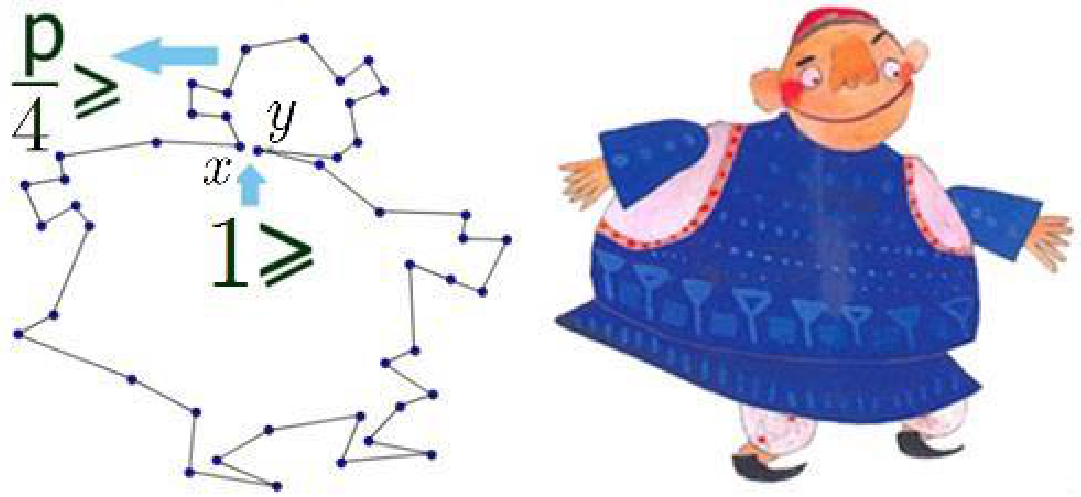
Intellectuals of the Earth and researchers of the planet Hot Dog! have devised two completely different approaches to solve the problem. In both approaches a chord is a line segment with its end points lying on the perimeter of the polygon. A diameter is a chord with its endpoints being vertices of the polygon. An inner chord is a chord that lies entirely inside or on the perimeter of the polygon. The distance on the perimeter between two points on the polygon is defined as the length of the smaller part of the perimeter between them.
### The Earth approach: the maximum chord
We know as a fact that for each polygon, an inner chord with a length less than or equal to unity can be found such that for each inner chord with a length less than or equal to unity, the distance on the perimeter of and is greater than or equal to the distance on the perimeter of and . This chord is called the maximum chord. In a rotund polygon there are two possibilities for the maximum chord:
a) First possibility: The length of the maximum chord equals unity. Prove that in this case a semicircle with the maximum chord as its diameter can fit completely inside the polygon ; therefore, a circle with radius can be drawn entirely inside the polygon.
b) Second possibility: The length of the maximum chord is less than unity. Prove that still in this case one can find a circle with radius that fits completely inside the polygon .
Intellectuals of the Earth thought for many times that they have tackled the problem, but each time they noticed a small flaw in their proof, until they could finally solve it.
### The Hot Dog approach: triangulation
Consider the two statements below:
First statement: "For each arbitrary polygon with edges of at most unity length for which there are no circles of radius that could be fit entirely inside it, it's possible to triangulate it with diameters of at most unit length."
Second statement: "For each arbitrary polygon that a circle of radius cannot be fit entirely inside it, it's possible to triangulate it with chords of at most unit length."
Researchers of Hot Dog could prove that if the second statement is true, then one can draw a circle of radius completely inside a rotund polygon.
c) Prove that if the second statement is true, then one can draw a circle of radius completely inside a rotund polygon.
They could easily deduce that if the first statement is true, then the second one is also true. So they announced that a house full of Hot Dogs would be the reward of anyone who could prove the first statement! After a while, a young barber called J.N who considered himself to be from the Earth, succeeded in contradicting the first statement and was rewarded the house, as promised.
d) Construct a 1392-gon that contradicts the first statement.
Still, researchers of Hot Dog have the hope to prove the second statement directly.
e) Write anything that you think might be true about the second statement.
Intellectuals of the Earth and researchers of the planet Hot Dog! have devised two completely different approaches to solve the problem. In both approaches a chord is a line segment with its end points lying on the perimeter of the polygon. A diameter is a chord with its endpoints being vertices of the polygon. An inner chord is a chord that lies entirely inside or on the perimeter of the polygon. The distance on the perimeter between two points on the polygon is defined as the length of the smaller part of the perimeter between them.
### The Earth approach: the maximum chord
We know as a fact that for each polygon, an inner chord with a length less than or equal to unity can be found such that for each inner chord with a length less than or equal to unity, the distance on the perimeter of and is greater than or equal to the distance on the perimeter of and . This chord is called the maximum chord. In a rotund polygon there are two possibilities for the maximum chord:
a) First possibility: The length of the maximum chord equals unity. Prove that in this case a semicircle with the maximum chord as its diameter can fit completely inside the polygon ; therefore, a circle with radius can be drawn entirely inside the polygon.
b) Second possibility: The length of the maximum chord is less than unity. Prove that still in this case one can find a circle with radius that fits completely inside the polygon .
Intellectuals of the Earth thought for many times that they have tackled the problem, but each time they noticed a small flaw in their proof, until they could finally solve it.
### The Hot Dog approach: triangulation
Consider the two statements below:
First statement: "For each arbitrary polygon with edges of at most unity length for which there are no circles of radius that could be fit entirely inside it, it's possible to triangulate it with diameters of at most unit length."
Second statement: "For each arbitrary polygon that a circle of radius cannot be fit entirely inside it, it's possible to triangulate it with chords of at most unit length."
Researchers of Hot Dog could prove that if the second statement is true, then one can draw a circle of radius completely inside a rotund polygon.
c) Prove that if the second statement is true, then one can draw a circle of radius completely inside a rotund polygon.
They could easily deduce that if the first statement is true, then the second one is also true. So they announced that a house full of Hot Dogs would be the reward of anyone who could prove the first statement! After a while, a young barber called J.N who considered himself to be from the Earth, succeeded in contradicting the first statement and was rewarded the house, as promised.
d) Construct a 1392-gon that contradicts the first statement.
Still, researchers of Hot Dog have the hope to prove the second statement directly.
e) Write anything that you think might be true about the second statement.
Solution
Throughout the solution the following notations will be used:
: The smaller part of the perimeter of the polygon which lies between and .
: The other part of the perimeter of the polygon joining and .
: The length of .
: A chord of the polygon whose end points are and .
a. Let be the maximum chord of with unit length. Our aim is to show that in this case the semicircle with diameter , which is on the same side of as , lies entirely inside .
Lemma 1. .
Proof. Assume that . Obviously and are both inner chords of . Note that if , then which is a contradiction since chord is maximal, hence . Similarly, . Therefore, , and form a partition of the perimeter of . This leads to a contradiction because is rotund and , and are all less than and consequently their sum is less than .
Lemma 2. The common part of and edges of that contain lies outside the semicircle mentioned above. A similar assertion holds for .
Proof. Assume to the contrary that is a point inside that semicircle, and it also lies on the common part of and the edge containing such that is very small. By lemma 1, we can choose such that intersects the perimeter of only at and . Since and is near to , which is a contradiction with the maximality of .
Lemma 3. and are the only intersection points of and the semicircle.
Proof. Assume to the contrary that the intersection set is not empty. Let be a point in this set which has the minimum distance to the segment . Note that by the above lemmas we know that this minimum is positive. We claim that and are both inner chords of , because if not, there is another point of the polygon inside triangle , which contradicts the minimality of . Rest of the proof is similar to that of lemma 1. and , so , and form a partition of the perimeter of , but we know that the length of each one is at most .
Using lemma 3, does not intersect the semicircle (except at and ). Therefore, does not intersect the semicircle because the polygon is not self-intersecting. Hence the semicircle fits completely inside .
b. Let be the maximum chord. Draw semicircles of radius and centers at and such that they are on the same side of line as . We claim that the common part of these two semicircles (say ) fits completely inside .
Lemma 4. .
Proof. The proof is the same as that one given in part a.
Lemma 5. The common part of and edges of which contain lies outside of . A similar assertion holds for .
Proof. The proof is similar to the proof of lemma 2. Assume to the contrary that is a point in the common part of and the edge containing such that is very small. By lemma 4, we can choose such that intersects the perimeter of exactly at and . Since and is near , which contradicts the maximality of .
Lemma 6. .
Proof. Assume to the contrary that there are points other than and in this intersection. Let be a point in this intersection which has the minimum distance from the segment . By the above lemmas, we know that this minimum is positive. We claim that and are both inner chords of , because if not, there exists another point of the polygon inside triangle which contradicts the minimality of . So and are both inner chords of . But lies in , therefore the lengths of and are less than . This implies that and are both less than . Rest of the proof is similar to lemma 1. and , so , and form a partition of the perimeter of , but we know that the length of each one is at most .
By lemma 6, does not intersect the region (except at and ). Therefore, does not intersect because the polygon is not self-intersecting. Hence the region fits completely inside . It is easy to see that a circle with radius can be drawn entirely inside .
c. Suppose that there exists a rotund polygon such that no circle of radius completely fits inside it. By the second statement, there is a triangulation of the polygon with chords of at most unit length. Let be the chord of the triangulation that has the maximum . There are two possibilities:
Case 1. There is no vertex of in other than and . Therefore, must be an edge of . Hence and the length of is less than because of the triangle inequality which is a contradiction.
Case 2. There is another vertex of in other than and . Therefore, there is some vertex such that forms one of the triangles of the triangulation. Note that if , then and this contradicts the maximality of . Thus and similarly . Therefore, , and form a partition of the perimeter of . This is a contradiction because the lengths of all these parts are less than .
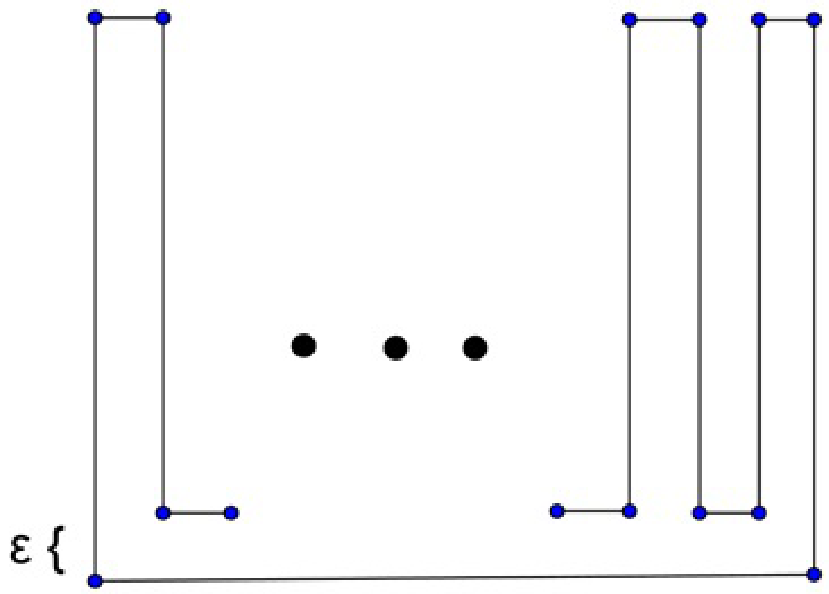
d. If is sufficiently small, the following polygon is a counterexample for the first statement.
e. [No specific answer provided.]
: The smaller part of the perimeter of the polygon which lies between and .
: The other part of the perimeter of the polygon joining and .
: The length of .
: A chord of the polygon whose end points are and .
a. Let be the maximum chord of with unit length. Our aim is to show that in this case the semicircle with diameter , which is on the same side of as , lies entirely inside .
Lemma 1. .
Proof. Assume that . Obviously and are both inner chords of . Note that if , then which is a contradiction since chord is maximal, hence . Similarly, . Therefore, , and form a partition of the perimeter of . This leads to a contradiction because is rotund and , and are all less than and consequently their sum is less than .
Lemma 2. The common part of and edges of that contain lies outside the semicircle mentioned above. A similar assertion holds for .
Proof. Assume to the contrary that is a point inside that semicircle, and it also lies on the common part of and the edge containing such that is very small. By lemma 1, we can choose such that intersects the perimeter of only at and . Since and is near to , which is a contradiction with the maximality of .
Lemma 3. and are the only intersection points of and the semicircle.
Proof. Assume to the contrary that the intersection set is not empty. Let be a point in this set which has the minimum distance to the segment . Note that by the above lemmas we know that this minimum is positive. We claim that and are both inner chords of , because if not, there is another point of the polygon inside triangle , which contradicts the minimality of . Rest of the proof is similar to that of lemma 1. and , so , and form a partition of the perimeter of , but we know that the length of each one is at most .
Using lemma 3, does not intersect the semicircle (except at and ). Therefore, does not intersect the semicircle because the polygon is not self-intersecting. Hence the semicircle fits completely inside .
b. Let be the maximum chord. Draw semicircles of radius and centers at and such that they are on the same side of line as . We claim that the common part of these two semicircles (say ) fits completely inside .
Lemma 4. .
Proof. The proof is the same as that one given in part a.
Lemma 5. The common part of and edges of which contain lies outside of . A similar assertion holds for .
Proof. The proof is similar to the proof of lemma 2. Assume to the contrary that is a point in the common part of and the edge containing such that is very small. By lemma 4, we can choose such that intersects the perimeter of exactly at and . Since and is near , which contradicts the maximality of .
Lemma 6. .
Proof. Assume to the contrary that there are points other than and in this intersection. Let be a point in this intersection which has the minimum distance from the segment . By the above lemmas, we know that this minimum is positive. We claim that and are both inner chords of , because if not, there exists another point of the polygon inside triangle which contradicts the minimality of . So and are both inner chords of . But lies in , therefore the lengths of and are less than . This implies that and are both less than . Rest of the proof is similar to lemma 1. and , so , and form a partition of the perimeter of , but we know that the length of each one is at most .
By lemma 6, does not intersect the region (except at and ). Therefore, does not intersect because the polygon is not self-intersecting. Hence the region fits completely inside . It is easy to see that a circle with radius can be drawn entirely inside .
c. Suppose that there exists a rotund polygon such that no circle of radius completely fits inside it. By the second statement, there is a triangulation of the polygon with chords of at most unit length. Let be the chord of the triangulation that has the maximum . There are two possibilities:
Case 1. There is no vertex of in other than and . Therefore, must be an edge of . Hence and the length of is less than because of the triangle inequality which is a contradiction.
Case 2. There is another vertex of in other than and . Therefore, there is some vertex such that forms one of the triangles of the triangulation. Note that if , then and this contradicts the maximality of . Thus and similarly . Therefore, , and form a partition of the perimeter of . This is a contradiction because the lengths of all these parts are less than .
d. If is sufficiently small, the following polygon is a counterexample for the first statement.
e. [No specific answer provided.]
Techniques
CirclesCombinatorial GeometryDistance chasingConstructions and loci