Browse · MathNet
PrintIranian Mathematical Olympiad
Iran counting and probability
Problem
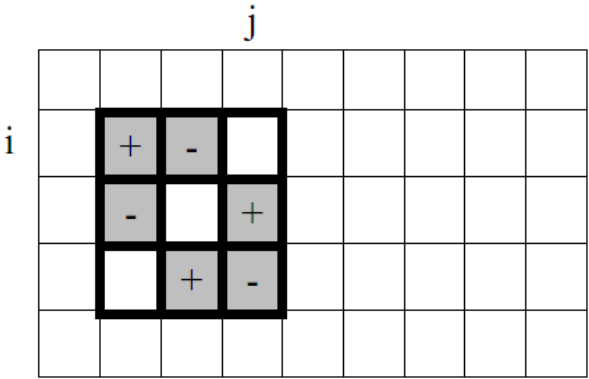
In each unit cell of a table an integer number is written. An diagonal is formed by those cells of the table for which the difference between their column number and their row number is a constant number. We want to make all the numbers in the table during a finite number of steps. In each step, we can select a row, a column or a diagonal and add or to the number in every cell of it. Prove that if we can make all the numbers in each subtable without altering the rest of the table, then we can make all the numbers in the table .
For example, in the table below, cells of a diagonal and also cells of a subtable are shown. Note that the rightmost upper cell (row , column ) is also considered a diagonal.
For example, in the table below, cells of a diagonal and also cells of a subtable are shown. Note that the rightmost upper cell (row , column ) is also considered a diagonal.
| 1 | 2 | 3 | 4 | 5 | 6 | 7 | 8 | 9 | |
|---|---|---|---|---|---|---|---|---|---|
| 1 | ♣ | ||||||||
| 2 | ◇ | ◇ | ◇ | ♣ | |||||
| 3 | ◇ | ◇ | ◇ | ♣ | |||||
| 4 | ◇ | ◇ | ◇ | ♣ | |||||
| 5 |
Solution
Let denote the number in the cell located in the -th row and -th column of the table, and the subtable whose rightmost upper number is .
First, assume that (If or , there is no subtable). For , consider the following value
Note that if we choose a row, a column or a diagonal of the table and add or to the number in every cell of it, this value stays invariant.
Since we can make all the numbers in each subtable zero, we have
The assertion is proved by induction on . If , then and the assertion is trivial. If , either or . Without loss of generality we can assume that . By omitting the last column, we get a table. By the induction hypothesis, we can make the numbers in the cells of this subtable zero, using allowable operations (except for the last column and the diagonal of the initial table).
Now, the numbers in the last column of the table may be nonzero. Considering the invariant values () implies that for . So . By using the last column several times all the numbers in the table except may become zero. But is itself a diagonal, hence we can also make this number zero.
If , where either or , the proof is very easy and is left to the reader.
First, assume that (If or , there is no subtable). For , consider the following value
Note that if we choose a row, a column or a diagonal of the table and add or to the number in every cell of it, this value stays invariant.
Since we can make all the numbers in each subtable zero, we have
The assertion is proved by induction on . If , then and the assertion is trivial. If , either or . Without loss of generality we can assume that . By omitting the last column, we get a table. By the induction hypothesis, we can make the numbers in the cells of this subtable zero, using allowable operations (except for the last column and the diagonal of the initial table).
Now, the numbers in the last column of the table may be nonzero. Considering the invariant values () implies that for . So . By using the last column several times all the numbers in the table except may become zero. But is itself a diagonal, hence we can also make this number zero.
If , where either or , the proof is very easy and is left to the reader.
Techniques
Invariants / monovariantsInduction / smoothing