Browse · MathNet
PrintEstonian Mathematical Olympiad
Estonia counting and probability
Problem
A gardener Andres wants to plant one currant bush to each cell of his garden of shape . He wants to plant as many blackcurrant bushes as possible under the following conditions: There must be at least one redcurrant and at least one whitecurrant bush, and for any cell with a blackcurrant bush, cells that have a common side with it must contain equally many redcurrant and whitecurrant bushes (maybe also 0 of both). Find the largest number of blackcurrant bushes Andres can plant.

Solution
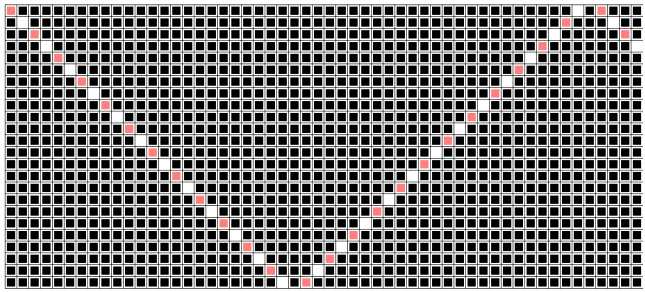
Firstly, we show that blackcurrant bushes is possible. Let's alternate redcurrant and whitecurrant bushes on the falling diagonal starting from the top left corner; when we reach the bottom edge of the garden, skip one column and proceed similarly along a rising diagonal starting from the next column, and so on. Into all remaining cells, we put blackcurrant bushes (Figure 14 depicts the beginning of the garden). This way, blocks consisting of columns, each containing blackcurrant bushes and non-blackcurrant bush, alternate with singleton columns that contain blackcurrants only. As , the last diagonal containing non-blackcurrant bushes ends in the bottom right corner of the garden (no column of blackcurrants follows). Each cell next to a diagonal of non-blackcurrant bushes (including the utmost cell of each column of blackcurrants) has exactly one red and one white neighbour. Other blackcurrant cells have only black neighbours. There are blackcurrant bushes in total.
Fig. 14 Fig. 15
Secondly, we show that there cannot be more blackcurrant bushes. To this end, consider an arbitrary situation that satisfies the conditions. Let the garden have rows and columns. If there is a column containing blackcurrants solely, there must definitely exist two consecutive columns, one of which contains non-blackcurrant bushes and the other does not. Then in the latter column, the blackcurrant bush next to a non-blackcurrant bush of the former column must have another non-black neighbour on the other side (Fig. 15). Thus there cannot be two consecutive columns with blackcurrant bushes only, nor can the first or the last column contain blackcurrants only. Consider now a block of consecutive columns, each containing at least one non-black cell. Assume that this block cannot be extended to obtain a bigger block with the same property. We show that if then this block must contain at least non-black cells in total. Consider two cases: If there is a row that contains no non-black cells within the block then there must be two consecutive rows, one of which contains non-black cells within the block and the other does not. Like above, we see that in the latter row, the black cell next to a non-black cell of the former row must have another non-black neighbour on the other side. Thus the column of this cell must contain two non-black cells. As every column of the block contains at least one non-black cell, the block must contain at least non-black cells in total. If every row contains non-black cells within the block then the block contains at least non-black cells in total. As , this implies that the block contains at least non-black cells. Let's add one more column of blackcurrants to the beginning of the garden; by the above, this does not give rise to two consecutive columns of blackcurrants. (We do not apply the condition of the problem to the extra column, it is introduced for convenience only.) Divide the garden into blocks, each of which begins with a column of blackcurrants and ends with the last column before the next column of blackcurrants (or with the last column of the garden if no columns of blackcurrants follow). By the definition of blocks, each block of columns contains at least non-black cells; but if then the block must contain at least non-black cells. Since , the number of blocks with less non-black cells than columns can be at most . Thus the garden contains at least non-black cells and at most black cells.
Fig. 14 Fig. 15
Secondly, we show that there cannot be more blackcurrant bushes. To this end, consider an arbitrary situation that satisfies the conditions. Let the garden have rows and columns. If there is a column containing blackcurrants solely, there must definitely exist two consecutive columns, one of which contains non-blackcurrant bushes and the other does not. Then in the latter column, the blackcurrant bush next to a non-blackcurrant bush of the former column must have another non-black neighbour on the other side (Fig. 15). Thus there cannot be two consecutive columns with blackcurrant bushes only, nor can the first or the last column contain blackcurrants only. Consider now a block of consecutive columns, each containing at least one non-black cell. Assume that this block cannot be extended to obtain a bigger block with the same property. We show that if then this block must contain at least non-black cells in total. Consider two cases: If there is a row that contains no non-black cells within the block then there must be two consecutive rows, one of which contains non-black cells within the block and the other does not. Like above, we see that in the latter row, the black cell next to a non-black cell of the former row must have another non-black neighbour on the other side. Thus the column of this cell must contain two non-black cells. As every column of the block contains at least one non-black cell, the block must contain at least non-black cells in total. If every row contains non-black cells within the block then the block contains at least non-black cells in total. As , this implies that the block contains at least non-black cells. Let's add one more column of blackcurrants to the beginning of the garden; by the above, this does not give rise to two consecutive columns of blackcurrants. (We do not apply the condition of the problem to the extra column, it is introduced for convenience only.) Divide the garden into blocks, each of which begins with a column of blackcurrants and ends with the last column before the next column of blackcurrants (or with the last column of the garden if no columns of blackcurrants follow). By the definition of blocks, each block of columns contains at least non-black cells; but if then the block must contain at least non-black cells. Since , the number of blocks with less non-black cells than columns can be at most . Thus the garden contains at least non-black cells and at most black cells.
Final answer
46632
Techniques
Coloring schemes, extremal arguments