Browse · MathNet
PrintEstonian Mathematical Olympiad
Estonia geometry
Problem
Let be the circumcentre of an acute triangle . Points and are chosen on the side such that is an altitude of the triangle and bisects the angle . Bisectors of the triangle meet at point . Prove that the triangle is isosceles.
Solution
Solution 1:
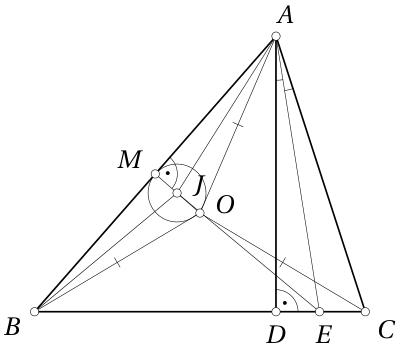
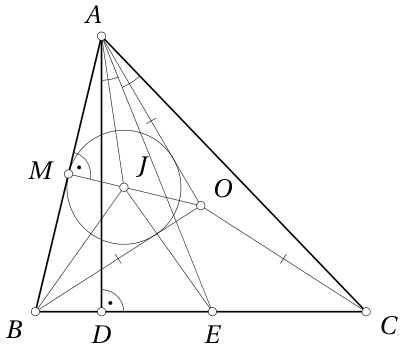
Let and let be the point of intersection of lines and (Figures 10 and 11). As and bisects the angle , we have . We also have , because lies inside the triangle . As , triangles and are similar. Hence also , implying Hence triangles and are similar, too. This implies the similarity of triangles and (spiral similarity). As , the latter similarity implies . By symmetry in the isosceles triangle , we obtain . Consequently, . Hence the triangle is isosceles.
Fig. 10 Fig. 11
---
Alternative solution.
Solution 2:
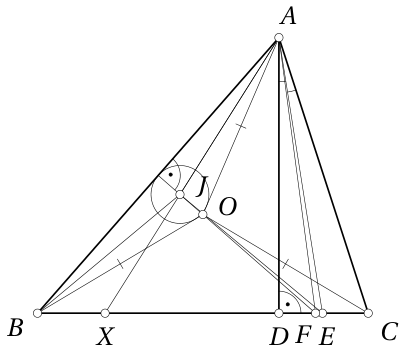
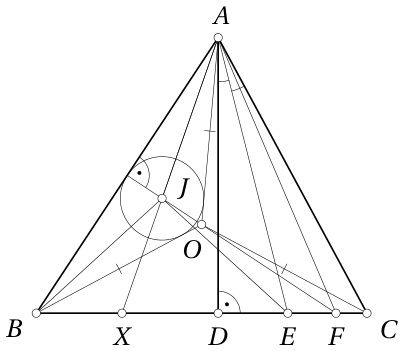
Let , and . We start by proving the equalities (6) as in Solution 1. Next, let lines and meet in , whereas let lines and meet in (Figures 12 and 13 depict situations that differ by the order of points and ). We show that points are concyclic. From equalities (6) we get As , the line is the perpendicular bisector of the line segment . Thus
Fig. 12 Fig. 13 Altogether, we have , implying that are concyclic.
Therefore , implying . But as lies on the perpendicular bisector of the line segment . Consequently, . Hence the triangle is isosceles.
---
Alternative solution.
Solution 3:
We use the known fact that lines drawn from a vertex of a triangle to its orthocentre and its circumcentre are isogonals which implies that the angles between these lines and the respective sides are equal. As and are the altitudes and the circumradius of the triangle , both drawn from vertex , we have . But bisects the angle and is the point of intersection of angle bisectors of the triangle , hence . This shows that rays and are isogonals in the triangle . As is also an altitude of the triangle , the line must pass through the circumcentre of the triangle . But the circumcentre of the triangle must also lie on the perpendicular bisector of the side . As , the bisector of the angle coincides with the perpendicular bisector of the side . Hence the circumcentre of the triangle is the point of intersection of lines and . Consequently, , implying that the triangle is isosceles.
---
Alternative solution.
Solution 4:
As , the bisector of the angle coincides with the perpendicular bisector of the side . Hence the point lies on the perpendicular bisector of the side , implying that points and lie on some circle with centre . We show that . Indeed, As implies , we obtain
Hence is the circumcircle of the triangle . Consequently, , implying that the triangle is isosceles.
Let and let be the point of intersection of lines and (Figures 10 and 11). As and bisects the angle , we have . We also have , because lies inside the triangle . As , triangles and are similar. Hence also , implying Hence triangles and are similar, too. This implies the similarity of triangles and (spiral similarity). As , the latter similarity implies . By symmetry in the isosceles triangle , we obtain . Consequently, . Hence the triangle is isosceles.
Fig. 10 Fig. 11
---
Alternative solution.
Solution 2:
Let , and . We start by proving the equalities (6) as in Solution 1. Next, let lines and meet in , whereas let lines and meet in (Figures 12 and 13 depict situations that differ by the order of points and ). We show that points are concyclic. From equalities (6) we get As , the line is the perpendicular bisector of the line segment . Thus
Fig. 12 Fig. 13 Altogether, we have , implying that are concyclic.
Therefore , implying . But as lies on the perpendicular bisector of the line segment . Consequently, . Hence the triangle is isosceles.
---
Alternative solution.
Solution 3:
We use the known fact that lines drawn from a vertex of a triangle to its orthocentre and its circumcentre are isogonals which implies that the angles between these lines and the respective sides are equal. As and are the altitudes and the circumradius of the triangle , both drawn from vertex , we have . But bisects the angle and is the point of intersection of angle bisectors of the triangle , hence . This shows that rays and are isogonals in the triangle . As is also an altitude of the triangle , the line must pass through the circumcentre of the triangle . But the circumcentre of the triangle must also lie on the perpendicular bisector of the side . As , the bisector of the angle coincides with the perpendicular bisector of the side . Hence the circumcentre of the triangle is the point of intersection of lines and . Consequently, , implying that the triangle is isosceles.
---
Alternative solution.
Solution 4:
As , the bisector of the angle coincides with the perpendicular bisector of the side . Hence the point lies on the perpendicular bisector of the side , implying that points and lie on some circle with centre . We show that . Indeed, As implies , we obtain
Hence is the circumcircle of the triangle . Consequently, , implying that the triangle is isosceles.
Techniques
Triangle centers: centroid, incenter, circumcenter, orthocenter, Euler line, nine-point circleSpiral similarityIsogonal/isotomic conjugates, barycentric coordinatesAngle chasing