Browse · MathNet
PrintIMO2024 Shortlisted Problems
2024 geometry
Problem
Let be a quadrilateral with parallel to and . Lines and intersect at a point . Point on the circumcircle of triangle is such that . Point on the circumcircle of triangle is such that . Lines and intersect at .
Prove that is parallel to .
Prove that is parallel to .
Solution
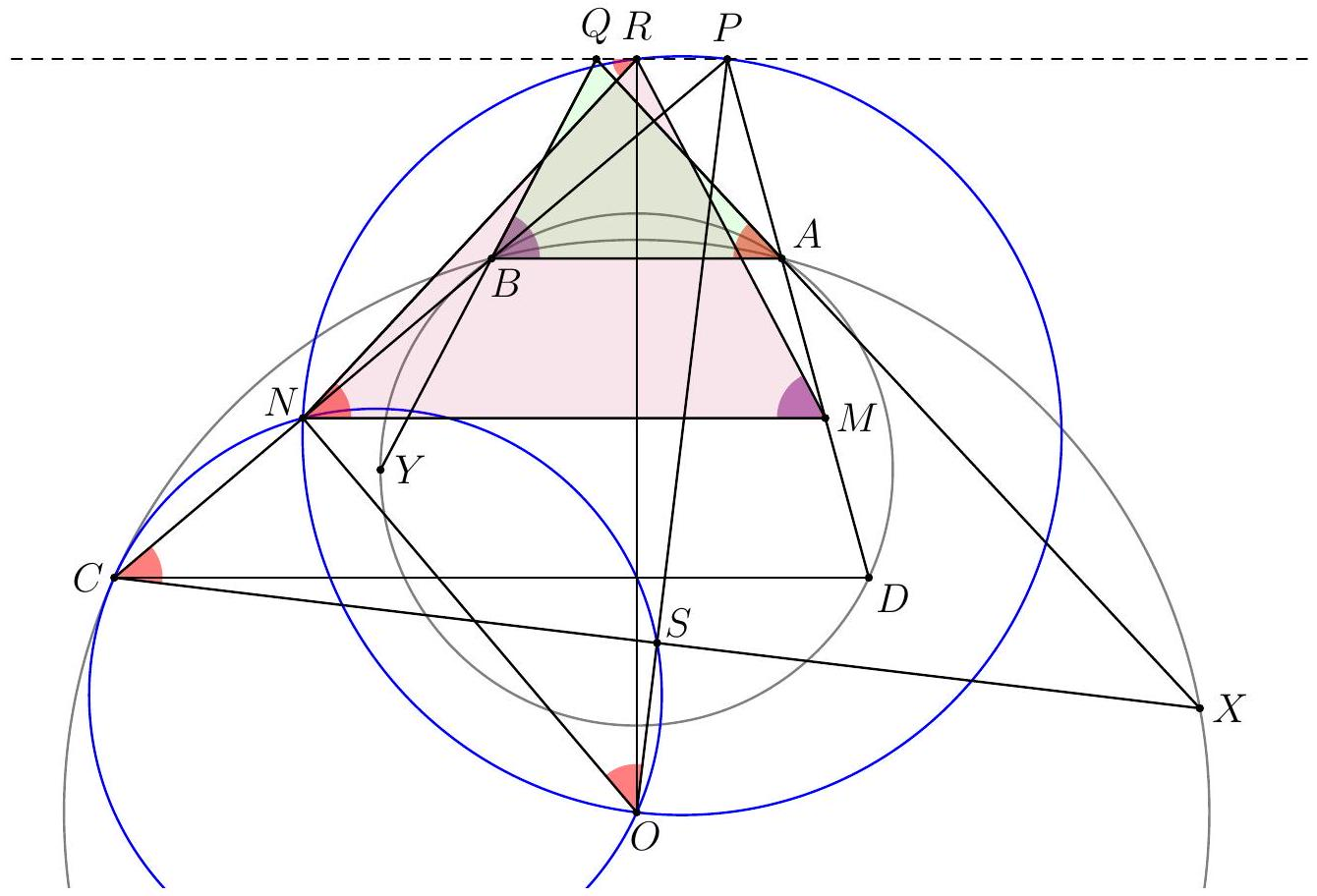
Let and be the midpoints of and , respectively and let the perpendicular bisector of intersect the line through parallel to at .
Lemma. Triangles and are similar.
Proof. Let be the circumcentre of triangle , and let be the midpoint of . Since , and are the respective perpendicular feet from to , and , we have that quadrilaterals and are cyclic. Furthermore, , and are collinear as . Since is also cyclic, we have that Analogously, we have that , so triangles and are similar.
Let denote the perpendicular distance from the point to the line . Using that along with the similarities and , we have that which implies that .
---
Alternative solution.
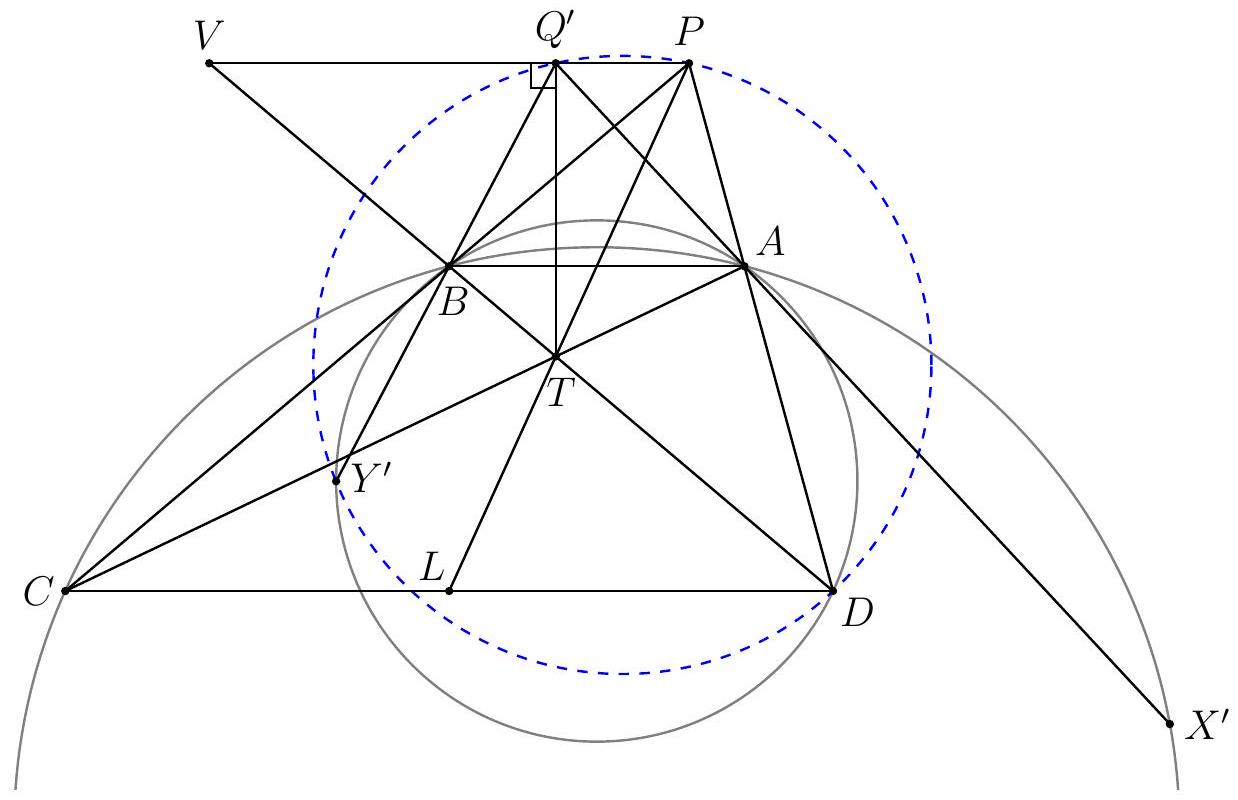
Let and intersect at and let the line through parallel to intersect at . Next, let be the foot of the perpendicular from to . Finally, let intersect circle again at and intersect circle again at .
Claim. bisects externally.
Proof. Let intersect at . Let be the point at infinity on line . From the standard Ceva-Menelaus configuration we have is harmonic. Hence projecting through we have As is harmonic, and also (by construction), the claim follows.
Now as we have cyclic. By the claim, we have that is the midpoint of , so .
Since is the unique point not equal to on circle satisfying , we have . Likewise so and we are done.
---
Alternative solution.
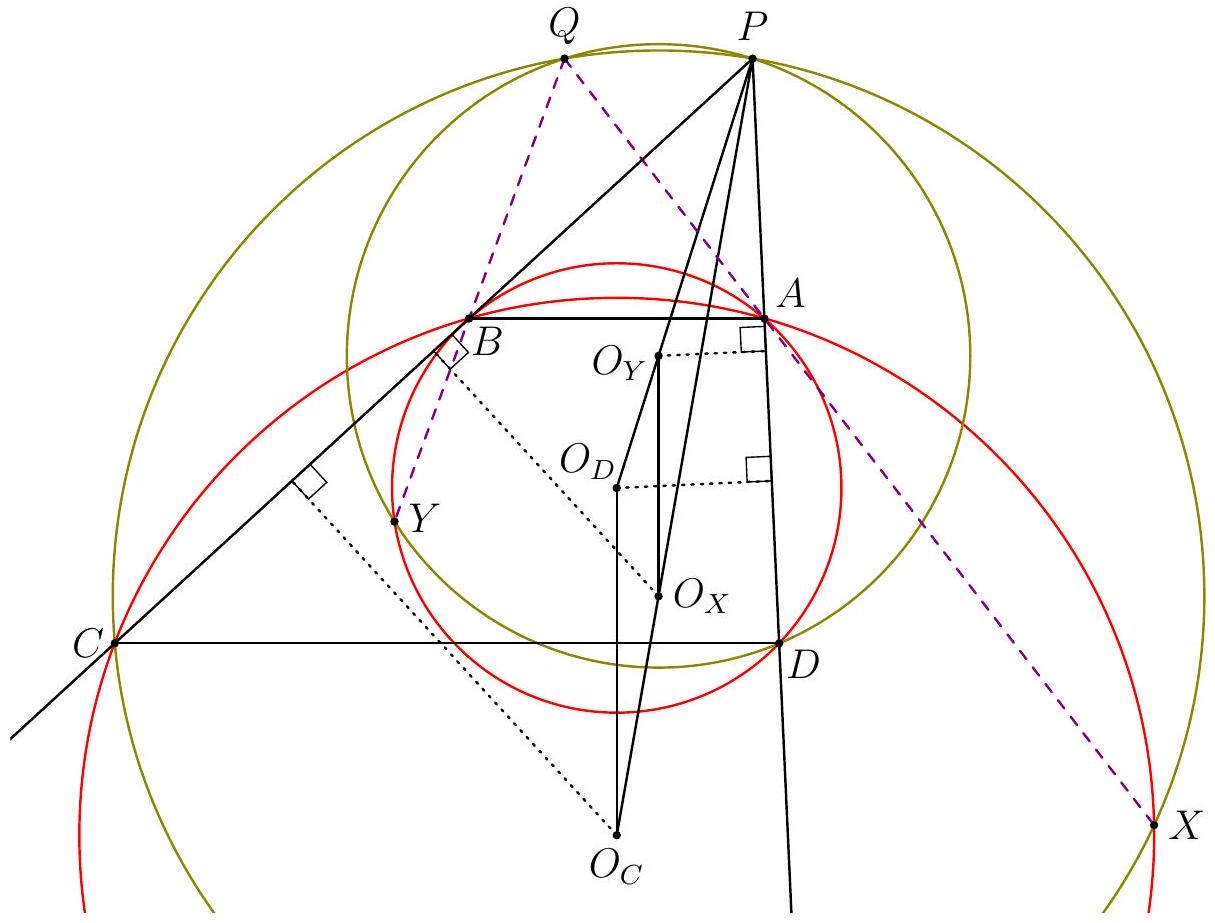
Let intersect circle for the second time at . Then so is parallel to . Hence, it suffices to show that is equal to . To do so, we aim to show the common chord of circles and is parallel to , since then by symmetry is also the second intersection of and circle .
Let the centres of circles and be and , respectively. Let the centres of circles and be and , respectively.
Note , and are collinear since they all lie on the perpendicular bisector of . Likewise , and are collinear on the perpendicular bisector of . By considering the projections of and onto , and and onto , we have Hence is parallel to , which is perpendicular to as desired.
Lemma. Triangles and are similar.
Proof. Let be the circumcentre of triangle , and let be the midpoint of . Since , and are the respective perpendicular feet from to , and , we have that quadrilaterals and are cyclic. Furthermore, , and are collinear as . Since is also cyclic, we have that Analogously, we have that , so triangles and are similar.
Let denote the perpendicular distance from the point to the line . Using that along with the similarities and , we have that which implies that .
---
Alternative solution.
Let and intersect at and let the line through parallel to intersect at . Next, let be the foot of the perpendicular from to . Finally, let intersect circle again at and intersect circle again at .
Claim. bisects externally.
Proof. Let intersect at . Let be the point at infinity on line . From the standard Ceva-Menelaus configuration we have is harmonic. Hence projecting through we have As is harmonic, and also (by construction), the claim follows.
Now as we have cyclic. By the claim, we have that is the midpoint of , so .
Since is the unique point not equal to on circle satisfying , we have . Likewise so and we are done.
---
Alternative solution.
Let intersect circle for the second time at . Then so is parallel to . Hence, it suffices to show that is equal to . To do so, we aim to show the common chord of circles and is parallel to , since then by symmetry is also the second intersection of and circle .
Let the centres of circles and be and , respectively. Let the centres of circles and be and , respectively.
Note , and are collinear since they all lie on the perpendicular bisector of . Likewise , and are collinear on the perpendicular bisector of . By considering the projections of and onto , and and onto , we have Hence is parallel to , which is perpendicular to as desired.
Techniques
Cyclic quadrilateralsMenelaus' theoremPolar triangles, harmonic conjugatesHomothetyAngle chasing