Browse · MathNet
PrintIMO2024 Shortlisted Problems
2024 geometry
Problem
Let be a triangle with , incentre and incircle . Let be the point in the interior of side such that the line through parallel to is tangent to . Similarly, let be the point in the interior of side such that the line through parallel to is tangent to . Let intersect the circumcircle of triangle again at . Let and be the midpoints of and , respectively. Prove that . (Poland)
Solution
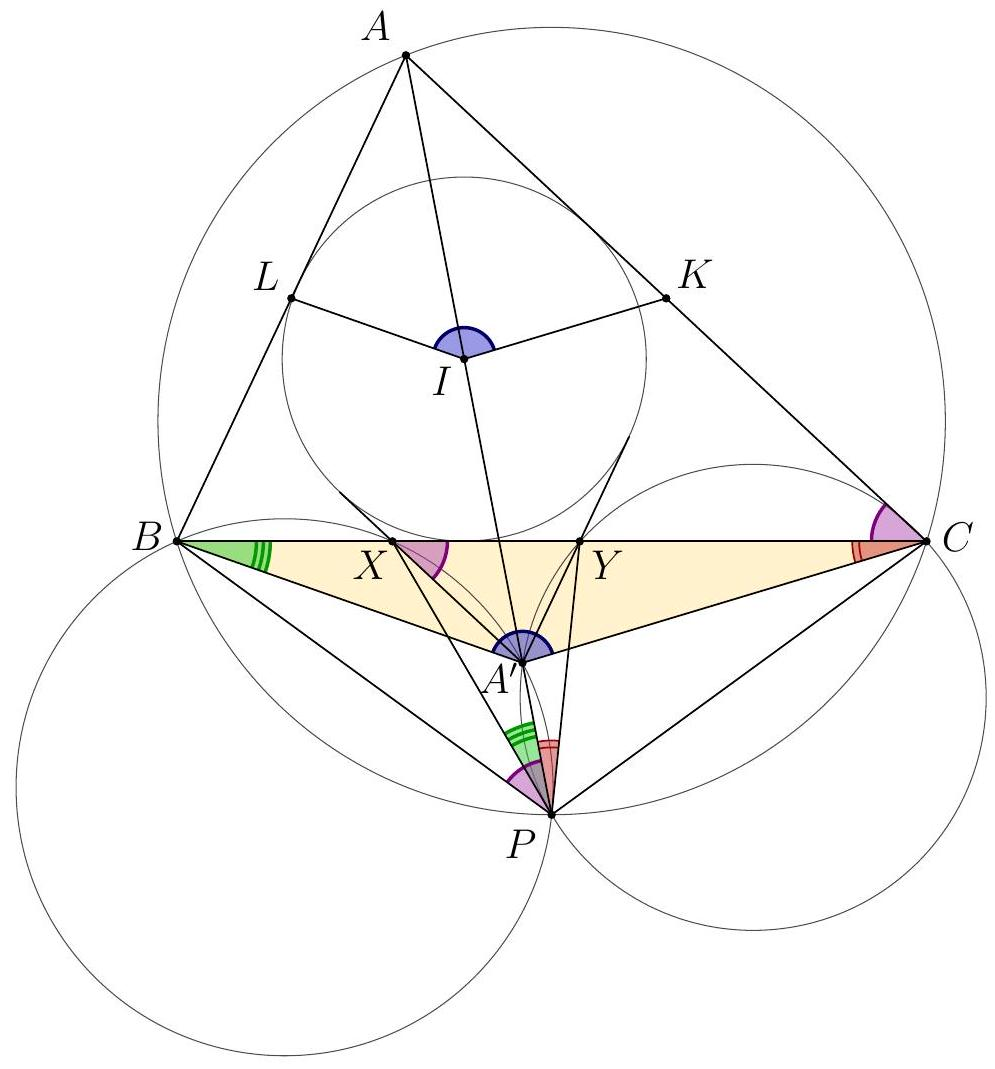
We have in the circumcircle and because . Hence, , and so quadrilateral is cyclic. Similarly, it follows that is cyclic. Now we are ready to transform to the sum of angles in triangle . By a homothety of factor 2 at we have . In circles and we have and , therefore
---
Alternative solution.
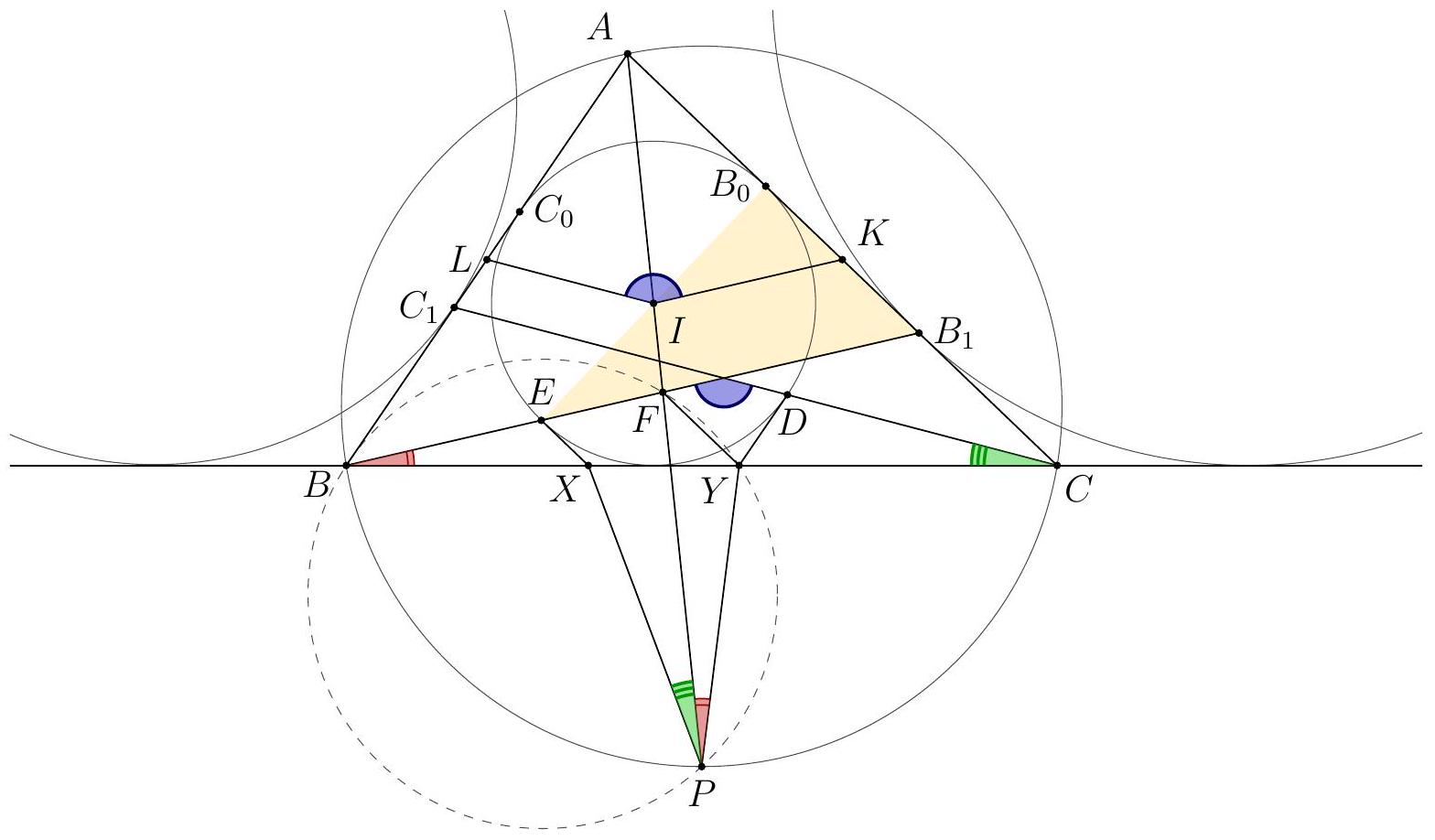
Let , , and , and let the radii of the incircle, -excircle and -excircle be and , respectively. Let the incircle be tangent to and at and , respectively; let the -excircle be tangent to at , and let the -excircle be tangent to at . As is well-known, and . Let the line through , parallel to be tangent to the incircle at , and the line through , parallel to be tangent to the incircle at . Finally, let meet at . It is well-known that points , and are collinear by the homothety between the incircle and the -excircle, and because is a midline in triangle . Similarly, it follows that , and are collinear and . Hence, the problem reduces to proving (and its symmetric counterpart with respect to the vertex ), so it suffices to prove that is cyclic. Since is cyclic, that is equivalent to and . By the angle bisector theorem we have The homothety at that maps the incircle to the -excircle sends to , so So, which completes the solution.
---
Alternative solution.
Let , , and , and let the radii of the incircle, -excircle and -excircle be and , respectively. Let the incircle be tangent to and at and , respectively; let the -excircle be tangent to at , and let the -excircle be tangent to at . As is well-known, and . Let the line through , parallel to be tangent to the incircle at , and the line through , parallel to be tangent to the incircle at . Finally, let meet at . It is well-known that points , and are collinear by the homothety between the incircle and the -excircle, and because is a midline in triangle . Similarly, it follows that , and are collinear and . Hence, the problem reduces to proving (and its symmetric counterpart with respect to the vertex ), so it suffices to prove that is cyclic. Since is cyclic, that is equivalent to and . By the angle bisector theorem we have The homothety at that maps the incircle to the -excircle sends to , so So, which completes the solution.
Techniques
Triangle centers: centroid, incenter, circumcenter, orthocenter, Euler line, nine-point circleTangentsCyclic quadrilateralsHomothetyAngle chasing