Browse · MathNet
PrintRioplatense Mathematical Olympiad
Argentina counting and probability
Problem
Ana placed the numbers from to in the squares of the figure, one in each square, without repeating numbers. It turned out that, for each of the four arrows indicated, the sum of the three numbers in that direction is equal to the number of Ana's cats. How many cats does Ana have? Find all possibilities. 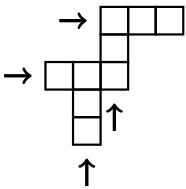
Solution
Denote the numbers in the squares as shown in the figure, and let be the number of cats Ana has. If we add up both vertical arrows plus the top horizontal arrow we find that each number appears exactly once on this sum, except for which is added twice, and which does not appear on the sum. Hence, since , we have . Since and are different numbers from the set , we know that is at least and at most . Therefore .
We will now prove that . If this were the case, then , but also . This implies and thus , which is impossible.
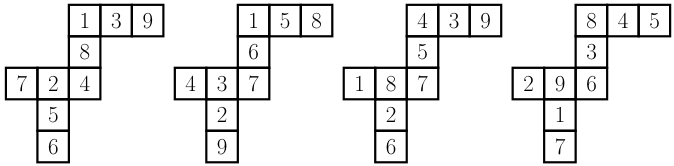
To complete the solution, we now show with the following examples that , , and are possible values for :
We will now prove that . If this were the case, then , but also . This implies and thus , which is impossible.
To complete the solution, we now show with the following examples that , , and are possible values for :
Final answer
13, 14, 16, 17
Techniques
Counting two waysLinear and quadratic inequalitiesIntegers