Browse · MathNet
PrintVMO
Vietnam counting and probability
Problem
There are several identical caro papers of size . Someone uses colors to fill in each paper such that two cells at the same position on two sides share the same color. Two papers are considered congruent if they can be stacked together in such a way that the pairs of squares at the same position have the same color. Prove that, by the definition of congruence, one can obtain at most distinct colored caro papers.
Solution
We will prove the following lemma
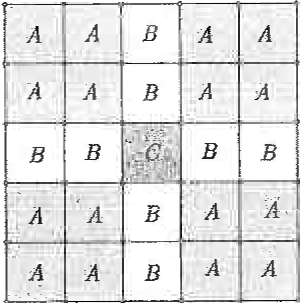
Lemma. Consider positive integer with , and the square table of size in which each cell is filled by one of colors. Then the number of different ways to color (not duplicated by the rotation) is equal to Proof. Note that the middle cell, with symbol C as shown in the image, is not affected by the rotation so there is always ways to fill it.
Consider the collection of 4 squares in the corners as set and 4 rectangles as set in such a way that is immediately followed by for . We consider 4 pairs consists of two subsets of . The number of cells on each pair are , so the number of ways to fill in each pair of subsets is . Here, we consider each pair like that as a vertex of some square . We will count the number of coloring for the vertices so that they do not duplicate by the rotation. We have the following cases
(1) All vertices are filled with the same color, there are ways.
(2) The coloring is alternative, so we just concern how to fill in 2 adjacent vertices with the number of ways is .
(3) Otherwise, there is some identical pairs that is not cyclical of 2, then the number is . This way of coloring has a circular permutations and will generates different ways.
In total, the number of coloring is
Back to the problem, Using the above lemma when , we have a number of ways to fill in the paper that not duplicate each other by the rotation is Denote as a set of these coloring ways. In this problem, we also need to consider the reflection transformation. We separate to two types of papers, namely , : papers can and cannot create itself through the vertical and horizontal reflections.
Notice that each paper in generates 2 different papers in (should only be counted as 1 in the original problem); meanwhile, each paper in generates exactly 1 paper in . Hence, Also, it is easy to count (fill the left half of the piece of paper, also the middle line as well). From there we can calculate so This is the number of different pieces of paper we need to count. The problem is completely solved. □
Lemma. Consider positive integer with , and the square table of size in which each cell is filled by one of colors. Then the number of different ways to color (not duplicated by the rotation) is equal to Proof. Note that the middle cell, with symbol C as shown in the image, is not affected by the rotation so there is always ways to fill it.
Consider the collection of 4 squares in the corners as set and 4 rectangles as set in such a way that is immediately followed by for . We consider 4 pairs consists of two subsets of . The number of cells on each pair are , so the number of ways to fill in each pair of subsets is . Here, we consider each pair like that as a vertex of some square . We will count the number of coloring for the vertices so that they do not duplicate by the rotation. We have the following cases
(1) All vertices are filled with the same color, there are ways.
(2) The coloring is alternative, so we just concern how to fill in 2 adjacent vertices with the number of ways is .
(3) Otherwise, there is some identical pairs that is not cyclical of 2, then the number is . This way of coloring has a circular permutations and will generates different ways.
In total, the number of coloring is
Back to the problem, Using the above lemma when , we have a number of ways to fill in the paper that not duplicate each other by the rotation is Denote as a set of these coloring ways. In this problem, we also need to consider the reflection transformation. We separate to two types of papers, namely , : papers can and cannot create itself through the vertical and horizontal reflections.
Notice that each paper in generates 2 different papers in (should only be counted as 1 in the original problem); meanwhile, each paper in generates exactly 1 paper in . Hence, Also, it is easy to count (fill the left half of the piece of paper, also the middle line as well). From there we can calculate so This is the number of different pieces of paper we need to count. The problem is completely solved. □
Techniques
Enumeration with symmetryCounting two waysGroup Theory