Browse · MathNet
PrintVMO
Vietnam geometry
Problem
Given an acute, scalene triangle with circumcircle and orthocenter . Let , and be the midpoints of , and and , and be the feet of the altitudes from , and of triangle . Let be the reflection of through . Two lines , intersect at and two lines , intersect at .
a) Line intersects the minor arc of at . Prove that , , and are concyclic.
b) Lines , meet at , . Prove that , and are concurrent.
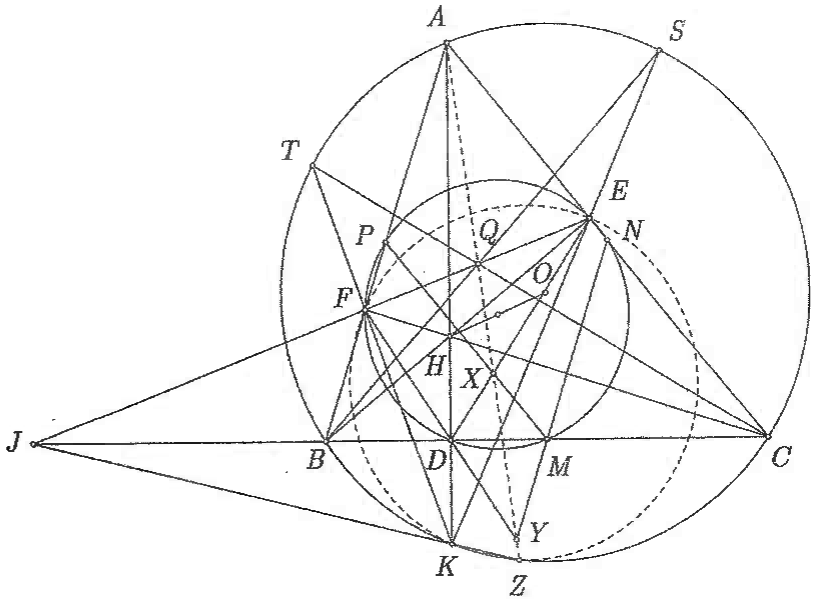
a) Line intersects the minor arc of at . Prove that , , and are concyclic.
b) Lines , meet at , . Prove that , and are concurrent.
Solution
a) First, applying Pascal's theorem for 6 points (, ), we get the intersections of pairs of lines (); (); () collinear or , and are collinear.
Clearly, so lies on . Next, we will prove that bisects .
Note that , are the midlines of the triangle so , . Therefore, by Thales's theorem, we have Let be the intersection of and . Applying Menelaus' theorem to triangle , we get or is the midpoint of . It follows that , are isogonal with respect to angle , so is the symmedian of triangle . Therefore, is a harmonic quadrilateral.
Let be the intersection of and , then so but we also have , which implies passes through .
Finally, we have so and are concyclic.
b) We have , because , are cyclic quadrilaterals. Therefore, (a.a). Hence, but we also have , then (s.a.s), which implies or , and are collinear. Similarly, , and are collinear. Therefore, , and are concurrent at .
Clearly, so lies on . Next, we will prove that bisects .
Note that , are the midlines of the triangle so , . Therefore, by Thales's theorem, we have Let be the intersection of and . Applying Menelaus' theorem to triangle , we get or is the midpoint of . It follows that , are isogonal with respect to angle , so is the symmedian of triangle . Therefore, is a harmonic quadrilateral.
Let be the intersection of and , then so but we also have , which implies passes through .
Finally, we have so and are concyclic.
b) We have , because , are cyclic quadrilaterals. Therefore, (a.a). Hence, but we also have , then (s.a.s), which implies or , and are collinear. Similarly, , and are collinear. Therefore, , and are concurrent at .
Techniques
Triangle centers: centroid, incenter, circumcenter, orthocenter, Euler line, nine-point circleCyclic quadrilateralsMenelaus' theoremBrocard point, symmediansPolar triangles, harmonic conjugatesAngle chasing