Browse · MathNet
PrintSaudi Arabia Mathematical Competitions
Saudi Arabia geometry
Problem
Prove that for each a parallelogram can be dissected in cyclic quadrilaterals.
Solution
Let be a parallelogram. If is a rectangle, then it is clear that we can dissect it into rectangles by parallel lines to its sides.
Assume that is not a rectangle. Without loss of generality we can assume that . Let and be the midpoints of and , respectively. There are two cases: and . Because the second case is analogous to the first one, we shall study only the situation .
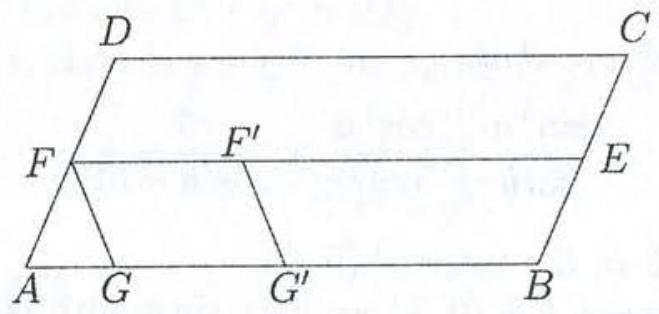
Construct the isosceles triangle , with and vertex on line . Because we have hence belongs to the interior of the segment . Let be any point in the interior of segment . Construct the parallelogram . Then and are isosceles trapezoids, hence they are cyclic quadrilaterals. Similarly, we divide into two isosceles trapezoids, hence is dissected into 4 isosceles trapezoids.
In order to pass from to cyclic quadrilaterals it is sufficient to notice that an isosceles trapezoid is divided into isosceles trapezoids by a parallel line to the basis.
Assume that is not a rectangle. Without loss of generality we can assume that . Let and be the midpoints of and , respectively. There are two cases: and . Because the second case is analogous to the first one, we shall study only the situation .
Construct the isosceles triangle , with and vertex on line . Because we have hence belongs to the interior of the segment . Let be any point in the interior of segment . Construct the parallelogram . Then and are isosceles trapezoids, hence they are cyclic quadrilaterals. Similarly, we divide into two isosceles trapezoids, hence is dissected into 4 isosceles trapezoids.
In order to pass from to cyclic quadrilaterals it is sufficient to notice that an isosceles trapezoid is divided into isosceles trapezoids by a parallel line to the basis.
Techniques
Cyclic quadrilateralsConstructions and lociTriangle trigonometry