Browse · MATH
Printjmc
geometry senior
Problem
In the diagram, four circles of radius 1 with centers , , , and are tangent to one another and to the sides of , as shown. 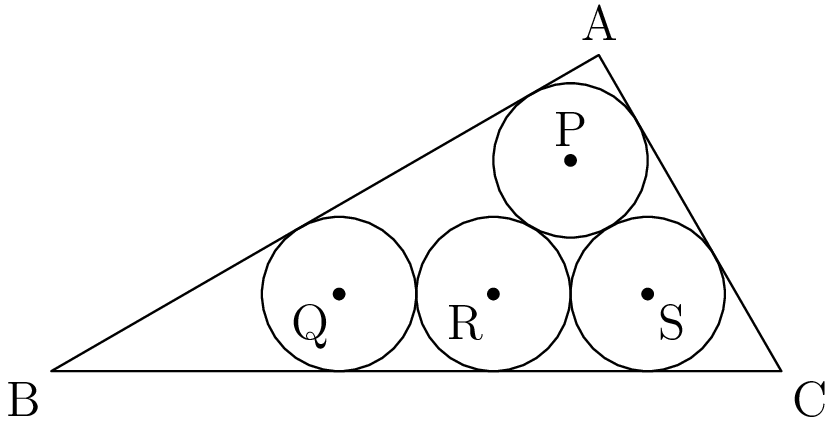
Find the perimeter of triangle .
Find the perimeter of triangle .
Solution
Join , , , , and . Since the circles with centers , and are all tangent to , then and are each parallel to (as the centers , and are each 1 unit above ). This tells us that passes through .
Similarly, since and are each one unit from , then is parallel to . Also, since and are each one unit from , then is parallel to . Therefore, the sides of are parallel to the corresponding sides of .
When the centers of tangent circles are joined, the line segments formed pass through the associated point of tangency, and so have lengths equal to the sum of the radii of those circles. Therefore, .
Since , we know is equilateral, so . Since and is a straight line, we have .
Since , we know is isosceles, so Since and , we have so is a -- triangle.
The angles of are equal to the corresponding angles of , so is a -- triangle. This means that if we can determine one of the side lengths of , we can then determine the lengths of the other two sides using the side ratios in a -- triangle.
Consider side . Since the circle with center is tangent to sides and , the line through and bisects . Thus, . Similarly, the line through and bisects . Thus, . We extract trapezoid from the diagram, obtaining
Drop perpendiculars from and to and , respectively, on side . Since is parallel to , and and are perpendicular to , we know that is a rectangle, so .
Since is right-angled at , has (the radius of the circle), and , we have . Since is right-angled at , has (the radius of the circle), and , we have (since is also a -- triangle). Thus, .
Since is a -- triangle, with and , we have , and Therefore, the side lengths of are , , and . Thus, the perimeter is
Similarly, since and are each one unit from , then is parallel to . Also, since and are each one unit from , then is parallel to . Therefore, the sides of are parallel to the corresponding sides of .
When the centers of tangent circles are joined, the line segments formed pass through the associated point of tangency, and so have lengths equal to the sum of the radii of those circles. Therefore, .
Since , we know is equilateral, so . Since and is a straight line, we have .
Since , we know is isosceles, so Since and , we have so is a -- triangle.
The angles of are equal to the corresponding angles of , so is a -- triangle. This means that if we can determine one of the side lengths of , we can then determine the lengths of the other two sides using the side ratios in a -- triangle.
Consider side . Since the circle with center is tangent to sides and , the line through and bisects . Thus, . Similarly, the line through and bisects . Thus, . We extract trapezoid from the diagram, obtaining
Drop perpendiculars from and to and , respectively, on side . Since is parallel to , and and are perpendicular to , we know that is a rectangle, so .
Since is right-angled at , has (the radius of the circle), and , we have . Since is right-angled at , has (the radius of the circle), and , we have (since is also a -- triangle). Thus, .
Since is a -- triangle, with and , we have , and Therefore, the side lengths of are , , and . Thus, the perimeter is
Final answer
12+6\sqrt{3}