Browse · MathNet
PrintNational Olympiad Final Round
Estonia geometry
Problem
Inside a circle of radius (or on the circumference), one marks points in such a way that the minimal distance between two marked points is as large as possible. Let be this distance between the two closest points. Is it true that for every natural number ?
Solution
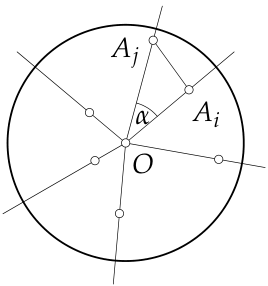
We show that . For the first inequality, assume arbitrary six points being marked in the circle. Let the centre of the circle be . If for some , the distance between and any other marked points is at most . Assume in the rest that for no . Let be the smallest angle that arises between some two rays and , where (Fig. 26). Fig. 26 is . If then is the largest side of the triangle , as the lengths of and do not exceed . The angle opposite to the longest side is the largest, whence should be larger than , contradiction. Thus there exist two marked points at distance at most from each other. As the choice of the points was arbitrary, this establishes .
On the other hand, when marking the vertices of a regular hexagon inscribed into the circle together with the centre of the circle, the distance between any two consecutive marked points on the circumference is equal to and their distance from the remaining point is also . Hence .
On the other hand, when marking the vertices of a regular hexagon inscribed into the circle together with the centre of the circle, the distance between any two consecutive marked points on the circumference is equal to and their distance from the remaining point is also . Hence .
Final answer
No
Techniques
CirclesAngle chasingTriangle inequalitiesOptimization in geometryPigeonhole principle