Browse · MathNet
PrintNational Olympiad Final Round
Estonia geometry
Problem
Prove that in every triangle there is a median whose length squared is at least times the area of the triangle.
Solution
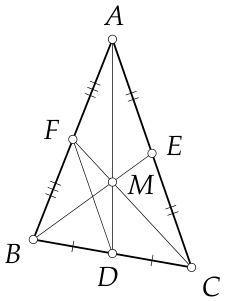
Assume w.l.o.g. that is the shortest side of the triangle. Then the least angle of the triangle is by vertex . Denote , , , and let be the length of the median drawn from vertex . By assumptions made at the beginning of the solution, . Let be the midpoints of sides , respectively (Fig. 21).
As because of , the law of cosines in triangle implies As , we obtain .
On the other hand, let be the area of the triangle . Then . Before we obtained the inequality . Consequently, .
Fig. 21
---
Alternative solution.
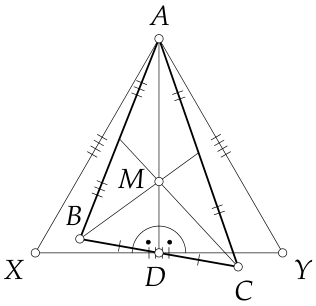
Let the median drawn from vertex of the triangle be and the centroid of the triangle be . W.l.o.g., let be the longest median of triangle ; denote . Draw to both sides of the median triangles and that have right angles by vertex and angles of size by vertex ; then is an equilateral triangle having median and centroid in common with triangle (Fig. 22). We show next that the area of triangle is at least as large as the area of triangle . Since a median divides the triangle into two parts of equal area, it suffices to show that the area of triangle is at least as large as the area of triangle .
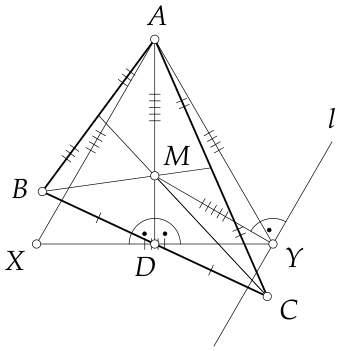
If point lies inside the triangle or on its side then this claim holds obviously. If point lies inside the triangle or on its side then this claim holds by symmetry. It remains to handle the case where both and lie outside the triangle (Fig. 23). Suppose w.l.o.g. that line segments and intersect (the other case where line segments and intersect is symmetric). Let be the line parallel to passing through . As line is symmetric w.r.t. point with line and , line segment intersects line . Therefore , which contradicts the assumption that is the longest median of the triangle . Hence this case cannot appear.
As , the area of the triangle is . By the argumentation above, the area of the triangle must be at most .
Fig. 22 Fig. 23
---
Alternative solution.
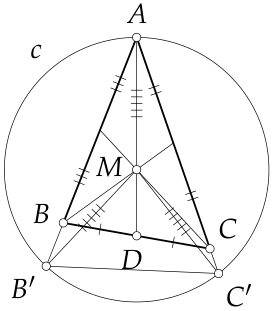
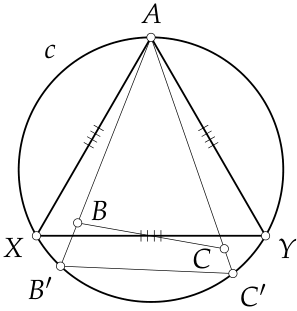
Let the median of the triangle drawn from point be and the centroid of the triangle be . W.l.o.g., let be the longest median of the triangle ; denote . Then is the vertex of the triangle with largest distance from point . Thus vertices and lie in circle with centre and radius . Let and be the second intersection points of rays and , respectively, with circle (Fig. 24); then the area of the triangle is at least as large as the area of triangle . Let and be points on circle such that triangle is equilateral (Fig. 25); then the area of is at least as large as the area of triangle and also at least as large as the area of triangle . The triangle can be divided into three equal triangles , and whose total area is , which equals . Hence the area of the triangle is at most .
Fig. 24 Fig. 25
---
Alternative solution.
Let be the centroid of the triangle and be the length of its longest median. The area of the triangle is where , and . As , and , we obtain . As and are less than , Jensen's inequality applies and gives Consequently, , directly implying the claim.
As because of , the law of cosines in triangle implies As , we obtain .
On the other hand, let be the area of the triangle . Then . Before we obtained the inequality . Consequently, .
Fig. 21
---
Alternative solution.
Let the median drawn from vertex of the triangle be and the centroid of the triangle be . W.l.o.g., let be the longest median of triangle ; denote . Draw to both sides of the median triangles and that have right angles by vertex and angles of size by vertex ; then is an equilateral triangle having median and centroid in common with triangle (Fig. 22). We show next that the area of triangle is at least as large as the area of triangle . Since a median divides the triangle into two parts of equal area, it suffices to show that the area of triangle is at least as large as the area of triangle .
If point lies inside the triangle or on its side then this claim holds obviously. If point lies inside the triangle or on its side then this claim holds by symmetry. It remains to handle the case where both and lie outside the triangle (Fig. 23). Suppose w.l.o.g. that line segments and intersect (the other case where line segments and intersect is symmetric). Let be the line parallel to passing through . As line is symmetric w.r.t. point with line and , line segment intersects line . Therefore , which contradicts the assumption that is the longest median of the triangle . Hence this case cannot appear.
As , the area of the triangle is . By the argumentation above, the area of the triangle must be at most .
Fig. 22 Fig. 23
---
Alternative solution.
Let the median of the triangle drawn from point be and the centroid of the triangle be . W.l.o.g., let be the longest median of the triangle ; denote . Then is the vertex of the triangle with largest distance from point . Thus vertices and lie in circle with centre and radius . Let and be the second intersection points of rays and , respectively, with circle (Fig. 24); then the area of the triangle is at least as large as the area of triangle . Let and be points on circle such that triangle is equilateral (Fig. 25); then the area of is at least as large as the area of triangle and also at least as large as the area of triangle . The triangle can be divided into three equal triangles , and whose total area is , which equals . Hence the area of the triangle is at most .
Fig. 24 Fig. 25
---
Alternative solution.
Let be the centroid of the triangle and be the length of its longest median. The area of the triangle is where , and . As , and , we obtain . As and are less than , Jensen's inequality applies and gives Consequently, , directly implying the claim.
Techniques
Triangle centers: centroid, incenter, circumcenter, orthocenter, Euler line, nine-point circleTriangle trigonometryTriangle inequalitiesJensen/smoothing