Browse · MathNet
Print72nd Czech and Slovak Mathematical Olympiad
Czech Republic geometry
Problem
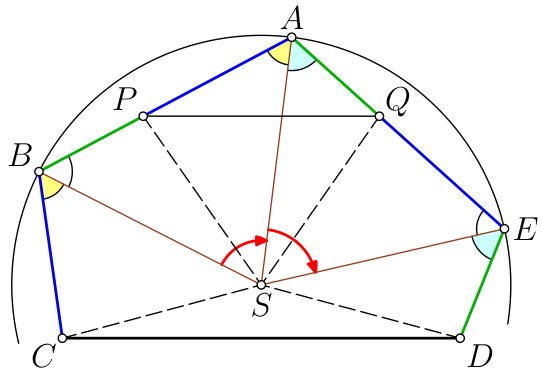
In the convex pentagon holds. On the sides and , there are points and , respectively, such that and . Prove that . (Patrik Bak)
Solution
Since , and , the triangles , and are congruent by the condition SAS.
Hence and also This means that by the condition SAS, the isosceles equilateral triangles and are also congruent. It follows that their altitudes from and to the common opposite side have the same lengths, and hence .
Solution 2:
Let denote the circumcenter of . Obviously, . Therefore, in the rotation with center by the oriented angle , and therefore . Another consequence of is the congruence of the four angles , , and . It follows that the angle bisectors of congruent angles , and are respectively the rays , and . In our rotation is thus the image of the oriented angle the oriented angle , so with respect to , holds. The same is true from the oriented angles and , the equality then leads to . Together we have , which implies
that the line segments CD and PQ have a common perpendicular bisector—the bisector of CD bisects the angle CSD, and therefore bisects the angle PSQ, and therefore is also the perpendicular bisector of PQ. Because of the common bisector, the lines CD and PQ are parallel.
Hence and also This means that by the condition SAS, the isosceles equilateral triangles and are also congruent. It follows that their altitudes from and to the common opposite side have the same lengths, and hence .
Solution 2:
Let denote the circumcenter of . Obviously, . Therefore, in the rotation with center by the oriented angle , and therefore . Another consequence of is the congruence of the four angles , , and . It follows that the angle bisectors of congruent angles , and are respectively the rays , and . In our rotation is thus the image of the oriented angle the oriented angle , so with respect to , holds. The same is true from the oriented angles and , the equality then leads to . Together we have , which implies
that the line segments CD and PQ have a common perpendicular bisector—the bisector of CD bisects the angle CSD, and therefore bisects the angle PSQ, and therefore is also the perpendicular bisector of PQ. Because of the common bisector, the lines CD and PQ are parallel.
Techniques
RotationAngle chasing