Browse · MathNet
Print72nd Czech and Slovak Mathematical Olympiad
Czech Republic geometry
Problem
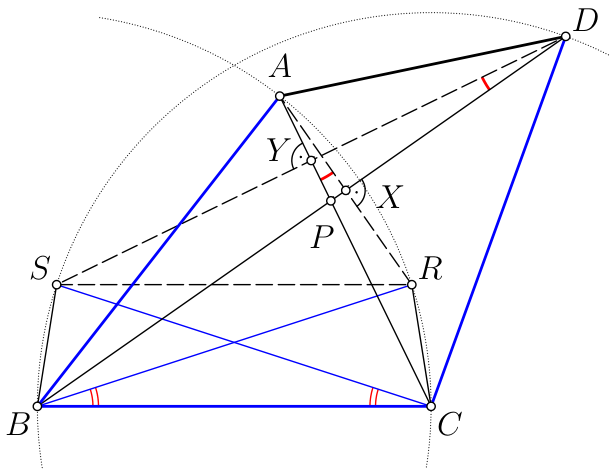
In a convex quadrilateral , . Let furthermore, for the intersection of its diagonals, . Let and be reflections of and with respect to and , respectively. Prove that the lines and are parallel.
Solution
By construction, the points are obviously different and the midpoint of the segment lies on its perpendicular bisector and the midpoint of the segment lies on its perpendicular bisector . In the following paragraph we prove that lies inside the angle and inside the angle , as in our figure. Together, this means that points lie inside the same half-plane with the boundary line .
The assumption implies , which for the interior point of the base of the isosceles triangle means that ; hence , hence the point is actually inside the angle . Analogously from the inequality for the interior point of the base of isosceles triangle , we conclude that the point actually lies inside the angle .
A further consequence of the inequality is that for the marked interior angles of the right triangles and , , i.e. .
Let us return to the equalities (1). According to these, the point is the circumcenter of the triangle , which evidently lies in the angle . Therefore, according to the inscribed angle theorem . By a similar reasoning about the circumcenter of the triangle in the angle we obtain . From the last two paragraphs we get the equality . This, together with (1), leads to the conclusion that (isosceles) triangles and are congruent by the SAS theorem. Hence, their altitudes from the vertices of and to the side have the same length. This already implies that .
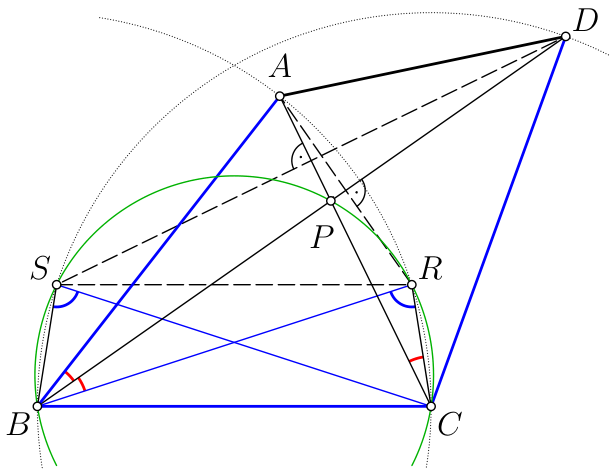
As in the first solution, we derive (1) and observe that lies inside the angle . From the condition it also follows that lies in the half plane . According to (1), is the circumcenter of , whose central angle with the bisector is therefore twice the angle . Therefore the three angles , and marked in the figure are congruent. Congruence of the last two angles with respect to the previous paragraph already means that the point does indeed lie on the circumcircle of . For the point the same is true due to the analogous congruence of the angles , and .
It follows from the proof that the points , , , lie on one circle, while the points and lie in the same half-plane with the boundary line . Hence the congruence of the angles and , which, together with the equality , means that the isosceles triangles and are congruent. The congruence of their altitudes proves the relation .
---
Alternative solution.
We show that the points and lie on the circumcircle of . We write the detailed proof only for the point , for the point the proof is analogous.
As in the first solution, we derive (1) and observe that lies inside the angle . From the condition it also follows that lies in the half plane . According to (1), is the circumcenter of , whose central angle with the bisector is therefore twice the angle . Therefore the three angles , and marked in the figure are congruent. Congruence of the last two angles with respect to the previous paragraph already means that the point does indeed lie on the circumcircle of . For the point the same is true due to the analogous congruence of the angles , and .
* Instead of consideration of the congruent triangles and , it suffices to state, that the congruent segments and are symmetrically clustered along the axis of the line segment .
The assumption implies , which for the interior point of the base of the isosceles triangle means that ; hence , hence the point is actually inside the angle . Analogously from the inequality for the interior point of the base of isosceles triangle , we conclude that the point actually lies inside the angle .
A further consequence of the inequality is that for the marked interior angles of the right triangles and , , i.e. .
Let us return to the equalities (1). According to these, the point is the circumcenter of the triangle , which evidently lies in the angle . Therefore, according to the inscribed angle theorem . By a similar reasoning about the circumcenter of the triangle in the angle we obtain . From the last two paragraphs we get the equality . This, together with (1), leads to the conclusion that (isosceles) triangles and are congruent by the SAS theorem. Hence, their altitudes from the vertices of and to the side have the same length. This already implies that .
As in the first solution, we derive (1) and observe that lies inside the angle . From the condition it also follows that lies in the half plane . According to (1), is the circumcenter of , whose central angle with the bisector is therefore twice the angle . Therefore the three angles , and marked in the figure are congruent. Congruence of the last two angles with respect to the previous paragraph already means that the point does indeed lie on the circumcircle of . For the point the same is true due to the analogous congruence of the angles , and .
It follows from the proof that the points , , , lie on one circle, while the points and lie in the same half-plane with the boundary line . Hence the congruence of the angles and , which, together with the equality , means that the isosceles triangles and are congruent. The congruence of their altitudes proves the relation .
---
Alternative solution.
We show that the points and lie on the circumcircle of . We write the detailed proof only for the point , for the point the proof is analogous.
As in the first solution, we derive (1) and observe that lies inside the angle . From the condition it also follows that lies in the half plane . According to (1), is the circumcenter of , whose central angle with the bisector is therefore twice the angle . Therefore the three angles , and marked in the figure are congruent. Congruence of the last two angles with respect to the previous paragraph already means that the point does indeed lie on the circumcircle of . For the point the same is true due to the analogous congruence of the angles , and .
* Instead of consideration of the congruent triangles and , it suffices to state, that the congruent segments and are symmetrically clustered along the axis of the line segment .
Techniques
Cyclic quadrilateralsTriangle centers: centroid, incenter, circumcenter, orthocenter, Euler line, nine-point circleAngle chasingDistance chasing