Browse · MathNet
PrintIRL_ABooklet_2023
Ireland 2023 geometry
Problem
Let be a pentagon with , and . Determine whether is smaller, equal or larger than 1.
Solution
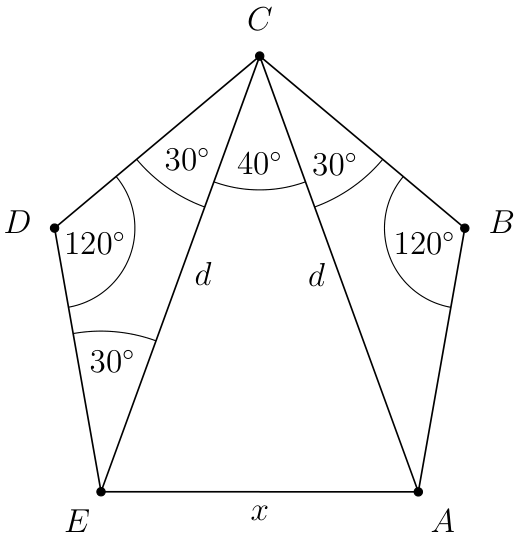
We connect to and . Because triangles and are isosceles with an angle of , we have .
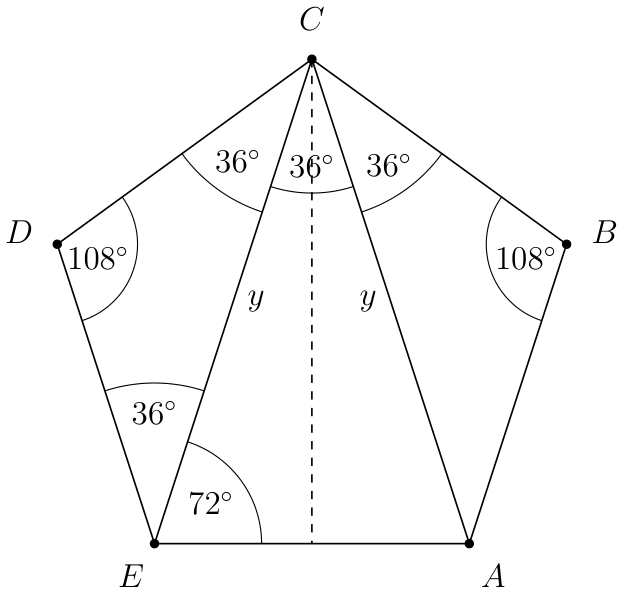
Hence, . Let and . The Cosine rule for gives . The Cosine Rule for then says , and so iff . To show this, we consider a regular pentagon with side length 1 and draw two diagonals that start at the same vertex. Because the internal angles of a regular pentagon have measure , the angles are as indicated in the diagram below. Our aim is to prove .
Letting and considering the perpendicular bisector of in triangle , we obtain . The Cosine Rule for triangle gives , hence . On the other hand, the Cosine Rule for triangle tells us . Using , this implies . Because is opposite the largest angle in triangle , it must be its largest side, i.e. . Therefore, . This then implies Finally, we obtain which shows that in the originally given pentagon.
Remark. From triangle we obtain (Cosine Rule) and so . Using our previous value, we get , hence, after multiplying by , . Comparing this with an earlier calculation gives , i.e. . The positive root of this quadratic is , the golden ratio. This gives us the precise value which can easily be shown to be smaller than .
Hence, . Let and . The Cosine rule for gives . The Cosine Rule for then says , and so iff . To show this, we consider a regular pentagon with side length 1 and draw two diagonals that start at the same vertex. Because the internal angles of a regular pentagon have measure , the angles are as indicated in the diagram below. Our aim is to prove .
Letting and considering the perpendicular bisector of in triangle , we obtain . The Cosine Rule for triangle gives , hence . On the other hand, the Cosine Rule for triangle tells us . Using , this implies . Because is opposite the largest angle in triangle , it must be its largest side, i.e. . Therefore, . This then implies Finally, we obtain which shows that in the originally given pentagon.
Remark. From triangle we obtain (Cosine Rule) and so . Using our previous value, we get , hence, after multiplying by , . Comparing this with an earlier calculation gives , i.e. . The positive root of this quadratic is , the golden ratio. This gives us the precise value which can easily be shown to be smaller than .
Final answer
larger than 1
Techniques
Triangle trigonometryAngle chasingTrigonometry