Browse · MathNet
PrintIRL_ABooklet_2023
Ireland 2023 geometry
Problem
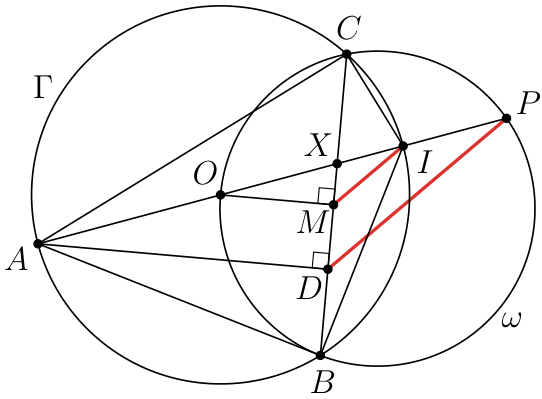
The triangle has circumcentre and circumcircle . Let be a diameter of . The ray extends to intersect the circumcircle of for the second time at a point . Let and be perpendicular to , with and on . Let be the midpoint of .
1. Prove that .
2. Prove that is parallel to .
1. Prove that .
2. Prove that is parallel to .
Solution
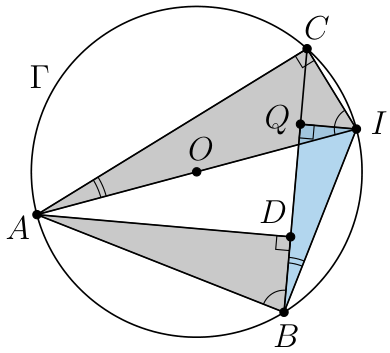
a. We denote the angles of by , , . Since is a diameter, we have . Also, (both standing on arc ), and (both standing on arc ). Therefore,
. Similarly, and which gives .
b. Solution 1: Let denote the intersection point of and . Then, by power of with respect to the circumcircle of (or ) we have . By power of with respect to the circumcircle of , we have . Combining both equations, we obtain
By the Intercept Theorem, or , we have This implies similarity of triangles and , hence .
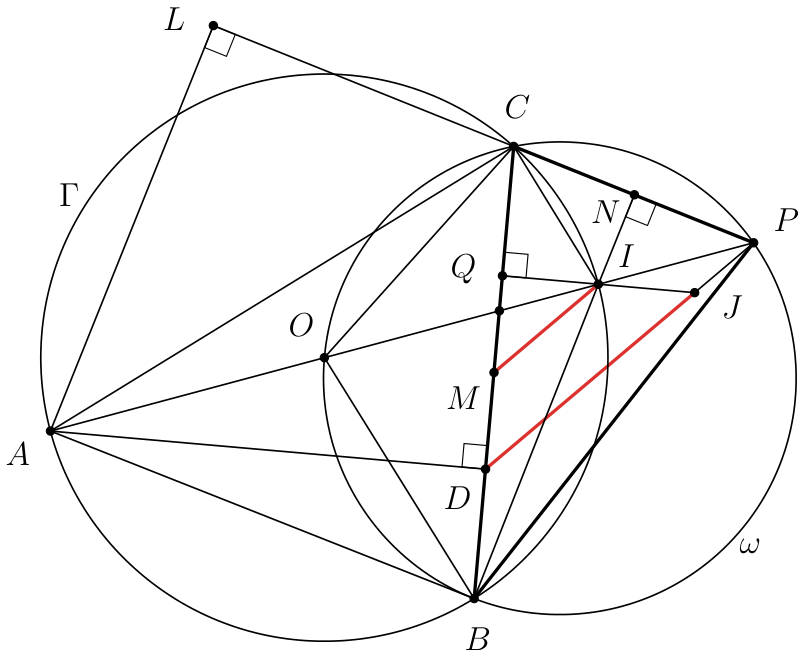
Solution 2: Substituting and in the equation from part (a) yields . Since is the midpoint of , it is then also the midpoint of . We define on the extended line such that is the midpoint of segment . Then (mid-line in ). It remains to prove that is on the line .
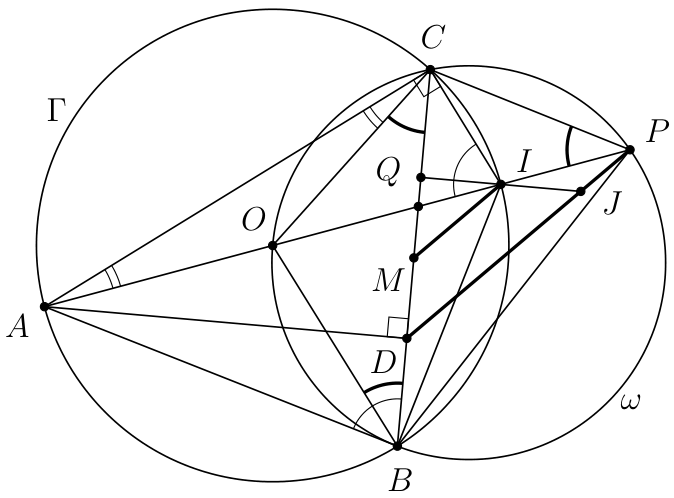
We first prove that is the incentre of . Indeed, we have and in and in so and hence and are angle bisectors and is the incentre of . Because is a diameter of , and . Therefore, and are external angle bisectors of and so is an excentre.
Consider the inradius and exradius given by and , both perpendicular to . Then triangles and are similar, which implies Because is parallel to , we have . Hence, triangles and are similar and , , are collinear.
Solution 3: From (a) we get , see Solution 2. This implies and that is the midpoint of . We extend the line to intersect at . To prove , it is sufficient to show . This is equivalent to , because follows from .
Using (a), we obtain
On the other hand, and , while and so . Hence Therefore,
. Similarly, and which gives .
b. Solution 1: Let denote the intersection point of and . Then, by power of with respect to the circumcircle of (or ) we have . By power of with respect to the circumcircle of , we have . Combining both equations, we obtain
By the Intercept Theorem, or , we have This implies similarity of triangles and , hence .
Solution 2: Substituting and in the equation from part (a) yields . Since is the midpoint of , it is then also the midpoint of . We define on the extended line such that is the midpoint of segment . Then (mid-line in ). It remains to prove that is on the line .
We first prove that is the incentre of . Indeed, we have and in and in so and hence and are angle bisectors and is the incentre of . Because is a diameter of , and . Therefore, and are external angle bisectors of and so is an excentre.
Consider the inradius and exradius given by and , both perpendicular to . Then triangles and are similar, which implies Because is parallel to , we have . Hence, triangles and are similar and , , are collinear.
Solution 3: From (a) we get , see Solution 2. This implies and that is the midpoint of . We extend the line to intersect at . To prove , it is sufficient to show . This is equivalent to , because follows from .
Using (a), we obtain
On the other hand, and , while and so . Hence Therefore,
Techniques
Triangle centers: centroid, incenter, circumcenter, orthocenter, Euler line, nine-point circleRadical axis theoremTriangle trigonometryAngle chasing