Browse · MathNet
PrintAPMO
geometry
Problem
Let be an acute triangle. Let be a point on side and be a point on side such that lines and are parallel. Let be an interior point of . Suppose rays and meet side at points and , respectively, such that both and lie between and . Suppose that the circumcircles of triangles and intersect at a point . Prove that points , , and are collinear.
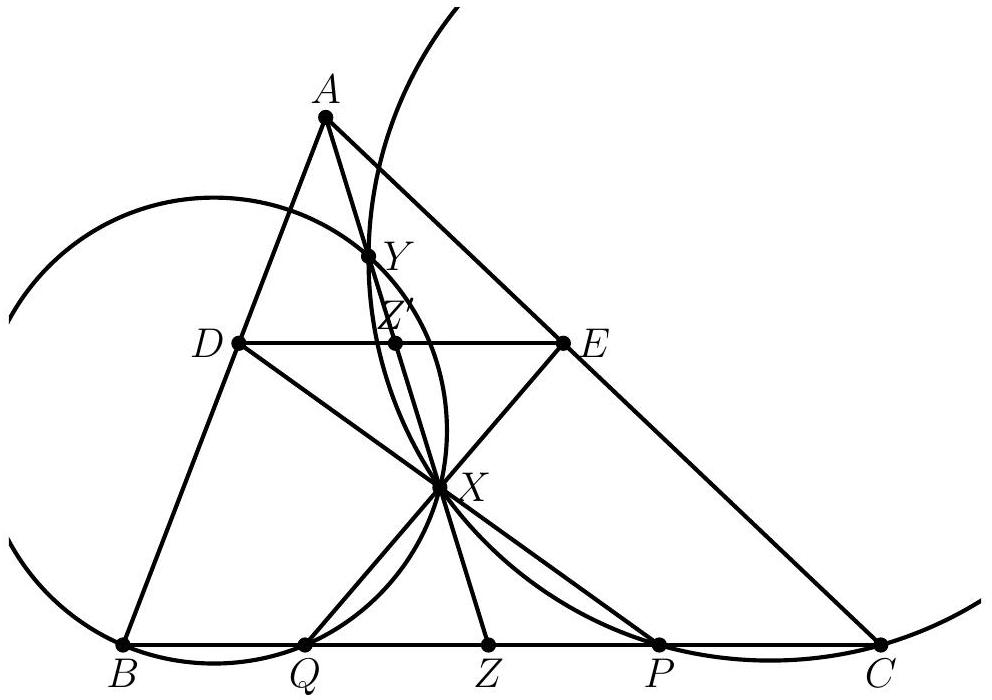
Solution
Let be the radical axis of circles and . Since and are on , it is sufficient to show that is on . Let line intersect segments and at and , respectively. Then it is sufficient to show that is on . By , we obtain thus , which implies that is on .
---
Alternative solution.
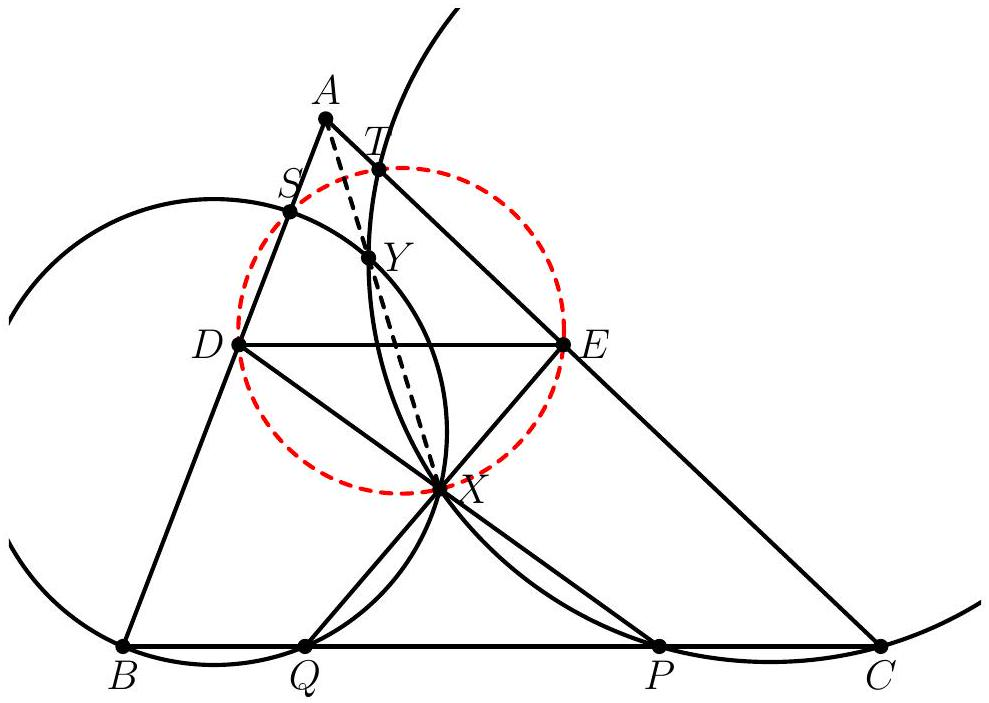
Let circle intersect line at a point which is different from . Then , thus is on circle . Similarly, let circle intersect line at a point which is different from . Then is on circle . The power of with respect to the circle is . Since , . Then is in the radical axis of circles and , which implies that three points , and are collinear.
---
Alternative solution.
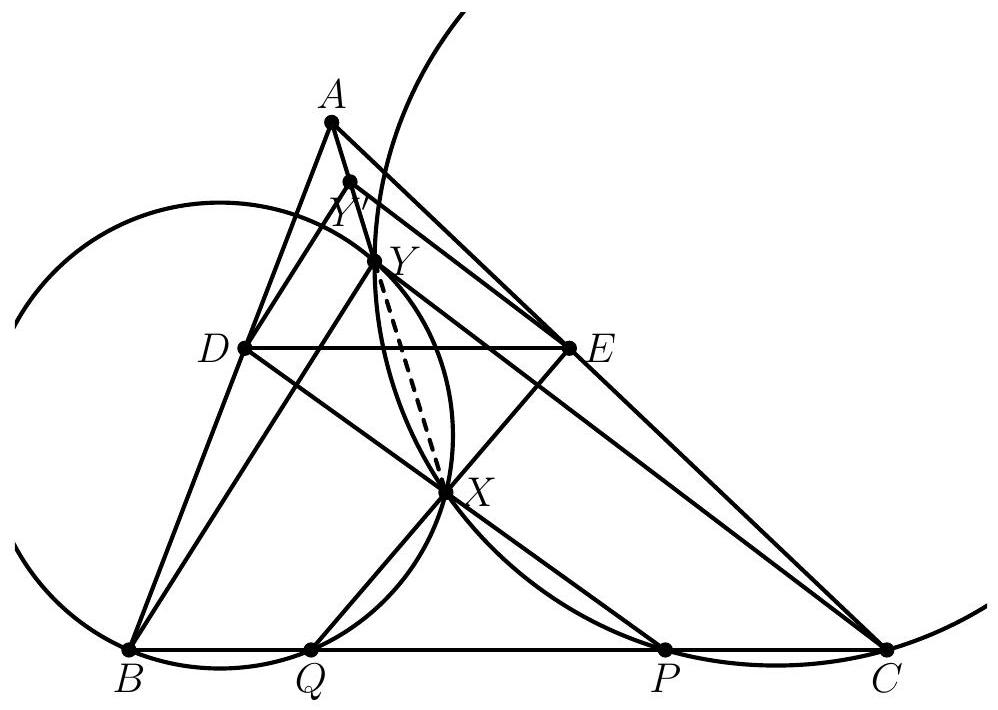
Consider the (direct) homothety that takes triangle to triangle , and let be the image of under this homothety; in other words, let be the intersection of the line parallel to through and the line parallel to through . The homothety implies that , , and are collinear, and that . Since and are cyclic, which implies that is cyclic. Therefore which, combined with , implies . This proves that , , and are collinear, which in turn shows that , , and are collinear.
---
Alternative solution.
Let circle intersect line at a point which is different from . Then , thus is on circle . Similarly, let circle intersect line at a point which is different from . Then is on circle . The power of with respect to the circle is . Since , . Then is in the radical axis of circles and , which implies that three points , and are collinear.
---
Alternative solution.
Consider the (direct) homothety that takes triangle to triangle , and let be the image of under this homothety; in other words, let be the intersection of the line parallel to through and the line parallel to through . The homothety implies that , , and are collinear, and that . Since and are cyclic, which implies that is cyclic. Therefore which, combined with , implies . This proves that , , and are collinear, which in turn shows that , , and are collinear.
Techniques
Radical axis theoremHomothetyCyclic quadrilateralsAngle chasing