Browse · MathNet
PrintAPMO
geometry
Problem
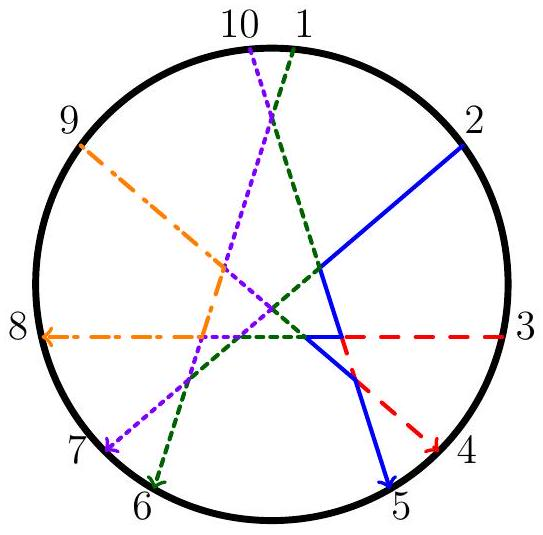
There are line segments on the plane, no three intersecting at a point, and each pair intersecting once in their respective interiors. Tony and his friends each stand at a distinct endpoint of a line segment. Tony wishes to send Christmas presents to each of his friends as follows: First, he chooses an endpoint of each segment as a "sink". Then he places the present at the endpoint of the segment he is at. The present moves as follows: - If it is on a line segment, it moves towards the sink. - When it reaches an intersection of two segments, it changes the line segment it travels on and starts moving towards the new sink. If the present reaches an endpoint, the friend on that endpoint can receive their present. Prove Tony can send presents to exactly of his friends.
Solution
Draw a circle that encloses all the intersection points between line segments and extend all line segments until they meet the circle, and then move Tony and all his friends to the circle. Number the intersection points with the circle from 1 to anticlockwise, starting from Tony (Tony has number 1). We will prove that the friends eligible to receive presents are the ones on even-numbered intersection points.
First part: at most friends can receive a present.
The solution relies on a well-known result: the lines determine regions inside the circle; then it is possible to paint the regions with two colors such that no regions with a common (line) boundary have the same color. The proof is an induction on : the fact immediately holds for , and the induction step consists on taking away one line , painting the regions obtained with lines, drawing again and flipping all colors on exactly one half plane determined by .
Now consider the line starting on point 1. Color the regions in red and blue such that neighboring regions have different colors, and such that the two regions that have point 1 as a vertex are red on the right and blue on the left, from Tony's point of view. Finally, assign to each red region the clockwise direction and to each blue region the anticlockwise direction. Because of the coloring, every boundary will have two directions assigned, but the directions are the same since every boundary divides regions of different colors. Then the present will follow the directions assigned to the regions: it certainly does for both regions in the beginning, and when the present reaches an intersection it will keep bordering one of the two regions it was dividing. To finish this part of the problem, consider the regions that share a boundary with the circle. The directions alternate between outcoming and incoming, starting from 1 (outcoming), so all even-numbered vertices are directed as incoming and are the only ones able to receive presents.
Second part: all even-numbered vertices can receive a present.
First notice that, since every two chords intersect, every chord separates the endpoints of each of the other chords. Therefore, there are vertices on each side of every chord, and each chord connects vertices and .
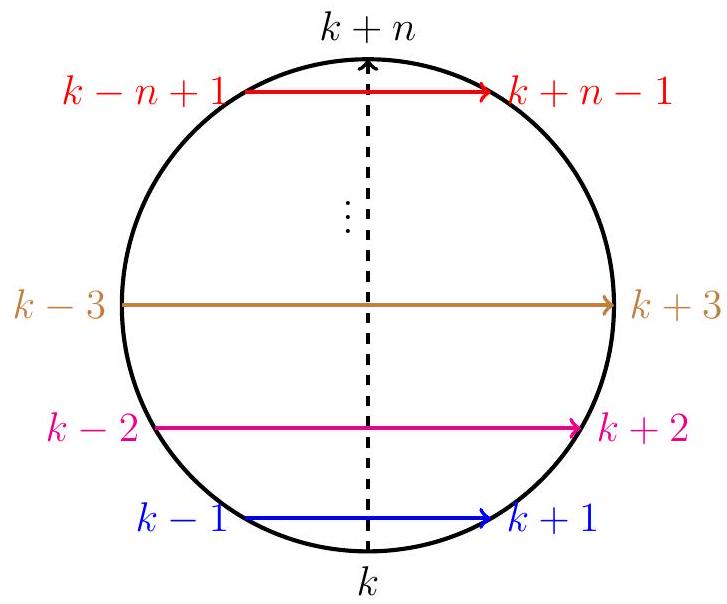
We prove a stronger result by induction in : let be an integer, . Direct each chord from to if and from to otherwise; in other words, the sinks are . Now suppose that each chord sends a present, starting from the vertex opposite to each sink, and all presents move with the same rules. Then sends a present to (indices taken modulo ). In particular, for , Tony, in vertex 1, send a present to vertex . Also, the paths the presents make do not cross (but they may touch.) More formally, for all , if one path takes a present from to , separating the circle into two regions, all paths taking a present from to , are completely contained in one region, and all paths taking a present from to , are completely contained in the other region. For instance, possible paths for and follow:
The result is true for . Let and assume the result is true for less chords. Consider the chord that takes to and remove it. Apply the induction hypothesis to the remaining lines: after relabeling, presents would go from to if the chord were not there.
Reintroduce the chord that takes to . From the induction hypothesis, the chord intersects the paths of the presents in the following order: the -th path the chord intersects is the the one that takes to .
Paths without chord
Corrected paths with chord
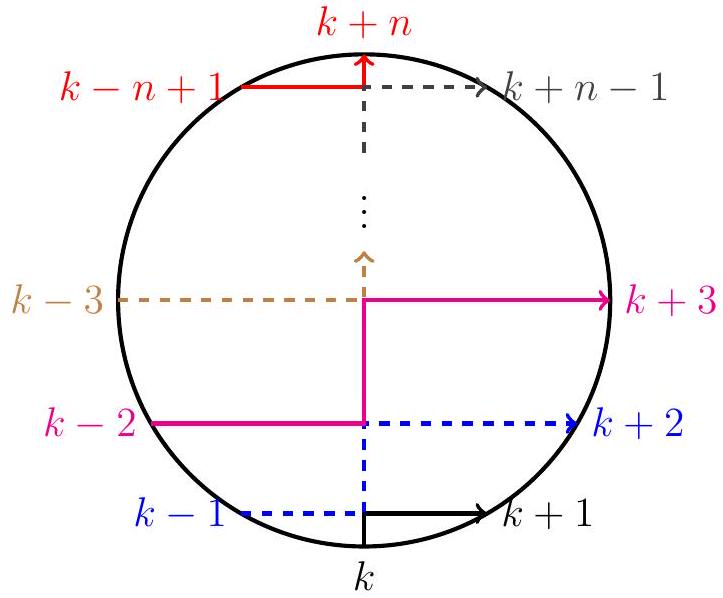
Then the presents cover the following new paths: the present from will leave its chord and take the path towards ; then, for , the present from will meet the chord from to , move towards the intersection with the path towards and go to , as desired. Notice that the paths still do not cross. The induction (and the solution) is now complete.
---
Alternative solution.
First part: at most friends can receive a present.
Similarly to the first solution, consider a circle that encompasses all line segments, extend the lines, and use the endpoints of the chords instead of the line segments, and prove that each chord connects vertices and . We also consider, even in the first part, presents leaving from outcoming vertices.
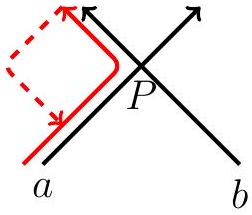
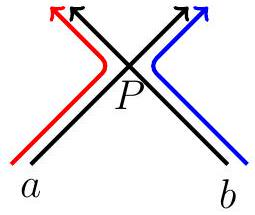
First we prove that a present always goes to a sink. If it does not, then it loops; let it first enter the loop at point after turning from chord to chord . Therefore after it loops once, it must turn to chord at . But is the intersection of and , so the present should turn from chord to chord , which can only be done in one way - the same way it came in first. This means that some part of chord before the present enters the loop at is part of the loop, which contradicts the fact that is the first point in the loop. So no present enters a loop, and every present goes to a sink.
There are no loops
No two paths cross
The present paths also do not cross: in fact, every time two paths share a point , intersection of chords and , one path comes from to and the other path comes from to , and they touch at . This implies the following sequence of facts: - Every path divides the circle into two regions with paths connecting vertices within each region. - All presents will be delivered to different persons; that is, all sinks receive a present. This implies that every vertex is an endpoint of a path. - The number of chord endpoints inside each region is even, because they are connected within their own region.
Now consider the path starting at vertex 1, with Tony. It divides the circle into two regions with an even number of vertices in their interior. Then there is an even number of vertices between Tony and the recipient of his present, that is, their vertex is an even numbered one.
Second part: all even-numbered vertices can receive a present.
The construction is the same as the in the previous solution: direct each chord from to if and from to otherwise; in other words, the sinks are . Then, since the paths do not cross, will send a present to will send a present to , and so on, until 1 sends a present to .
First part: at most friends can receive a present.
The solution relies on a well-known result: the lines determine regions inside the circle; then it is possible to paint the regions with two colors such that no regions with a common (line) boundary have the same color. The proof is an induction on : the fact immediately holds for , and the induction step consists on taking away one line , painting the regions obtained with lines, drawing again and flipping all colors on exactly one half plane determined by .
Now consider the line starting on point 1. Color the regions in red and blue such that neighboring regions have different colors, and such that the two regions that have point 1 as a vertex are red on the right and blue on the left, from Tony's point of view. Finally, assign to each red region the clockwise direction and to each blue region the anticlockwise direction. Because of the coloring, every boundary will have two directions assigned, but the directions are the same since every boundary divides regions of different colors. Then the present will follow the directions assigned to the regions: it certainly does for both regions in the beginning, and when the present reaches an intersection it will keep bordering one of the two regions it was dividing. To finish this part of the problem, consider the regions that share a boundary with the circle. The directions alternate between outcoming and incoming, starting from 1 (outcoming), so all even-numbered vertices are directed as incoming and are the only ones able to receive presents.
Second part: all even-numbered vertices can receive a present.
First notice that, since every two chords intersect, every chord separates the endpoints of each of the other chords. Therefore, there are vertices on each side of every chord, and each chord connects vertices and .
We prove a stronger result by induction in : let be an integer, . Direct each chord from to if and from to otherwise; in other words, the sinks are . Now suppose that each chord sends a present, starting from the vertex opposite to each sink, and all presents move with the same rules. Then sends a present to (indices taken modulo ). In particular, for , Tony, in vertex 1, send a present to vertex . Also, the paths the presents make do not cross (but they may touch.) More formally, for all , if one path takes a present from to , separating the circle into two regions, all paths taking a present from to , are completely contained in one region, and all paths taking a present from to , are completely contained in the other region. For instance, possible paths for and follow:
The result is true for . Let and assume the result is true for less chords. Consider the chord that takes to and remove it. Apply the induction hypothesis to the remaining lines: after relabeling, presents would go from to if the chord were not there.
Reintroduce the chord that takes to . From the induction hypothesis, the chord intersects the paths of the presents in the following order: the -th path the chord intersects is the the one that takes to .
Paths without chord
Corrected paths with chord
Then the presents cover the following new paths: the present from will leave its chord and take the path towards ; then, for , the present from will meet the chord from to , move towards the intersection with the path towards and go to , as desired. Notice that the paths still do not cross. The induction (and the solution) is now complete.
---
Alternative solution.
First part: at most friends can receive a present.
Similarly to the first solution, consider a circle that encompasses all line segments, extend the lines, and use the endpoints of the chords instead of the line segments, and prove that each chord connects vertices and . We also consider, even in the first part, presents leaving from outcoming vertices.
First we prove that a present always goes to a sink. If it does not, then it loops; let it first enter the loop at point after turning from chord to chord . Therefore after it loops once, it must turn to chord at . But is the intersection of and , so the present should turn from chord to chord , which can only be done in one way - the same way it came in first. This means that some part of chord before the present enters the loop at is part of the loop, which contradicts the fact that is the first point in the loop. So no present enters a loop, and every present goes to a sink.
There are no loops
No two paths cross
The present paths also do not cross: in fact, every time two paths share a point , intersection of chords and , one path comes from to and the other path comes from to , and they touch at . This implies the following sequence of facts: - Every path divides the circle into two regions with paths connecting vertices within each region. - All presents will be delivered to different persons; that is, all sinks receive a present. This implies that every vertex is an endpoint of a path. - The number of chord endpoints inside each region is even, because they are connected within their own region.
Now consider the path starting at vertex 1, with Tony. It divides the circle into two regions with an even number of vertices in their interior. Then there is an even number of vertices between Tony and the recipient of his present, that is, their vertex is an even numbered one.
Second part: all even-numbered vertices can receive a present.
The construction is the same as the in the previous solution: direct each chord from to if and from to otherwise; in other words, the sinks are . Then, since the paths do not cross, will send a present to will send a present to , and so on, until 1 sends a present to .
Techniques
Constructions and lociColoring schemes, extremal argumentsInvariants / monovariants