Browse · MathNet
PrintIranian Mathematical Olympiad
Iran geometry
Problem
Suppose that is a convex pentagon in the cartesian plane with all its vertices having rational coordinates. For each , define as the intersection point of the extensions of the sides and (the vertices of the pentagon are numbered in a cyclic manner, i.e for each , ). Prove that at most three of the lines , , are concurrent.
Solution
First, note that if and are two points with rational coordinates, then the equation of the line passing through them in the cartesian coordinates is Therefore, the equation of this line can be written using only rational numbers. We will call such lines a rational line. It is easy to see that the intersection point of two rational lines has rational coordinates. Furthermore, the ratio of the lengths of two line segments with rational end points is a rational number. Consequently, every four collinear points with rational coordinates have a rational cross ratio.
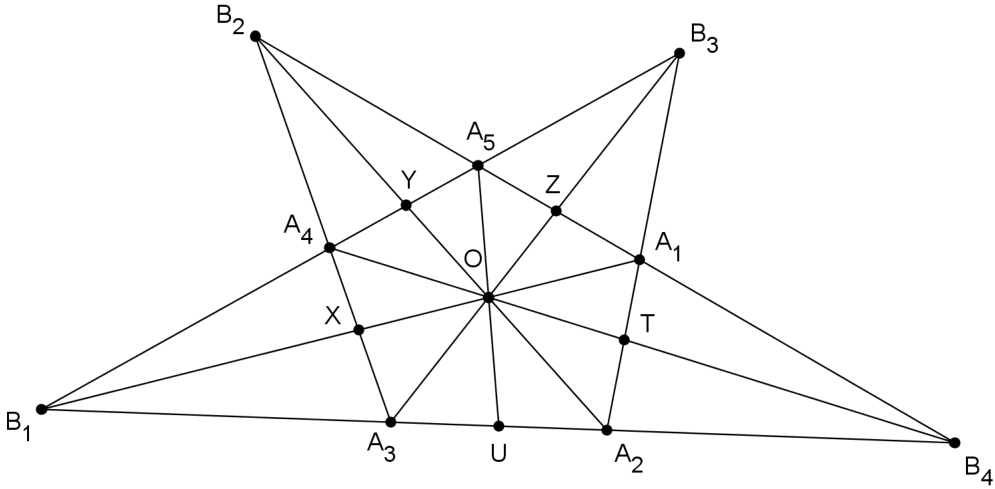
Assume to the contrary that is a rational pentagon that at least four lines from the lines are concurrent. Without loss of generality, we can assume these four lines are for . We will use the notation given in the following figure.
Let . According to the figure we have Using the properties of cross ratio we get Hence is a root of the equation that has no rational root. We assumed that points , , have rational coordinates. Therefore, all the lines and points in the figure are rational. Furthermore, every four collinear points with rational coordinates have a rational cross ratio. Consequently, must be rational which is a contradiction since . Therefore, at most three of the lines are concurrent.
Assume to the contrary that is a rational pentagon that at least four lines from the lines are concurrent. Without loss of generality, we can assume these four lines are for . We will use the notation given in the following figure.
Let . According to the figure we have Using the properties of cross ratio we get Hence is a root of the equation that has no rational root. We assumed that points , , have rational coordinates. Therefore, all the lines and points in the figure are rational. Furthermore, every four collinear points with rational coordinates have a rational cross ratio. Consequently, must be rational which is a contradiction since . Therefore, at most three of the lines are concurrent.
Techniques
Cartesian coordinatesPolar triangles, harmonic conjugates