Browse · MathNet
PrintXXVII Olimpiada Matemática Rioplatense
Argentina counting and probability
Problem
All numbers from to are written in a board, one in each cell. We calculate all the differences between two numbers that occupy adjacent cells and call value of the board the greatest of these differences.
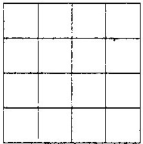
Which is the smallest value that a board can have? Show a board having that value and explain why no board can have a smaller value.
Remark: Two cells are adjacent if they share a side. Remark: The difference between two numbers is the subtraction of the smaller from the larger of them.
Which is the smallest value that a board can have? Show a board having that value and explain why no board can have a smaller value.
Remark: Two cells are adjacent if they share a side. Remark: The difference between two numbers is the subtraction of the smaller from the larger of them.
Solution
The smallest value that a board can have is , and an example of a board having this value is the following:
Let us now show that the value of any board is at least . Assume there is a board where the value is at most . Then, all the numbers from to are not neighbors of and so, can only have , and in adjacent cells. It follows that cannot be in the interior cells of the board (since these cells have adjacent cells each). Therefore, is written in a cell on the border of the board. Let us consider two cases:
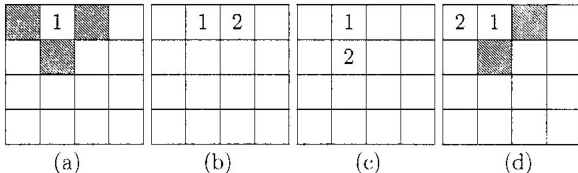
Case 1: is written in a cell on the border but not in a corner. In this case, we may assume that is written in the cell in row , column (since the remaining cases are equivalent by rotations and reflections). As this cell has exactly adjacent cells (shaded in Figure (a)), the numbers , and must be written in them. If is written as in Figures (b) or (c), we have a contradiction, since and combined can only have , and as neighbors, but there are more than adjacent cells. Finally, if is written as in Figure (d), as , , and combined can only have , and as neighbors, and should be written on the two shaded cells, both neighbors of ; we reach a contradiction.
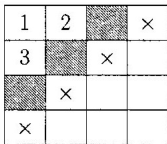
Case 2: is written in a cell of a corner. In this case, we may assume is written in row , column (the remaining cases are equivalent by rotation). If is not a neighbor of , then and combined have at least neighbors, which leads to a contradiction, since the only possible neighbors of and are , and . Therefore, we may assume is written in row , column (the case where is written in row , column is equivalent by reflection). Since , and combined can only have neighbors (, , ), then must be written in row , column , and , and must be written in the cells shaded in the figure below. Thus, some number will be written in one of the cells with a , and therefore, it will be in a cell adjacent to a number (written in a shaded cell). This implies that the value of the board is at least , a contradiction.
| 1 | 2 | 3 | 4 |
|---|---|---|---|
| 5 | 6 | 7 | 8 |
| 9 | 10 | 11 | 12 |
| 13 | 14 | 15 | 16 |
Case 1: is written in a cell on the border but not in a corner. In this case, we may assume that is written in the cell in row , column (since the remaining cases are equivalent by rotations and reflections). As this cell has exactly adjacent cells (shaded in Figure (a)), the numbers , and must be written in them. If is written as in Figures (b) or (c), we have a contradiction, since and combined can only have , and as neighbors, but there are more than adjacent cells. Finally, if is written as in Figure (d), as , , and combined can only have , and as neighbors, and should be written on the two shaded cells, both neighbors of ; we reach a contradiction.
Case 2: is written in a cell of a corner. In this case, we may assume is written in row , column (the remaining cases are equivalent by rotation). If is not a neighbor of , then and combined have at least neighbors, which leads to a contradiction, since the only possible neighbors of and are , and . Therefore, we may assume is written in row , column (the case where is written in row , column is equivalent by reflection). Since , and combined can only have neighbors (, , ), then must be written in row , column , and , and must be written in the cells shaded in the figure below. Thus, some number will be written in one of the cells with a , and therefore, it will be in a cell adjacent to a number (written in a shaded cell). This implies that the value of the board is at least , a contradiction.
Final answer
4
Techniques
Coloring schemes, extremal arguments