Browse · MathNet
PrintXXVII Olimpiada Matemática Rioplatense
Argentina counting and probability
Problem
A square board is given. Carla paints some of the cells of the board in blue, so that at least one cell remains unpainted and the following two conditions hold simultaneously:
In every sub-board, the number of blue cells is even. In every sub-board, the number of blue cells is odd.
Determine the maximum number of cells that Carla can paint.
In every sub-board, the number of blue cells is even. In every sub-board, the number of blue cells is odd.
Determine the maximum number of cells that Carla can paint.
Solution
We will first show that in a valid coloring of the board there cannot be a sub-board with all its cells painted in blue.
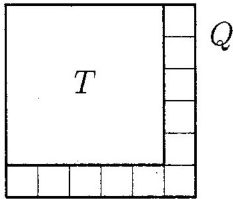
Consider an sub-board with all cells painted in blue, for the maximum , and assume . Since the board has unpainted cells, we may find an sub-board containing . Without loss of generality, we may assume is in the upper-left corner of , as in the following picture:
We look at the cells to the left of ; we call them , from top to bottom. Note that, given two adjacent cells and , there cannot be one painted and the other unpainted, since in this case, the sub-board of containing them would have exactly three painted cells (two cells in and one in the last column). We deduce that the cells are either all painted or all unpainted. If , the former is not possible, since at least one of the cells must be painted so that the sub-board in the right-upper corner of has an odd number of blue cells. We conclude that all the cells must be painted. Similarly, the same holds for all the cells of that are below . Now, by looking at the sub-board in the bottom right corner of , we deduce that the corner cell is also painted since, otherwise, this sub-board would contain exactly 3 blue cells. Summarizing, we have proved that all the cells of are painted in blue, contradicting the maximality of . The contradiction arises from the assumption . It follows that the board cannot contain any board completely painted in blue.
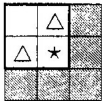
Now consider any sub-board . By assumption, it contains an odd number of blue cells, and we have proved that this number cannot be 9. Let us show that there cannot be 7 blue cells either. If this is not the case, the two unpainted cells and belong to the same sub-board of (otherwise, a sub-board of containing would have 3 blue cells). Assume, with no loss of generality, that and are in the sub-board in the upper-left corner of . Then, the 5 cells of around this sub-board are painted:
But then, the cell marked with has to be painted so that the board in the bottom-right corner has an even number of blue cells. From this fact, with a similar argument, it follows that the cells marked with are also painted. This contradicts the fact that has 2 unpainted cells.
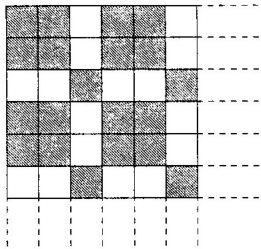
We conclude that every sub-board has at most 5 blue cells. As the board can be subdivided into 81 of those sub-boards, we have that Carla can paint at most cells in blue. In the next example, in which the pattern is repeated every 3 rows and every 3 columns, every board has exactly 5 blue cells.
Therefore, the maximum number of cells that Carla can paint is 405.
Consider an sub-board with all cells painted in blue, for the maximum , and assume . Since the board has unpainted cells, we may find an sub-board containing . Without loss of generality, we may assume is in the upper-left corner of , as in the following picture:
We look at the cells to the left of ; we call them , from top to bottom. Note that, given two adjacent cells and , there cannot be one painted and the other unpainted, since in this case, the sub-board of containing them would have exactly three painted cells (two cells in and one in the last column). We deduce that the cells are either all painted or all unpainted. If , the former is not possible, since at least one of the cells must be painted so that the sub-board in the right-upper corner of has an odd number of blue cells. We conclude that all the cells must be painted. Similarly, the same holds for all the cells of that are below . Now, by looking at the sub-board in the bottom right corner of , we deduce that the corner cell is also painted since, otherwise, this sub-board would contain exactly 3 blue cells. Summarizing, we have proved that all the cells of are painted in blue, contradicting the maximality of . The contradiction arises from the assumption . It follows that the board cannot contain any board completely painted in blue.
Now consider any sub-board . By assumption, it contains an odd number of blue cells, and we have proved that this number cannot be 9. Let us show that there cannot be 7 blue cells either. If this is not the case, the two unpainted cells and belong to the same sub-board of (otherwise, a sub-board of containing would have 3 blue cells). Assume, with no loss of generality, that and are in the sub-board in the upper-left corner of . Then, the 5 cells of around this sub-board are painted:
But then, the cell marked with has to be painted so that the board in the bottom-right corner has an even number of blue cells. From this fact, with a similar argument, it follows that the cells marked with are also painted. This contradicts the fact that has 2 unpainted cells.
We conclude that every sub-board has at most 5 blue cells. As the board can be subdivided into 81 of those sub-boards, we have that Carla can paint at most cells in blue. In the next example, in which the pattern is repeated every 3 rows and every 3 columns, every board has exactly 5 blue cells.
Therefore, the maximum number of cells that Carla can paint is 405.
Final answer
405
Techniques
Coloring schemes, extremal argumentsInvariants / monovariants