Browse · MathNet
PrintSelected Problems from Open Contests
Estonia geometry
Problem
Consider the diagonals , , , , and of a convex hexagon . The hexagon whose vertices are the points of intersection of the diagonals is regular. Can we conclude that the hexagon is also regular?
Solution
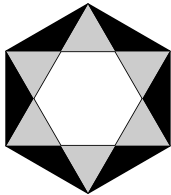
We show that the hexagon has all its side lengths equal and all its angles equal. As the internal hexagon is regular, the grey triangles in Fig. 2 all have two angles of equal size and so they are isosceles. Additionally, all these six isosceles triangles have their bases of equal lengths, thus they are all congruent. The black triangles on Fig. 2 are isosceles because the grey triangles are isosceles. Additionally, their vertex angles are equal, as
Fig. 2
they all are equal to the angles of a regular hexagon. Therefore the black triangles are all congruent and thus their bases are of equal length. Now the angles of the external hexagon are all formed of the angles of two grey triangles and one black triangle. As both of the latter are congruent, the external hexagon has its angles of equal size.
---
Alternative solution.
Lengthen the sides of the internal regular hexagon until intersection. The points of intersection are exactly the vertices of the initial external hexagon. Because of the symmetry of the internal hexagon the points of intersection are symmetrically located about the midpoint of the internal hexagon. Thus, the external (initial) hexagon is also regular.
Fig. 2
they all are equal to the angles of a regular hexagon. Therefore the black triangles are all congruent and thus their bases are of equal length. Now the angles of the external hexagon are all formed of the angles of two grey triangles and one black triangle. As both of the latter are congruent, the external hexagon has its angles of equal size.
---
Alternative solution.
Lengthen the sides of the internal regular hexagon until intersection. The points of intersection are exactly the vertices of the initial external hexagon. Because of the symmetry of the internal hexagon the points of intersection are symmetrically located about the midpoint of the internal hexagon. Thus, the external (initial) hexagon is also regular.
Final answer
Yes, the original hexagon must be regular.
Techniques
Angle chasingConstructions and lociRotation