Browse · MathNet
PrintUSA IMO
United States geometry
Problem
Let be a convex quadrilateral such that and Prove that the diagonals of quadrilateral are perpendicular.
Solution
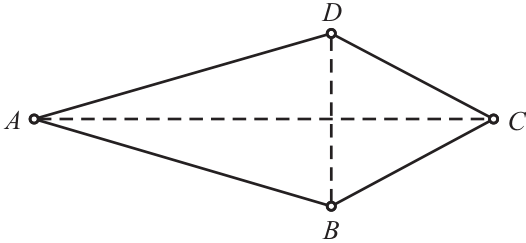
First Solution. Let be the angle formed by diagonals and , where . We calculate the area of quadrilateral in two ways. We obtain and Combining the above two equations yields For real numbers and , , hence It follows that . Therefore, and , as desired.
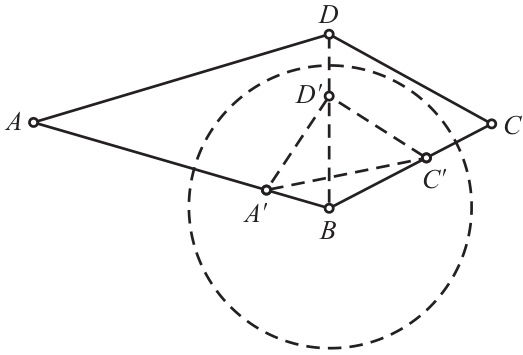
Second Solution. Consider an inversion of center and radius . Let denote the images of under the inversion, respectively. Then and . It follows that Applying the Inversive Distance Formula we obtain Applying the Pythagorean Theorem to right triangle yields or Rewriting this as we have ; that is, . Because , it follows that triangles and are similar. These two triangle share the corresponding side , so they are congruent. This implies that is a kite with segment as its symmetry axis. Therefore, .
Second Solution. Consider an inversion of center and radius . Let denote the images of under the inversion, respectively. Then and . It follows that Applying the Inversive Distance Formula we obtain Applying the Pythagorean Theorem to right triangle yields or Rewriting this as we have ; that is, . Because , it follows that triangles and are similar. These two triangle share the corresponding side , so they are congruent. This implies that is a kite with segment as its symmetry axis. Therefore, .
Techniques
Quadrilaterals with perpendicular diagonalsInversionAngle chasingTrigonometryQM-AM-GM-HM / Power Mean