Browse · MathNet
Print75th NMO Selection Tests
Romania geometry
Problem
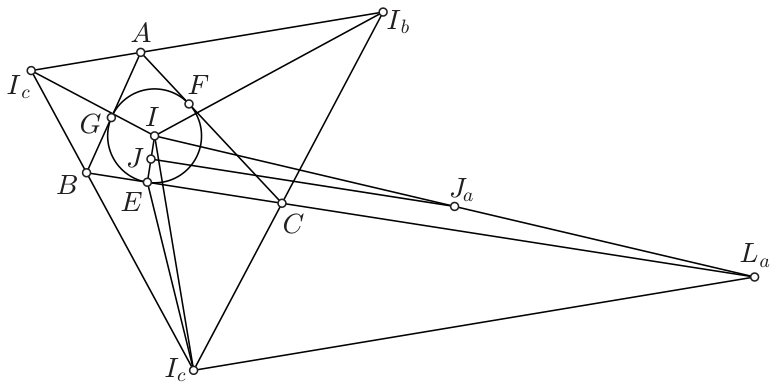
Consider an arbitrary triangle with incenter , and let , , and be the excenters of triangle opposite to vertices , , and , respectively, tangent to sides , , and . Let , , and be the points of tangency of the incircle with the sides , , and , respectively. Prove that the circumcircles of triangles , , and intersect in a second common point different from . Petru Braica
Solution
Denote by , , and the centers of the circumcircles of triangles , , and , respectively. We prove that , , and are collinear.
Let , , and be the points diametrically opposite to on the circumcircles of triangles , , and , respectively. Since , , and are midlines in triangles , , and , respectively, it suffices to show that , , and are collinear.
Since is a diameter in the circumcircle of triangle , we have . Hence . But , so , implying Let be the midpoint of segment . Since is a midline in triangle , it follows that . But is the perpendicular bisector of , so , and since , it follows that . From and , we deduce that , so . Similarly, we deduce that and .
We have . Similarly, , .
Therefore, , and by the converse of Menelaus' theorem, , , and are collinear, hence , , and are collinear. It follows that the radical axes of any two of the three circles are parallel or coincide. Since lies on all three circles, we deduce that these circles have the same radical axis. But , so the three circles are not tangent, and therefore their radical axis contains a point different from lying on all three circles.
Let , , and be the points diametrically opposite to on the circumcircles of triangles , , and , respectively. Since , , and are midlines in triangles , , and , respectively, it suffices to show that , , and are collinear.
Since is a diameter in the circumcircle of triangle , we have . Hence . But , so , implying Let be the midpoint of segment . Since is a midline in triangle , it follows that . But is the perpendicular bisector of , so , and since , it follows that . From and , we deduce that , so . Similarly, we deduce that and .
We have . Similarly, , .
Therefore, , and by the converse of Menelaus' theorem, , , and are collinear, hence , , and are collinear. It follows that the radical axes of any two of the three circles are parallel or coincide. Since lies on all three circles, we deduce that these circles have the same radical axis. But , so the three circles are not tangent, and therefore their radical axis contains a point different from lying on all three circles.
Techniques
Coaxal circlesRadical axis theoremMenelaus' theoremTriangle centers: centroid, incenter, circumcenter, orthocenter, Euler line, nine-point circleAngle chasing