Browse · MathNet
PrintBalkan Mathematical Olympiad
Romania geometry
Problem
A strip of breadth is the set of those points in the plane, situated between or on two parallel lines at distance one from the other. Consider a finite set of (distinct) points in the plane, with the property that any three points of can be covered by a strip of breadth 1. Prove the set can be covered by a strip of breadth 2.
Solution
All solutions encountered in the competition (including the Official one) make use of the following
LEMMA. A triangle can be covered by a strip of breadth 1 if and only if (at least) one of its altitudes is at most 1 long.
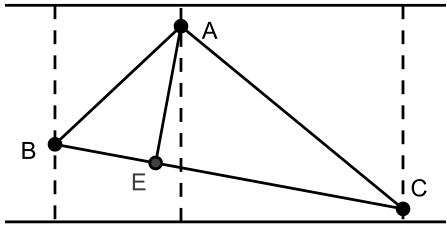
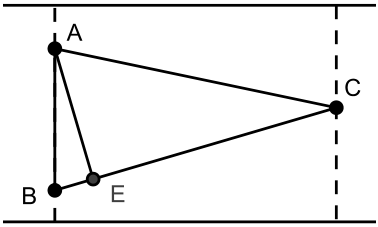
Proof. The other implication being trivial, consider a triangle covered by a strip of breadth 1. The perpendicular lines through on the lines that define the strip can determine two situations one of them meets a side of the triangle at an interior point (Figure 1) one side of the triangle contains one of them perpendiculars (Figure 2)
Figure 1 Figure 2
In both cases notice one of the altitudes (in the figures – ) is at most 1 long.
Now either choose points such that the distance be maximal, or choose points such that the area of triangle be maximal.
In the former case, for any other point , the distance from to is at most 1 (when is a non-degenerate triangle, then this is the least altitude of the triangle), hence the set of points can be covered by a strip of breadth 2, determined by two parallel lines to , situated at distance 1 on each side of it.
In the latter case, it is easy to show all points of the set are included in the triangle , determined by parallels through to the opposite sides (in effect, an old chestnut). Since one of the altitudes of is at most 1 long, one of the altitudes of will be at most 2 long, and we close the argument as above.
LEMMA. A triangle can be covered by a strip of breadth 1 if and only if (at least) one of its altitudes is at most 1 long.
Proof. The other implication being trivial, consider a triangle covered by a strip of breadth 1. The perpendicular lines through on the lines that define the strip can determine two situations one of them meets a side of the triangle at an interior point (Figure 1) one side of the triangle contains one of them perpendiculars (Figure 2)
Figure 1 Figure 2
In both cases notice one of the altitudes (in the figures – ) is at most 1 long.
Now either choose points such that the distance be maximal, or choose points such that the area of triangle be maximal.
In the former case, for any other point , the distance from to is at most 1 (when is a non-degenerate triangle, then this is the least altitude of the triangle), hence the set of points can be covered by a strip of breadth 2, determined by two parallel lines to , situated at distance 1 on each side of it.
In the latter case, it is easy to show all points of the set are included in the triangle , determined by parallels through to the opposite sides (in effect, an old chestnut). Since one of the altitudes of is at most 1 long, one of the altitudes of will be at most 2 long, and we close the argument as above.
Techniques
TrianglesHomothetyConvex hullsOptimization in geometryDistance chasing