Browse · MATH
Printjmc
prealgebra senior
Problem
In BINGO, a card is filled by marking the middle square as WILD and placing 24 other numbers in the remaining 24 squares.
Specifically a card is made by placing 5 numbers from the set in the first column, 5 numbers from in the second column, 4 numbers in the third column (skipping the WILD square in the middle), 5 numbers from in the fourth column and 5 numbers from in the last column.
One possible BINGO card is:
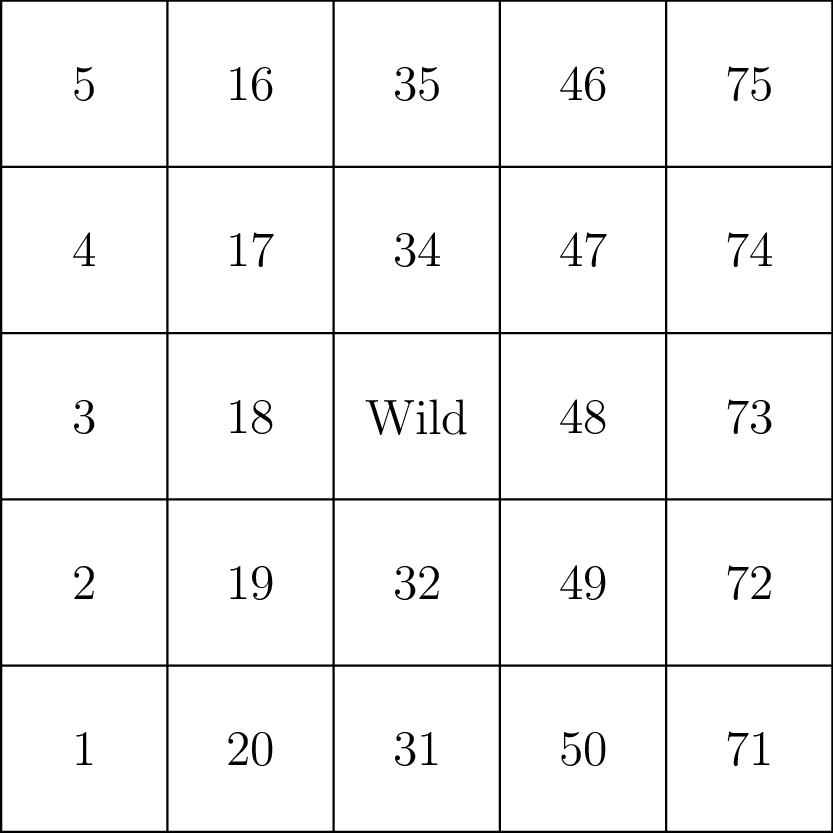
To play BINGO, someone names numbers, chosen at random, and players mark those numbers on their cards. A player wins when he marks 5 in a row, horizontally, vertically, or diagonally.
How many distinct possibilities are there for the values in the diagonal going from top left to bottom right of a BINGO card, in order?
Specifically a card is made by placing 5 numbers from the set in the first column, 5 numbers from in the second column, 4 numbers in the third column (skipping the WILD square in the middle), 5 numbers from in the fourth column and 5 numbers from in the last column.
One possible BINGO card is:
To play BINGO, someone names numbers, chosen at random, and players mark those numbers on their cards. A player wins when he marks 5 in a row, horizontally, vertically, or diagonally.
How many distinct possibilities are there for the values in the diagonal going from top left to bottom right of a BINGO card, in order?
Solution
The middle square is WILD, so we do not need to consider it in our count.
There are 15 choices for the first number. Since the second number cannot be equal to the first number, there are also 15 choices for the second number. Likewise, there are 15 choices for the third and fourth numbers. Therefore there are total choices for this diagonal.
There are 15 choices for the first number. Since the second number cannot be equal to the first number, there are also 15 choices for the second number. Likewise, there are 15 choices for the third and fourth numbers. Therefore there are total choices for this diagonal.
Final answer
50,\!625