Browse · MathNet
Print63rd Czech and Slovak Mathematical Olympiad
Czech Republic geometry
Problem
We are given an acute-angled triangle . Denote by the circle with diameter . A circle touching the bisector of the angle at the point and passing through the point meets the circle in a point , . Similarly, a circle touching the bisector of the angle at the point and passing through the point meets the circle in a point , . Prove that the lines and intersect each other on the bisector of the angle . (Peter Novotný)
Solution
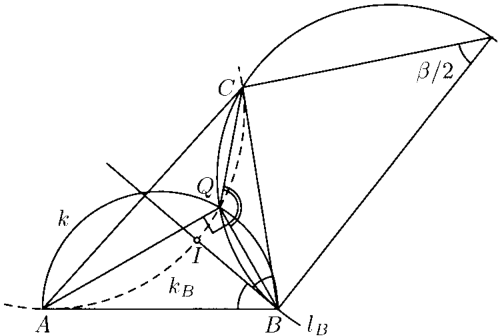
Besides the Thales' circle , denote as and the other two circles under consideration. Let us deal, for example, with the circle drawn in Fig. 4. In what follows the interior angles of are denoted as usual.
Fig. 4
Let us explain that it is true indeed what the figure suggests. First of all, the point lies in the half-plane , because the local arc of the circle has the following property: as its point moves from to , the angle varies from an acute angle to an obtuse angle , and hence the Thales' circle meets the arc in an interior point . Applying the properties of inscribed and subtended angles to the chord of the circle , we conclude that and hence . Consequently, is a point of the half-plane which lies in the interior of the triangle and the convex angle equals . As known, the last is a measure of the angle , where denotes the incentre of (indeed, ). In this way, the congruence of the angles and is proven and hence the points and lie on the same arc of a new circle . Therefore, the line is the radical axis of the circles and . Analogously, the line is the radical axis of the circles and .
It remains to note that the intersection point of the lines and (treated as the above radical axes) has the same power with respect to the circles and , whose radical axis is the line , i.e. just the bisector of the angle . This completes our solution.
Fig. 4
Fig. 4
Let us explain that it is true indeed what the figure suggests. First of all, the point lies in the half-plane , because the local arc of the circle has the following property: as its point moves from to , the angle varies from an acute angle to an obtuse angle , and hence the Thales' circle meets the arc in an interior point . Applying the properties of inscribed and subtended angles to the chord of the circle , we conclude that and hence . Consequently, is a point of the half-plane which lies in the interior of the triangle and the convex angle equals . As known, the last is a measure of the angle , where denotes the incentre of (indeed, ). In this way, the congruence of the angles and is proven and hence the points and lie on the same arc of a new circle . Therefore, the line is the radical axis of the circles and . Analogously, the line is the radical axis of the circles and .
It remains to note that the intersection point of the lines and (treated as the above radical axes) has the same power with respect to the circles and , whose radical axis is the line , i.e. just the bisector of the angle . This completes our solution.
Fig. 4
Techniques
Radical axis theoremTangentsTriangle centers: centroid, incenter, circumcenter, orthocenter, Euler line, nine-point circleAngle chasing