Browse · MathNet
PrintInternational Mathematical Olympiad
geometry
Problem
Let and be two triangles having the same circumcircle , and the same orthocentre . Let be the circumcircle of the triangle determined by the lines , , and . Prove that , the centre of , and the centre of are collinear. (Denmark)
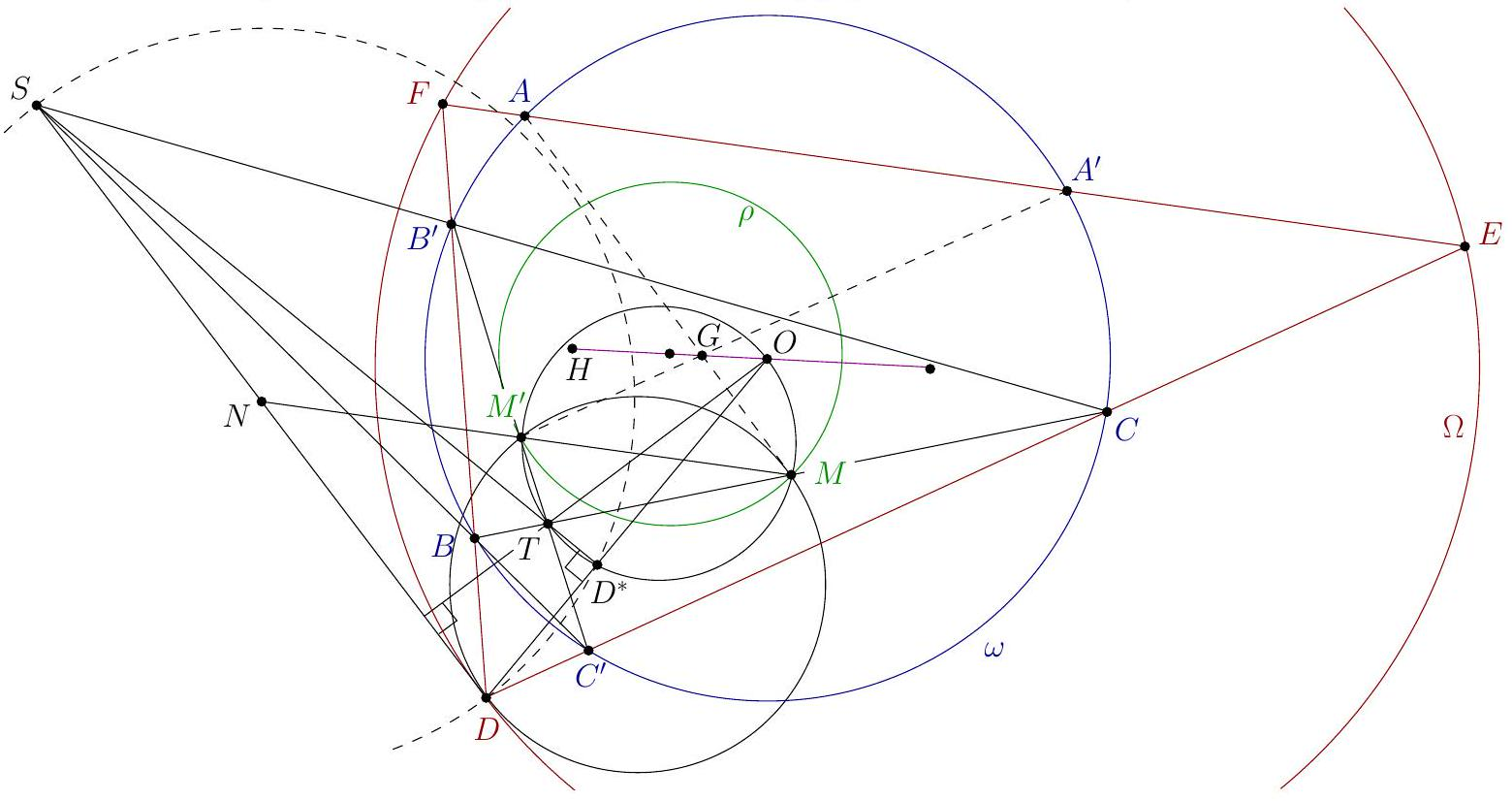
Solution
In what follows, will denote the directed angle between lines and , taken modulo . Denote by the centre of . In any triangle, the homothety with ratio centred at the centroid of the triangle takes the vertices to the midpoints of the opposite sides and it takes the orthocentre to the circumcentre. Therefore the triangles and share the same centroid and the midpoints of their sides lie on a circle with centre on . We will prove that , , and are coaxial, so in particular it follows that their centres are collinear on .
Let , , , , and . Since , , and are the intersections of opposite sides and of the diagonals in the quadrilateral inscribed in , by Brocard's theorem triangle is self-polar with respect to , i.e. each vertex is the pole of the opposite side. We apply this in two ways.
First, from being the pole of it follows that the inverse of with respect to is the projection of onto . In particular, lies on the circle with diameter . If denotes the midpoint of and the radius of , then the power of with respect to this circle is . By rearranging, we see that is the power of with respect to .
Second, from being the pole of it follows that is perpendicular to . Let and denote the midpoints of and . Then since and , it follows that is cyclic and From being cyclic we also have , hence we obtain Now from the homothety mentioned in the beginning, we know that is parallel to , hence the above implies that , which shows that is tangent to at . In particular, is also the power of with respect to .
Additionally, from being cyclic it follows that triangles and are inversely similar, so . This yields which shows that the circle is also tangent to . Since , , and are collinear on the Newton-Gauss line of the complete quadrilateral determined by the lines , , , and , it follows that . Hence has the same power with respect to , , and .
By the same arguments there exist points on the tangents to at and which have the same power with respect to , , and . The tangents to a given circle at three distinct points cannot be concurrent, hence we obtain at least two distinct points with the same power with respect to , , and . Hence the three circles are coaxial, as desired.
Let , , , , and . Since , , and are the intersections of opposite sides and of the diagonals in the quadrilateral inscribed in , by Brocard's theorem triangle is self-polar with respect to , i.e. each vertex is the pole of the opposite side. We apply this in two ways.
First, from being the pole of it follows that the inverse of with respect to is the projection of onto . In particular, lies on the circle with diameter . If denotes the midpoint of and the radius of , then the power of with respect to this circle is . By rearranging, we see that is the power of with respect to .
Second, from being the pole of it follows that is perpendicular to . Let and denote the midpoints of and . Then since and , it follows that is cyclic and From being cyclic we also have , hence we obtain Now from the homothety mentioned in the beginning, we know that is parallel to , hence the above implies that , which shows that is tangent to at . In particular, is also the power of with respect to .
Additionally, from being cyclic it follows that triangles and are inversely similar, so . This yields which shows that the circle is also tangent to . Since , , and are collinear on the Newton-Gauss line of the complete quadrilateral determined by the lines , , , and , it follows that . Hence has the same power with respect to , , and .
By the same arguments there exist points on the tangents to at and which have the same power with respect to , , and . The tangents to a given circle at three distinct points cannot be concurrent, hence we obtain at least two distinct points with the same power with respect to , , and . Hence the three circles are coaxial, as desired.
Techniques
Coaxal circlesTangentsRadical axis theoremHomothetyAngle chasingCyclic quadrilateralsPolar triangles, harmonic conjugatesTriangle centers: centroid, incenter, circumcenter, orthocenter, Euler line, nine-point circle