Browse · MathNet
PrintXXVIII-th Balkan Mathematical Olympiad
North Macedonia geometry
Problem
Let be a convex hexagon of area whose opposite sides are parallel. The lines , and meet in pairs to determine the vertices of a triangle. Similarly, the lines , and meet in pairs to determine the vertices of another triangle. Show that the area of the least one of these two triangles is at least .
Solution
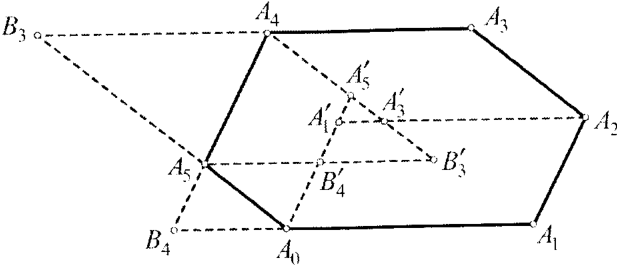
Unless otherwise stated, throughout the proof indices take on values from to and are reduced modulo . Label the vertices of the hexagon in circular order, , and let the lines of support of the alternate sides and meet at . To show that the area of at least one of the triangles , is greater than or equal to , it is sufficient to prove that the total area of the six triangles is at least : To begin with, reflect each through the midpoint of the segment to get the points . We shall prove that the six triangles cover the hexagon. To this end, reflect through the midpoint of the segment to get the points , . The hexagon splits into three parallelograms, , , and a (possibly degenerate) triangle, . Notice first that each parallelogram is covered by the pair of triangles (, ), . The proof is completed by showing that at least one of these pairs contains a triangle that covers the triangle . To this end, it is sufficient to prove that and for some indices . To establish the first inequality, notice that to get Similarly, whence the conclusion.
Techniques
RotationConstructions and lociDistance chasingOptimization in geometry