Browse · MathNet
PrintAPMO
geometry
Problem
Let be an integer. Consider squares with side lengths , respectively. The squares are arranged in the plane with their sides parallel to the and axes. Suppose that no two squares touch, except possibly at their vertices. Show that it is possible to arrange these squares in a way such that every square touches exactly two other squares.
Solution
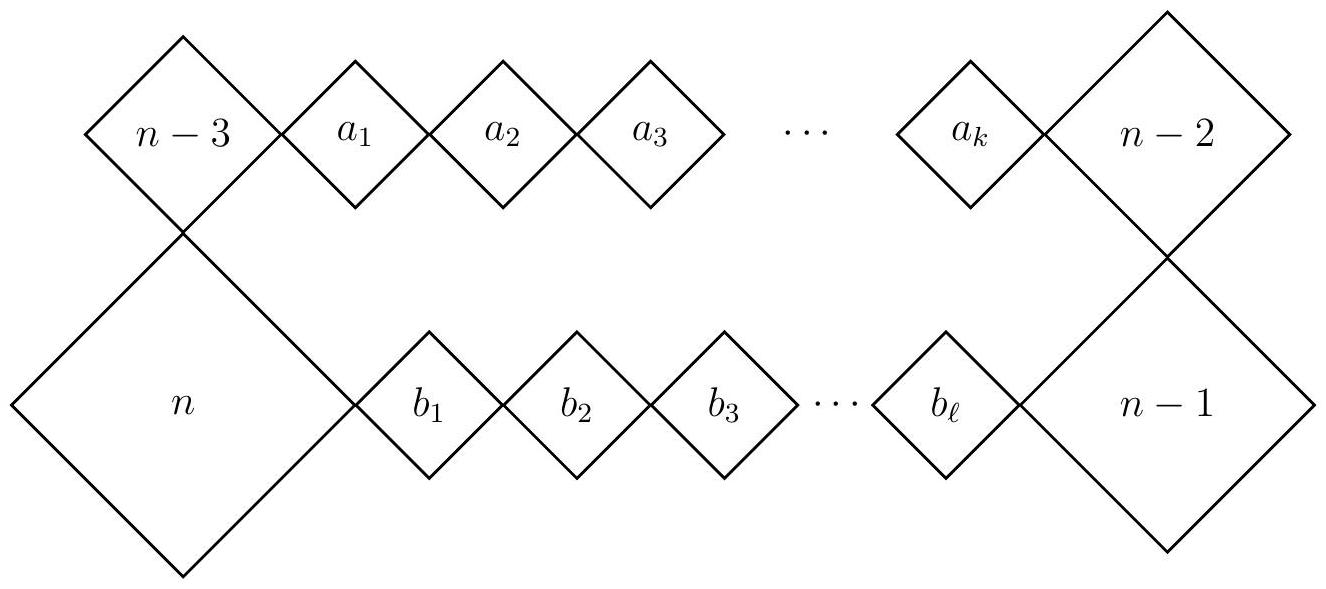
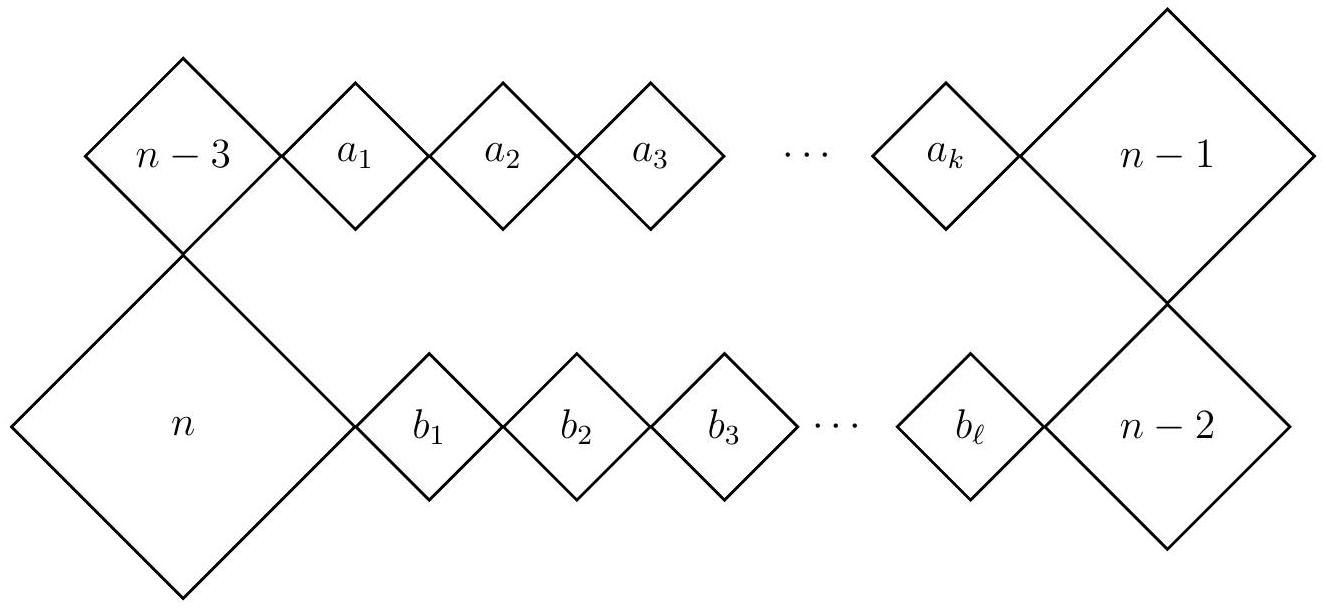
Set aside the squares with sidelengths , and and suppose we can split the remaining squares into two sets and such that the sum of the sidelengths of the squares in is 1 or 2 units larger than the sum of the sidelengths of the squares in . String the squares of each set along two parallel diagonals, one for each diagonal. Now use the four largest squares along two perpendicular diagonals to finish the construction: one will have sidelengths and , and the other, sidelengths and . If the sum of the sidelengths of the squares in is 1 unit larger than the sum of the sidelengths of the squares in , attach the squares with sidelengths and to the -diagonal, and the other two squares to the -diagonal. The resulting configuration, in which the and -diagonals are represented by unit squares, and the sidelengths of squares from and of squares from are indicated within each square, follows:
Since , this case is done. If the sum of the sidelengths of the squares in is 1 unit larger than the sum of the sidelengths of the squares in , attach the squares with sidelengths and to the -diagonal, and the other two squares to the -diagonal. The resulting configuration follows:
Since , this case is also done. In both cases, the distance between the -diagonal and the -diagonal is . Since , and therefore the - and -diagonals do not overlap. Finally, we prove that it is possible to split the squares of sidelengths 1 to into two sets and such that the sum of the sidelengths of the squares in is 1 or 2 units larger than the sum of the sidelengths of the squares in . One can do that in several ways; we present two possibilities: - Direct construction: Split the numbers from 1 to into several sets of four consecutive numbers , beginning with the largest numbers; put squares of sidelengths and in and squares of sidelengths and in . Notice that . In the end, at most four numbers remain. - If only 1 remains, put the corresponding square in , so the sum of the sidelengths of the squares in is one unit larger that those in ; - If 1 and 2 remains, put the square of sidelength 2 in and the square of sidelength 1 in (the difference is 1 ); - If 1,2 , and 3 remains, put the squares of sidelengths 1 and 3 in , and the square of sidelength 2 in (the difference is 2 ); - If , and 4 remains, put the squares of sidelengths 2 and 4 in , and the squares of sidelengths 1 and 3 in (the difference is 2 ). - Indirect construction: Starting with and as empty sets, add the squares of sidelengths to either or in that order such that at each stage the difference between the sum of the sidelengths in and the sum of the sidelengths of B is minimized. By induction it is clear that after adding an integer to one of the sets, this difference is at most . In particular, the difference is 0,1 or 2 at the end. Finally adding the final 1 to one of the sets can ensure that the final difference is 1 or 2 . If necessary, flip and .
---
Alternative solution.
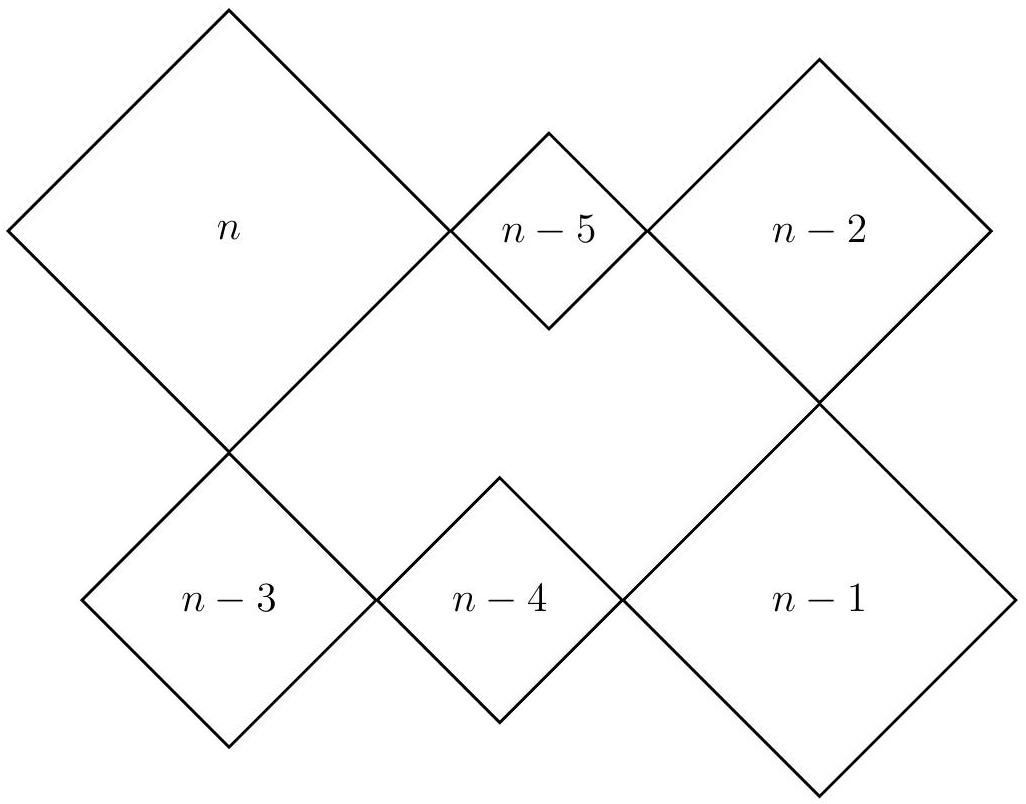
Solve the problem by induction in . Construct examples for (one can use the constructions from the previous solution, for instance). For , set aside the six larger squares and arrange them in the following fashion:
By the induction hypothesis, one can arrange the remaining squares away from the six larger squares, so we are done.
Since , this case is done. If the sum of the sidelengths of the squares in is 1 unit larger than the sum of the sidelengths of the squares in , attach the squares with sidelengths and to the -diagonal, and the other two squares to the -diagonal. The resulting configuration follows:
Since , this case is also done. In both cases, the distance between the -diagonal and the -diagonal is . Since , and therefore the - and -diagonals do not overlap. Finally, we prove that it is possible to split the squares of sidelengths 1 to into two sets and such that the sum of the sidelengths of the squares in is 1 or 2 units larger than the sum of the sidelengths of the squares in . One can do that in several ways; we present two possibilities: - Direct construction: Split the numbers from 1 to into several sets of four consecutive numbers , beginning with the largest numbers; put squares of sidelengths and in and squares of sidelengths and in . Notice that . In the end, at most four numbers remain. - If only 1 remains, put the corresponding square in , so the sum of the sidelengths of the squares in is one unit larger that those in ; - If 1 and 2 remains, put the square of sidelength 2 in and the square of sidelength 1 in (the difference is 1 ); - If 1,2 , and 3 remains, put the squares of sidelengths 1 and 3 in , and the square of sidelength 2 in (the difference is 2 ); - If , and 4 remains, put the squares of sidelengths 2 and 4 in , and the squares of sidelengths 1 and 3 in (the difference is 2 ). - Indirect construction: Starting with and as empty sets, add the squares of sidelengths to either or in that order such that at each stage the difference between the sum of the sidelengths in and the sum of the sidelengths of B is minimized. By induction it is clear that after adding an integer to one of the sets, this difference is at most . In particular, the difference is 0,1 or 2 at the end. Finally adding the final 1 to one of the sets can ensure that the final difference is 1 or 2 . If necessary, flip and .
---
Alternative solution.
Solve the problem by induction in . Construct examples for (one can use the constructions from the previous solution, for instance). For , set aside the six larger squares and arrange them in the following fashion:
By the induction hypothesis, one can arrange the remaining squares away from the six larger squares, so we are done.
Techniques
Combinatorial GeometryConstructions and lociInduction / smoothingGames / greedy algorithms