Browse · MathNet
PrintFinal Round
Belarus geometry
Problem
Points , and are marked on the sides , and of a parallelogram , respectively. It is known that .
a) Prove that at least one of the inequalities holds
b) Is it true that ?
a) Prove that at least one of the inequalities holds
b) Is it true that ?
Solution
b) It is not true.
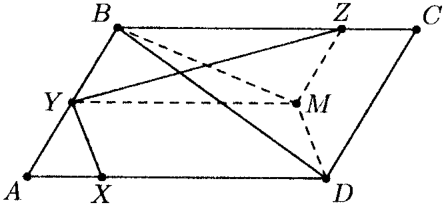
a) Without loss of generality we assume that . In this case we have So, it is sufficient to show that . Let , (see the Fig.). It is evident that is a parallelogram, so and . Since , we have . Since , we see that is a parallelogram.
In the parallelogram we have , therefore, Thus , as required.
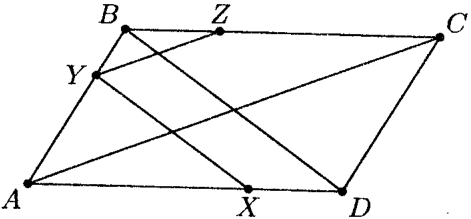
b) We show that there exist a parallelogram and a point such that the inequality is not valid. Let a parallelogram is different from a rectangle. Then its diagonals are not equal. Without loss of generality we assume that . Let (see the Fig.). Let . By Thales' theorem, we have . Hence . It follows that the triangles and are similar and , i.e. .
Moreover, by construction of , the triangles and are similar and , hence .
Therefore, and (*) has the form or . But this inequality is not valid if .
a) Without loss of generality we assume that . In this case we have So, it is sufficient to show that . Let , (see the Fig.). It is evident that is a parallelogram, so and . Since , we have . Since , we see that is a parallelogram.
In the parallelogram we have , therefore, Thus , as required.
b) We show that there exist a parallelogram and a point such that the inequality is not valid. Let a parallelogram is different from a rectangle. Then its diagonals are not equal. Without loss of generality we assume that . Let (see the Fig.). Let . By Thales' theorem, we have . Hence . It follows that the triangles and are similar and , i.e. .
Moreover, by construction of , the triangles and are similar and , hence .
Therefore, and (*) has the form or . But this inequality is not valid if .
Final answer
No
Techniques
QuadrilateralsTriangle trigonometryTriangle inequalitiesTrigonometryConstructions and loci