Browse · MathNet
Print48th International Mathematical Olympiad Vietnam 2007 Shortlisted Problems with Solutions
2007 geometry
Problem
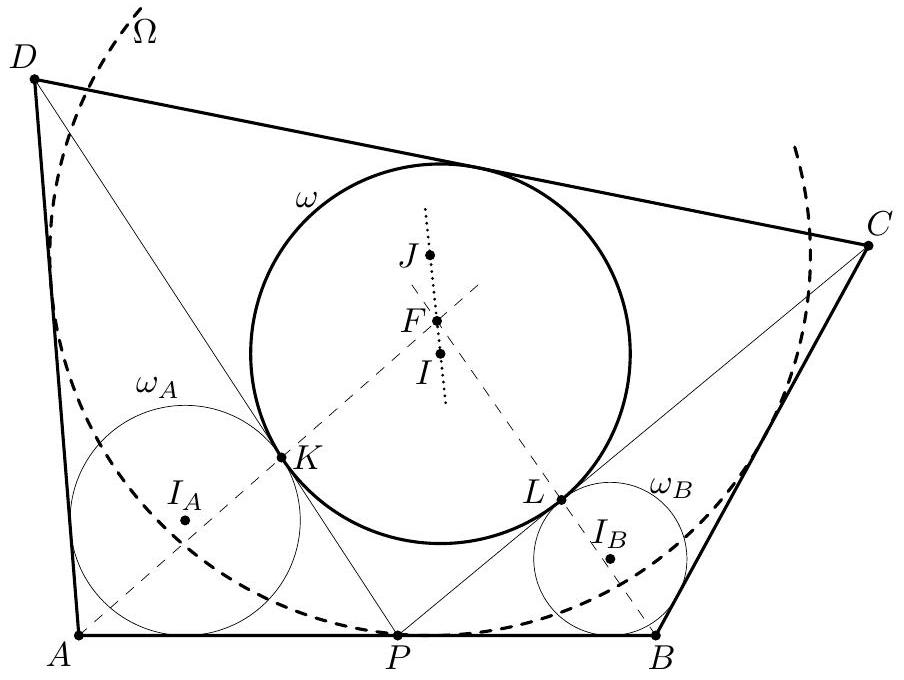
Point lies on side of a convex quadrilateral . Let be the incircle of triangle , and let be its incenter. Suppose that is tangent to the incircles of triangles and at points and , respectively. Let lines and meet at , and let lines and meet at . Prove that points , , and are collinear. (Poland)
Solution
Let be the circle tangent to segment and to rays and ; let be its center. We prove that points and lie on line .
Denote the incircles of triangles and by and . Let be the homothety with a negative scale taking to . Consider this homothety as the composition of two homotheties: one taking to (with a negative scale and center ), and another one taking to (with a positive scale and center ). It is known that in such a case the three centers of homothety are collinear (this theorem is also referred to as the theorem on the three similitude centers). Hence, the center of lies on line . Analogously, it also lies on , so this center is . Hence, lies on the line of centers of and , i.e. on (if , then as well, and the claim is obvious).
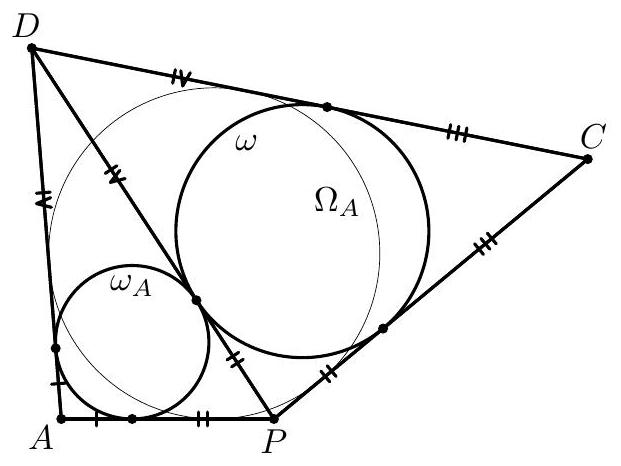
Consider quadrilateral and mark the equal segments of tangents to and (see the figure below to the left). Since circles and have a common point of tangency with , one can easily see that . So, quadrilateral is circumscribed; analogously, circumscribed is also quadrilateral . Let and respectively be their incircles.
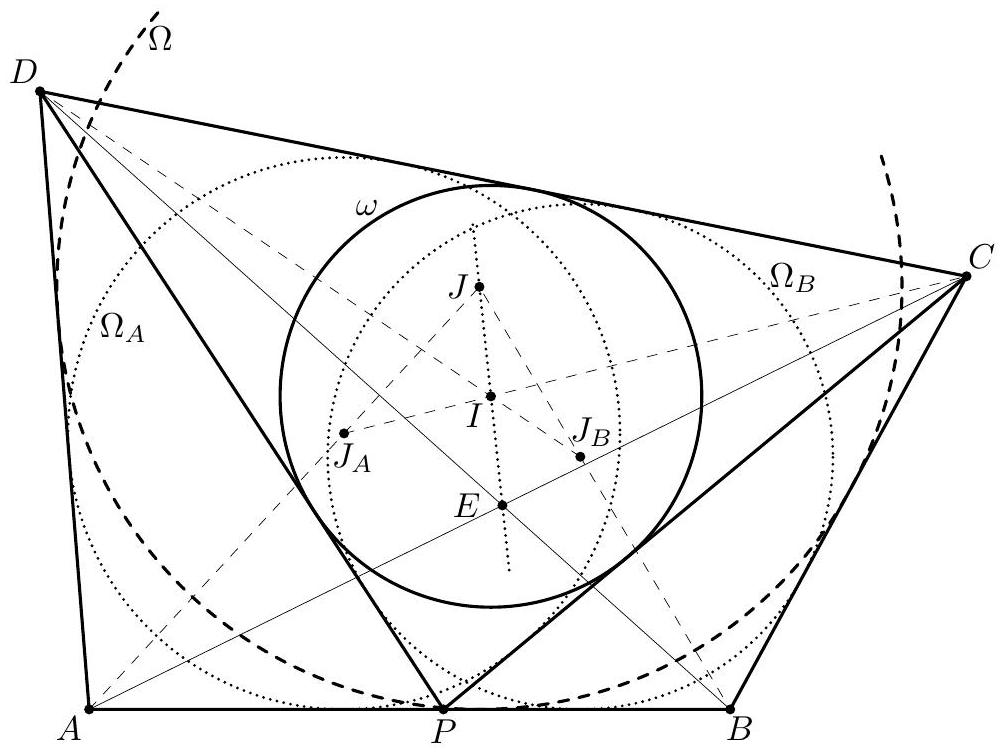
Consider the homothety with a positive scale taking to . Consider as the composition of two homotheties: taking to (with a positive scale and center ), and taking to (with a positive scale and center ), respectively. So the center of lies on line . By analogous reasons, it lies also on , hence this center is . Thus, also lies on the line of centers , and the claim is proved.
Denote the incircles of triangles and by and . Let be the homothety with a negative scale taking to . Consider this homothety as the composition of two homotheties: one taking to (with a negative scale and center ), and another one taking to (with a positive scale and center ). It is known that in such a case the three centers of homothety are collinear (this theorem is also referred to as the theorem on the three similitude centers). Hence, the center of lies on line . Analogously, it also lies on , so this center is . Hence, lies on the line of centers of and , i.e. on (if , then as well, and the claim is obvious).
Consider quadrilateral and mark the equal segments of tangents to and (see the figure below to the left). Since circles and have a common point of tangency with , one can easily see that . So, quadrilateral is circumscribed; analogously, circumscribed is also quadrilateral . Let and respectively be their incircles.
Consider the homothety with a positive scale taking to . Consider as the composition of two homotheties: taking to (with a positive scale and center ), and taking to (with a positive scale and center ), respectively. So the center of lies on line . By analogous reasons, it lies also on , hence this center is . Thus, also lies on the line of centers , and the claim is proved.
Techniques
HomothetyTangentsInscribed/circumscribed quadrilateralsConstructions and loci