Browse · MathNet
PrintFinal Round
Belarus geometry
Problem
The graph of the hyperbola is drawn on the Cartesian plane . Three snails start simultaneously from the origin and move along the abscissa axis (each snail has its constant speed). Let , and be points on the graph of the hyperbola such that their abscissae are equal to the abscissae of the first, the second and the third snails at the moment , respectively. Prove that the area of the triangle is independent of time.
Solution
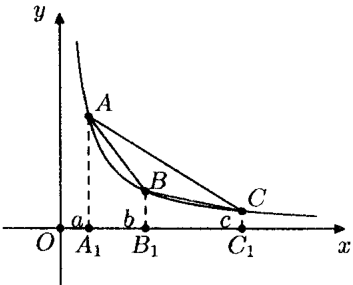
Let , , be the abscissae of the first, the second and the third snails at the moment , respectively, and be their speeds respectively. First, suppose that all snails move in the same direction. Without loss of generality we assume that the snails move along the positive part of the axis and . Then (see Fig. 1) Fig. 1 Fig. 2 Since the quadrilaterals , , are trapezia and we know the coordinates of their vertices , , and , , , we can find their areas: Since the speeds of the snails are constant, we see that the area is independent of time. Similarly, we conclude that the areas of the trapezia and are independent of time, too.
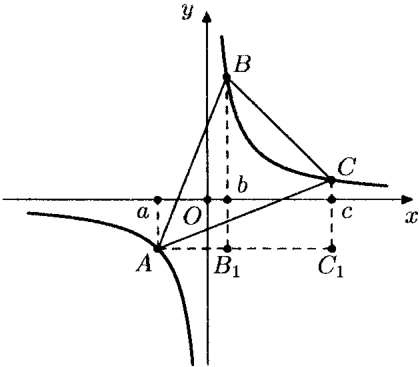
Now we consider the case when two snails (say, the second and the third snails) move in the same direction and the first snail moves in the opposite direction. Without loss of generality we assume that the first snail moves along the negative part of the axis (see Fig. 2) and . Then We have Since the speeds of the snails are constant we see that the areas of the triangles and are independent of time. It remains to show that the area of the trapezium is also independent of time. Indeed, Therefore, the area of the triangle ABC is independent of time.
Now we consider the case when two snails (say, the second and the third snails) move in the same direction and the first snail moves in the opposite direction. Without loss of generality we assume that the first snail moves along the negative part of the axis (see Fig. 2) and . Then We have Since the speeds of the snails are constant we see that the areas of the triangles and are independent of time. It remains to show that the area of the trapezium is also independent of time. Indeed, Therefore, the area of the triangle ABC is independent of time.
Techniques
Cartesian coordinates