Browse · MathNet
PrintSelected Problems from the Final Round of National Olympiad
Estonia counting and probability
Problem
Every face of a unit cube has one of numbers , , written on it in such a way that every two faces with a common edge contain different numbers. Is it possible to form
a) a cube of size ;
b) a cube of size
so that in the grids that come up on the faces, every two squares with a common side contain different numbers and the sum of all numbers on each face equals ?
a) a cube of size ;
b) a cube of size
so that in the grids that come up on the faces, every two squares with a common side contain different numbers and the sum of all numbers on each face equals ?
Solution
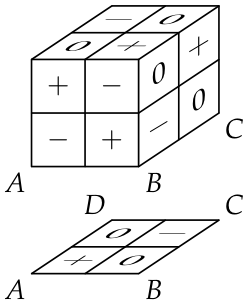
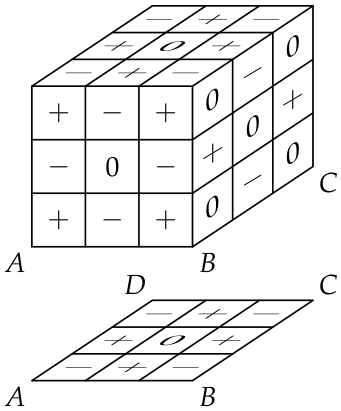
First note that the placement of the numbers on the faces of the unit cube is unique. Indeed, let a number be written on some face; then the neighboring faces contain alternately the other numbers and , while the opposite face again contains . This means that each of the numbers , , occurs in one pair of opposite faces. Figures 10 and 11 show suitable constructions (where and denote and , respectively).
Fig. 10
Fig. 11
Fig. 10
Fig. 11
Final answer
a) yes; b) yes
Techniques
Coloring schemes, extremal arguments