Browse · MathNet
PrintSelected Problems from the Final Round of National Olympiad
Estonia geometry
Problem
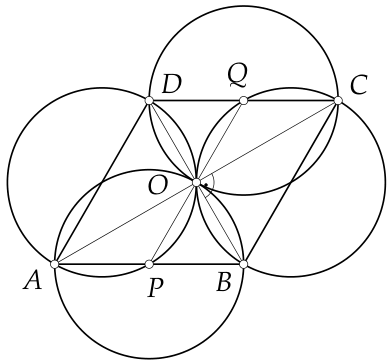
Each side of a convex quadrangle is a diameter of a circle. All four circles pass through the same point , different from the vertices of the quadrangle, and no two circles have common points other than those mentioned. Prove that is a rhombus.
Solution
Since , , , and are diameters (Fig. 9), , , , and are right angles. Hence and are straight angles, i.e., the diagonals of the quadrangle meet at . The circles drawn on the opposite sides and cannot have common points besides , since otherwise one circle would pass through three collinear points (two vertices of the quadrangle and the point ). Consequently, the circles drawn on and must touch at . Let and be the centers of these circles, respectively; then lies on the segment .
Fig. 9
and , isosceles triangles give . Thus and are parallel. Similarly, the remaining sides are parallel. Thus is a rectangle; the diagonals of a rectangle are perpendicular only if the rectangle is a rhombus.
Fig. 9
Fig. 9
and , isosceles triangles give . Thus and are parallel. Similarly, the remaining sides are parallel. Thus is a rectangle; the diagonals of a rectangle are perpendicular only if the rectangle is a rhombus.
Fig. 9
Techniques
TangentsQuadrilaterals with perpendicular diagonalsAngle chasing