Browse · MathNet
Print59th Ukrainian National Mathematical Olympiad
Ukraine geometry
Problem
The inscribed circle of an acute triangle ABC touches sides AB and BC in points and respectively. Let M be the midpoint of the side AC, and N be the midpoint of an arc ABC of the circumcircle of ABC. Also, let P be the projection of a point M to the segment . Prove the points I, P, and N lie on the same line. (Anton Trygub)
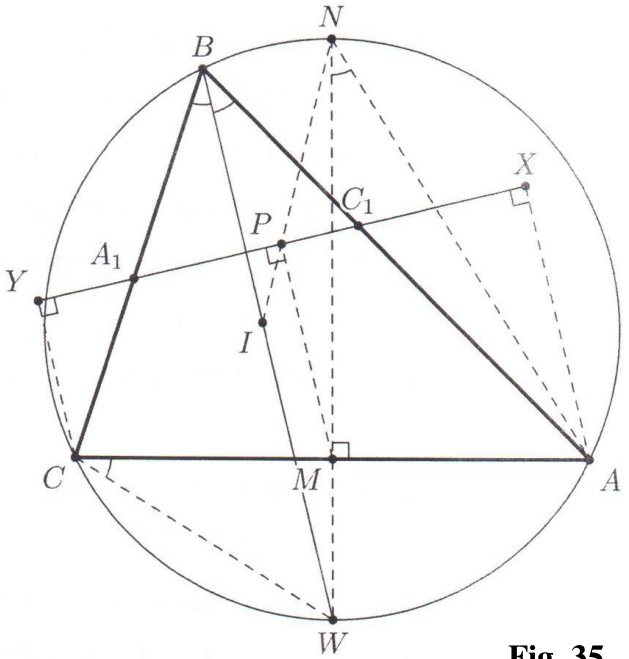 Fig. 35
Solution
Let's denote the second intersection point of the line BI with the circumcircle of as W (fig. 35). Clearly, W is a midpoint of the smaller arc AC, and points M, W, and N lie on the same line.
Hence, it is enough to prove that triangles and are similar (which will imply that and the desired collinearity). In order to prove the similarity, we are going to show that . Let , then and
Considering a segment PM yields that PM is a midline of a trapezoid AXYC, where X, Y are the projections of A and C onto the line respectively. Going further, we get because , and , because and are the points in which inscribed circle touches the sides of a triangle . Finally, from the trillium theorem, , meaning that finishing the proof.
Hence, it is enough to prove that triangles and are similar (which will imply that and the desired collinearity). In order to prove the similarity, we are going to show that . Let , then and
Considering a segment PM yields that PM is a midline of a trapezoid AXYC, where X, Y are the projections of A and C onto the line respectively. Going further, we get because , and , because and are the points in which inscribed circle touches the sides of a triangle . Finally, from the trillium theorem, , meaning that finishing the proof.
Techniques
Triangle centers: centroid, incenter, circumcenter, orthocenter, Euler line, nine-point circleTriangle trigonometryTangentsAngle chasingDistance chasing