Browse · MathNet
PrintUkrainian Mathematical Olympiad
Ukraine counting and probability
Problem
There are 2012 cities in the land of Olympia. Some of the cities are connected by direct two-way routes (each route connects exactly two cities and no two routes connect the same pair of cities). It is known that no city is directly connected to more than 8 other cities. Prove that it is possible to close at most 2012 routes in such a way that among any four cities there will be two with no direct route between them.
Solution
Let be the graph of the problem. Partition the set of its 2012 vertices into three subsets , , and so that the sum of the numbers of edges in the subgraphs , , and is minimal (clearly, this is possible). Suppose that in one of the subsets (let it be ), there is a vertex such that in the subgraph its degree . Since , the vertex cannot be connected to each of the subgraphs and by more than two edges. Suppose the vertex is connected to the subgraph by at most two edges. Then, for the subgraphs , , and , the sum decreases, which is impossible. Therefore, in the subgraphs , , and , the degree of all their vertices does not exceed 2. As is known, in any graph, the sum of the degrees of all vertices equals twice the number of edges, so in each of the subgraphs , , and , the number of edges does not exceed the number of vertices, that is, . Remove all these edges (make the graphs with vertex sets , , and empty). For any four vertices, at least two lie in one of these three vertex sets, and after removing the edges, such two vertices are not connected by an edge.
Solution 2:
Let us prove the following auxiliary fact.
Lemma. If in a graph with vertices the degree of each vertex does not exceed , then all its vertices can be partitioned into groups so that in each group no two vertices are connected by an edge.
Proof. We use induction on the order of the graph. The base case is obvious. Suppose the statement holds for . Consider a graph with vertices that satisfies the lemma's condition. Let be any of its vertices. For the subgraph , we can apply the induction hypothesis and partition the set of all its vertices as required into groups. Since , the vertex is not connected by any edge to at least one of the formed groups. It remains to add to this group, and the lemma is proved.
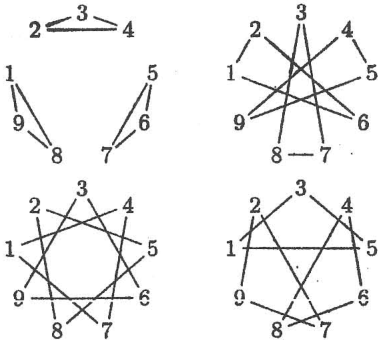
Partition — according to the lemma — the set of vertices of the graph of the problem into 9 groups (some may be empty). Call a bundle of edges all the edges that connect vertices of two different groups. In total, bundles of edges are formed (some bundles may contain no edges). Divide them into four groups of 9 bundles each as shown in the figures. In each group, the bundles of edges form three "triangles" that "cover" all 9 groups of vertices. In the graph there are at most edges, so in at least one of the four groups of bundles, the number of edges does not exceed . Remove all the edges of this group. Whatever four vertices we now choose, by the pigeonhole principle at least two of them will fall into one of the formed "triangles". Clearly, such two vertices are not connected by an edge.
Solution 2:
Let us prove the following auxiliary fact.
Lemma. If in a graph with vertices the degree of each vertex does not exceed , then all its vertices can be partitioned into groups so that in each group no two vertices are connected by an edge.
Proof. We use induction on the order of the graph. The base case is obvious. Suppose the statement holds for . Consider a graph with vertices that satisfies the lemma's condition. Let be any of its vertices. For the subgraph , we can apply the induction hypothesis and partition the set of all its vertices as required into groups. Since , the vertex is not connected by any edge to at least one of the formed groups. It remains to add to this group, and the lemma is proved.
Partition — according to the lemma — the set of vertices of the graph of the problem into 9 groups (some may be empty). Call a bundle of edges all the edges that connect vertices of two different groups. In total, bundles of edges are formed (some bundles may contain no edges). Divide them into four groups of 9 bundles each as shown in the figures. In each group, the bundles of edges form three "triangles" that "cover" all 9 groups of vertices. In the graph there are at most edges, so in at least one of the four groups of bundles, the number of edges does not exceed . Remove all the edges of this group. Whatever four vertices we now choose, by the pigeonhole principle at least two of them will fall into one of the formed "triangles". Clearly, such two vertices are not connected by an edge.
Techniques
Graph TheoryPigeonhole principleInduction / smoothingColoring schemes, extremal arguments