Browse · MathNet
Print42nd Balkan Mathematical Olympiad
geometry
Problem
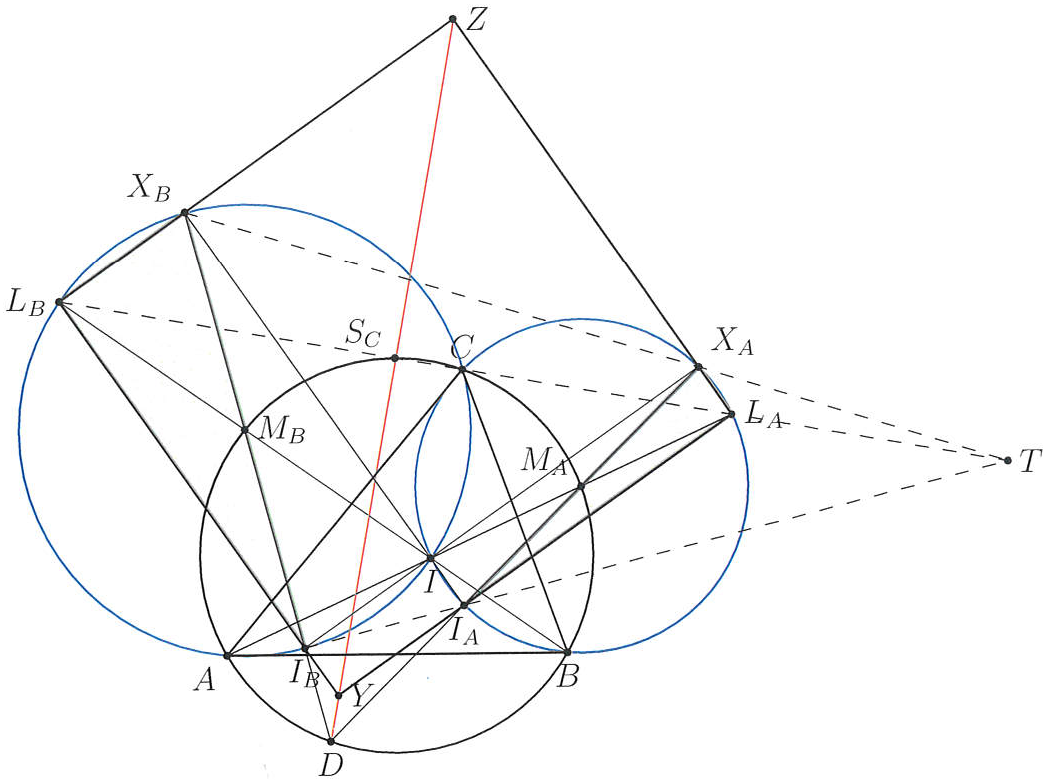
Let be the incenter of triangle , and be an arbitrary point on arc , not containing point , of the circumcircle of . Let and be the incenters of and respectively. Lines and intersect at point , and lines and intersect at point . Prove that the intersection of lines and lies on a fixed line, independent of the choice of .
Solution
Let and be the midpoints of arcs and (not containing points and respectively), and be the midpoint of arc of the circumcircle of . We will prove that lines and intersect on . By the Incenter/Excenter lemma, , hence is cyclic with circumcenter . Similarly, is cyclic with circumcenter . Let us denote these circumcircles as and respectively. Then Therefore is a diameter of as lies on line and . Similarly, is a diameter of . Let intersect and for a second time at and respectively. We introduce and . By Desargues's theorem for and it follows that the lines , and are concurrent if and only if the points , and are collinear. We will show this collinearity, which will finish the proof. Note that , hence are the midpoints of and in and respectively. Therefore, and are rectangles, and so is a rectangle as well. Furthermore, it is well-known that is the midpoint of . This implies that is the midpoint of the diagonal of the rectangle and the condition is therefore equivalent to . We have as desired, which concludes the solution.
---
Alternative solution.
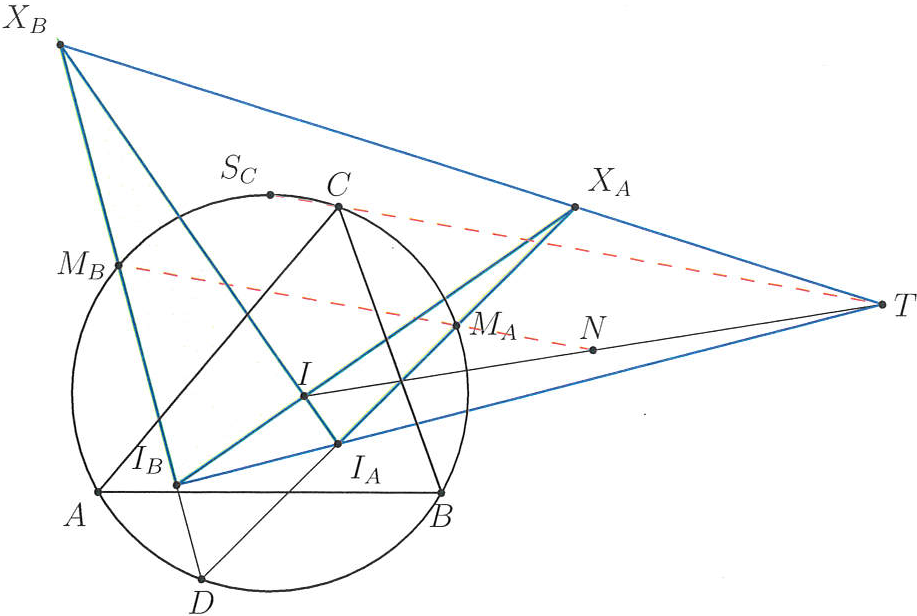
In the same way as in Solution 1, we define points and , and show that they are the midpoints of , and , respectively. Now, if we denote , we get that line is the Newton-Gauss line of the complete quadrilateral . Therefore, bisects the segment . Let be the midpoint of , and be defined as in Solution 1. Then, under the homothety centered at with coefficient 2, is mapped to . Additionally, this homothety maps to because point and are symmetric with respect to , and . As , we get that . This is a fixed line, which concludes the proof.
---
Alternative solution.
In the same way as in Solution 1, we define points and , and show that they are the midpoints of , and , respectively. Now, if we denote , we get that line is the Newton-Gauss line of the complete quadrilateral . Therefore, bisects the segment . Let be the midpoint of , and be defined as in Solution 1. Then, under the homothety centered at with coefficient 2, is mapped to . Additionally, this homothety maps to because point and are symmetric with respect to , and . As , we get that . This is a fixed line, which concludes the proof.
Techniques
Triangle centers: centroid, incenter, circumcenter, orthocenter, Euler line, nine-point circleCyclic quadrilateralsDesargues theoremHomothetyAngle chasingConstructions and loci