Browse · MATH
Printjmc
geometry intermediate
Problem
If , , and are consecutive integers, find the area of the shaded region in the square below: 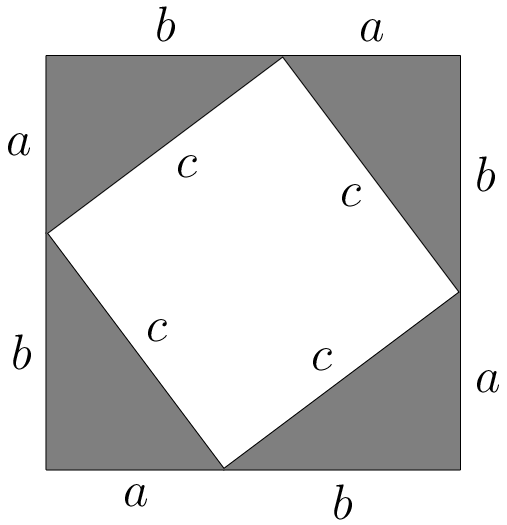
Solution
By the Pythagorean theorem, . Since , , and are consecutive integers, we can write and . Substituting this into the Pythagorean theorem, we get . This becomes , or . Factoring, we have , so or . If , then , which can't happen since is a length. So , and , .
We'll now find the area of one shaded right triangle. It is one half times the base times the height. If we use as the height, then is the base (since it's a right triangle), so the area is . There are four right triangles, so the total shaded area is .
We'll now find the area of one shaded right triangle. It is one half times the base times the height. If we use as the height, then is the base (since it's a right triangle), so the area is . There are four right triangles, so the total shaded area is .
Final answer
24