Browse · MathNet
PrintXXIII OBM
Brazil geometry
Problem
In a convex quadrilateral, the altitude relative to a side is defined to be the line perpendicular to this side through the midpoint of the opposite side. Prove that the four altitudes have a common point if and only if the quadrilateral is cyclic, that is, if and only if, there exists a circle which contains its four vertices.
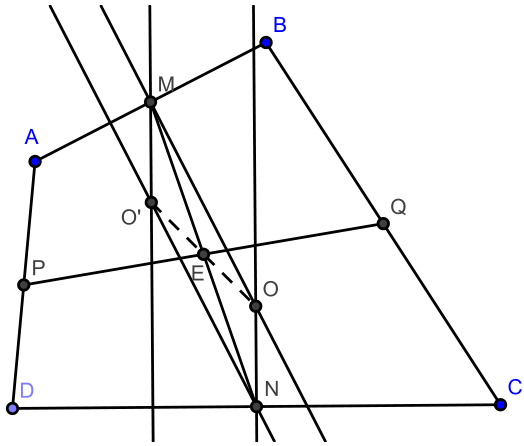
Solution
Consider the following Lemma. Let be a convex quadrilateral. The lines that connect the midpoints of opposite sides meet in and the perpendicular bisectors of opposite sides and meet in . Then the altitudes relative to and meet in a point symmetric to with respect to .
Proof. It's well known that the quadrilateral whose vertices are the midpoints of is a parallelogram. So is the midpoint of both its diagonals, in particular . But since the pairs of lines , and , are parallel, is also a parallelogram, so the diagonals and meet in their respective midpoints. This means that is the midpoint of and we're done.
Let and be the intersection of the perpendicular bisectors of , and , , respectively and and be the intersection points of the altitudes relative to , and , respectively. The four altitudes have a common point if and only if , which by the lemma is equivalent to , which is, in turn, equivalent to being cyclic.
Proof. It's well known that the quadrilateral whose vertices are the midpoints of is a parallelogram. So is the midpoint of both its diagonals, in particular . But since the pairs of lines , and , are parallel, is also a parallelogram, so the diagonals and meet in their respective midpoints. This means that is the midpoint of and we're done.
Let and be the intersection of the perpendicular bisectors of , and , , respectively and and be the intersection points of the altitudes relative to , and , respectively. The four altitudes have a common point if and only if , which by the lemma is equivalent to , which is, in turn, equivalent to being cyclic.
Techniques
Cyclic quadrilateralsRotationConstructions and loci